

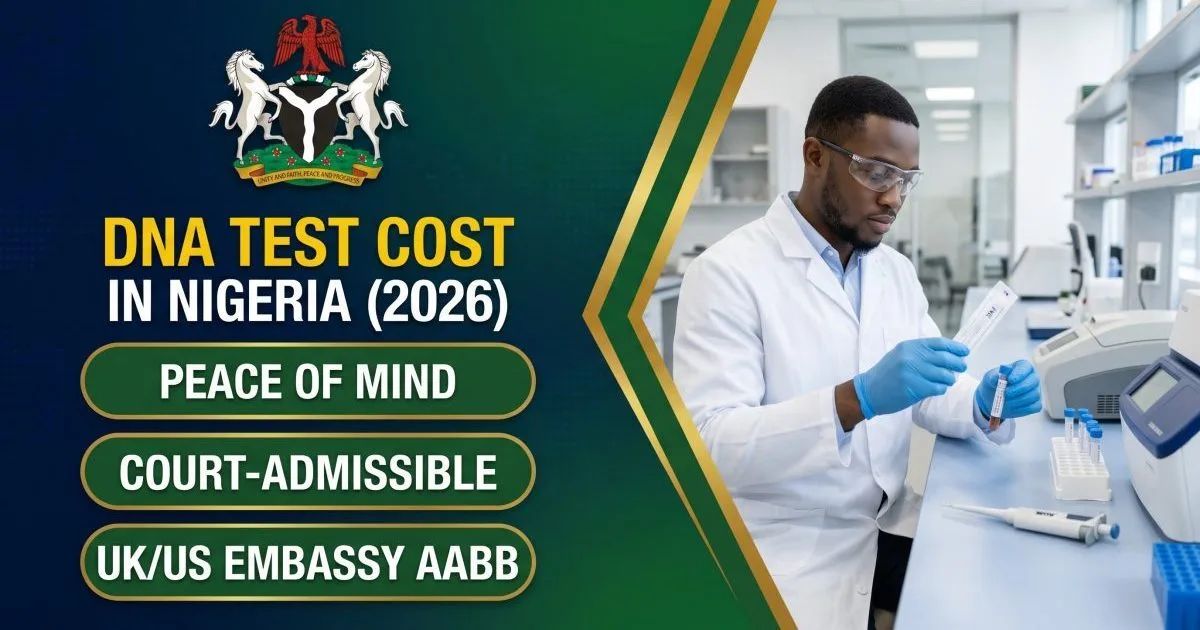


Key Takeaways: DNA Paternity Testing in Nigeria (2026 Verified Guide)
- Four Distinct Price Tiers (2026 Market Ranges): Expect roughly ₦120,000 – ₦280,000+ for a standard Peace-of-Mind DNA test, ₦200,000 – ₦450,000+ for a Court-Admissible (Legal) test, ₦700,000 – ₦1,500,000+ (FX-linked, ~$450–$900+ / £350–£700+) for UK/US/Canada Embassy Immigration DNA, and ₦1,200,000 – ₦2,500,000+ for Non-Invasive Prenatal Paternity (NIPP) testing during pregnancy.
- Cheek Swab Is Just as Accurate as Blood: Painless inner-cheek (buccal) swabs yield 99.99%+ accuracy for biological inclusion and 0% for exclusion—identical to a blood draw because DNA is uniform across every nucleated cell in the body.
- NEVER Walk Into the US or UK Embassy With a Private DNA Test: Both the U.S. Embassy (Abuja/Lagos) and UKVI/IRCC will automatically reject any self-ordered Peace-of-Mind DNA result. Immigration DNA must be initiated after an official embassy request letter using an AABB (US), UK Ministry of Justice / ISO 17025 (UK), or SCC (Canada) accredited laboratory.
- Accreditation Beats Flashy Advertising: Never judge a Nigerian lab by Instagram followers. Verify that the testing facility (or its international processing partner) holds valid ISO/IEC 17025 accreditation, plus MLSCN regulatory oversight and state facility registration (e.g., HEFAMAA in Lagos).
- Turnaround Time Reality: Standard Peace-of-Mind and Legal DNA results take 5 to 10 working days (express 2–4 working days costs extra); Embassy immigration tests typically take 2 to 4 weeks due to diplomatic pouch/courier chain of custody.
- Zero NHIA or HMO Coverage: DNA paternity testing is classified as non-therapeutic/elective and is not covered by NHIA or Nigerian HMO plans—budget 100% out of pocket.
Demand for DNA paternity and kinship testing across Lagos, Abuja, Port Harcourt, and other Nigerian cities has surged dramatically in recent years—driven by three very different realities: private family certainty (“Peace-of-Mind” tests), High Court child custody and estate inheritance disputes, and strict biological verification requests from the U.S. Embassy, UK Visas and Immigration (UKVI), and Immigration, Refugees and Citizenship Canada (IRCC) during family-reunification visa applications. Yet because DNA testing is deeply personal and rarely discussed openly, thousands of Nigerians walk into the process blind—overpaying middlemen, submitting unusable samples, or paying ₦250,000 for a private test that a judge or embassy visa officer throws straight into the bin.
 Advertisement
The biggest trap in Nigeria’s diagnostics market is treating all DNA tests as identical. In molecular genetics and law, how the sample is collected, witnessed, sealed, and tracked—known as the Chain of Custody—matters just as much as the laboratory polymerase chain reaction (PCR) analysis itself. A cheap, unverified clinic swab might look official on glossy letterhead, yet fail both scientific accuracy standards (analysing too few genetic markers) and international accreditation rules (lacking ISO/IEC 17025 or AABB certification).
Continuing NaijaSabi’s transparent 2026 Medical & Legal Cost Series—alongside our verified breakdowns of Dental Care Costs, IVF Costs, and Antenatal Care Costs in Nigeria—the NaijaSabi Editorial Desk breaks down every type of DNA test available in Nigeria, realistic 2026 price benchmarks, exact US/UK/Canada embassy rules, how to read your STR genetic report, how to verify laboratory accreditation before paying, and how to avoid fake results and rogue sample-swapping scams.
1. 2026 DNA Test Cost Master Table in Nigeria (All 4 Test Categories)
Because molecular DNA extraction kits, capillary electrophoresis reagents, and overseas courier shipments to ISO 17025 / AABB reference laboratories are heavily FX-sensitive, Nigerian DNA pricing moves in line with foreign-exchange costs and the exact legal standard required. Below are realistic 2026 benchmark ranges for a standard 1 alleged father + 1 child duo test across major Nigerian cities (Lagos, Abuja, Port Harcourt, Ibadan, Kano, and Enugu):
| DNA Test Category | Estimated 2026 Cost Range (₦) | Typical Turnaround | Accepted in Court or Embassy? |
|---|---|---|---|
| Peace-of-Mind (Private / Informational) | ₦120,000 – ₦280,000+ | 5 – 10 working days (Express 2–4 days extra) | No (Personal knowledge only) |
| Legal / Court-Admissible (Chain of Custody) | ₦200,000 – ₦450,000+ | 5 – 12 working days | Yes — Nigerian Courts (Custody, Probate, Divorce) |
| Embassy / Immigration DNA (US AABB / UKVI / IRCC) | ₦700,000 – ₦1,500,000+ (Often billed in USD/GBP/CAD) | 2 – 4 weeks (Embassy/courier workflow) | Yes — Foreign Embassies (Must follow exact mission rules) |
| Non-Invasive Prenatal Paternity (NIPP — During Pregnancy) | ₦1,200,000 – ₦2,500,000+ | 7 – 14 working days | Optional legal chain-of-custody upgrade available at higher cost |
| Additional Child / Additional Alleged Father | +₦60,000 – ₦150,000 per extra sample | Same batch timeline | Testing multiple children in one order is cheaper per child than separate orders |
Important Pricing Note: Quotes vary widely depending on whether the lab runs local PCR/capillary electrophoresis in Lagos/Abuja or couriers samples internationally to partner labs in the UK, US, or South Africa, plus whether you add express processing or mobile home collection. Always ask for an all-inclusive written invoice covering kit, collection, courier, and final PDF/hard-copy report before paying.
2. Peace-of-Mind DNA Test: Procedure, Discreet Samples & Privacy Rules
A Peace-of-Mind DNA Test is designed purely for private personal knowledge—when a father, mother, or adult child wants definitive scientific clarity without involving lawyers, courts, or embassies. Scientifically, reputable accredited labs run the exact same 21-to-24-loci STR laboratory analysis on a Peace-of-Mind test as they do on a Court-Admissible test; the only difference is the absence of witnessed legal identity verification.
How a Standard Peace-of-Mind Test Works (4 Simple Steps)
- Book Walk-In Clinic Collection or Mobile/Home Swabbing: Visit a reputable lab collection centre in Lagos (VI, Ikeja, Lekki, Surulere), Abuja (Wuse II, Maitama, Garki), or Port Harcourt (GRA, Trans-Amadi), or request an official sterile swab kit / discreet nurse home visit.
- Collect Inner-Cheek (Buccal) Swabs: Avoid eating, drinking coffee/soft drinks, chewing gum, or brushing teeth for 30 to 60 minutes before swabbing (for infants, wait 30 minutes after breastfeeding/formula). Rub the sterile cotton/foam swab firmly along the inside of each cheek for 30–60 seconds to harvest epithelial cells, allow the swab to air-dry briefly, and seal it in its clearly labelled paper envelope (never wet inside airtight plastic, which grows mould and degrades DNA!).
- Laboratory STR Extraction & Profiling: The lab extracts nuclear DNA from the alleged father and child (including the biological mother’s sample is optional and often free or low-cost—it helps eliminate maternal alleles cleanly and boosts statistical certainty).
- Confidential Result Delivery: Your password-protected digital PDF report is emailed directly to the authorised client email within 5 to 10 working days, with strict confidentiality protocols.
3. Buccal Swab vs. Blood vs. Forensic Samples (Hair, Nails, Toothbrush): Accuracy Compared
A persistent myth across Nigeria is that “blood DNA is more accurate than saliva/mouth swab DNA.” Scientifically, that is false. Every nucleated cell in a human body—whether inside your cheek lining or white blood cells in your vein—contains the exact same genetic code (exceptions are ultra-rare bone-marrow transplant recipients or recent whole-blood transfusions, where a cheek swab is actually safer than blood!). Here is how sample types compare in 2026:
| Sample Type | DNA Reliability & Yield | Extra Cost? | Legal / Embassy Acceptance |
|---|---|---|---|
| Buccal (Inner Cheek) Swab | Gold Standard (99.99%+ accuracy); painless for newborns & adults | Included in standard price | Accepted Worldwide (Courts & Embassies) |
| Whole Blood (EDTA Tube / FTA Card) | Equally Accurate (99.99%+); mandatory for maternal NIPP prenatal draw | Small phlebotomy fee may apply | Accepted when collected under Chain of Custody |
| Discreet / Non-Standard Samples (Toothbrush, Nail Clippings, Earwax Swab, Pulled Hair with root) | Variable / Higher Failure Risk (cut hair without root bulb contains virtually no nuclear DNA; toothbrushes risk mixed DNA) | +₦50,000 – ₦150,000+ forensic extraction surcharge (non-refundable if no DNA is recovered) | NEVER Accepted in Courts or Embassies |
4. Legal / Court-Admissible DNA Testing in Nigeria: Chain of Custody & Child Rights Rules
If your DNA report may ever be presented before a Nigerian High Court, Family Court, Customary/Sharia Court, or Probate Registry—for example, during child maintenance petitions, divorce proceedings, birth certificate disputes, or contested inheritance claims under Letters of Administration & Probate in Nigeria—do not waste money on a Peace-of-Mind test. Opposing counsel will instantly get a private test struck out as inadmissible hearsay.
What Makes a Nigerian DNA Test Legally Admissible? (Strict Chain of Custody)
- Neutral Third-Party Sample Collector: Samples must be collected in person by a trained, independent medical laboratory scientist, nurse, or designated phlebotomist—never self-swabbed at home by the father or mother.
- Mandatory Government Photo ID & Biometric Capture: Every adult participant must present original valid ID (NIN Slip, Nigerian International Passport, or Driver’s Licence). The collector takes live passport photographs of all participants (including the child), records thumbprints, and has adults sign legal consent and identity declarations.
- Tamper-Evident Sealing & Logged Handoff: Each swab envelope is sealed with tamper-evident security tape signed across the seal by the collector and donor, logged with exact timestamps, and tracked via signed courier/lab manifests right into the analytical laboratory.
- Parental Consent & Court Orders (Child Rights Act): Under Nigeria’s Child Rights Act (domesticated across most Nigerian states), testing a minor child legally requires informed consent from a person holding parental responsibility—or an explicit Court Order directing both parties to present the child at a named accredited laboratory (note that in Lagos, court-ordered forensic cases are also frequently routed through the Lagos State DNA & Forensic Center or designated ISO 17025 facilities).
5. Immigration DNA Testing for US Embassy (AABB), UKVI & Canada (IRCC): Exact Workflow
This is where thousands of Nigerian families relocating abroad lose ₦300,000+ to bad agent advice. If you are sponsoring a child, parent, or sibling for a US Immigrant Visa, Consular Report of Birth Abroad (CRBA), UK Family/Dependent Visa, British Passport claim, or Canadian Permanent Residency—and budgeting your relocation via our NaijaSabi Japa Cost Planner—NEVER take a private DNA test proactively before the Embassy asks for it!
A. U.S. Embassy Abuja & U.S. Consulate Lagos (Strict AABB Protocol)
- Wait for Official Written Request: Do not initiate DNA testing until USCIS, the National Visa Center (NVC), or the U.S. Embassy/Consulate in Nigeria issues a formal written letter recommending DNA evidence (see official guidance at ng.usembassy.gov).
- Choose ONLY an AABB-Accredited Lab: The petitioner in the United States must select a relationship-testing laboratory actively accredited by the Association for the Advancement of Blood & Biotherapies (AABB)—verify live accreditation at aabb.org.
- Direct Kit Shipment
7. How to Verify Accredited DNA Labs in Lagos, Abuja, Port Harcourt & Nationwide
Nigeria has a handful of genuine molecular genetics laboratories and reputable multi-city diagnostic collection networks (spanning Lagos Island/Victoria Island/Ikeja, Abuja Wuse II/Garki, Port Harcourt GRA, Ibadan, Enugu, and Kano), alongside dozens of unverified walk-in diagnostic kiosks that merely act as middlemen—or worse, fabricate results. Because laboratory partnerships and branch addresses change periodically, never rely solely on a Google Ads listing or a WhatsApp referral. Verify every facility against this 5-point accreditation checklist before paying:
- Demand Proof of Active ISO/IEC 17025 Accreditation: ISO/IEC 17025 is the international gold standard specifically governing technical competence in DNA testing laboratories. Ask the Nigerian centre whether analysis is performed in-house or sent to an international partner lab—and ask for the exact laboratory name and ISO/IEC 17025 Certificate Number so you can verify it online.
- Check Destination-Specific Accreditation (For Immigration):
- US Embassy: Verify the exact testing lab appears on the live AABB relationship-testing list at aabb.org.
- UKVI / HMPO: Confirm listing on the official UK Ministry of Justice / ISO 17025 approved providers directory on gov.uk.
- Canada IRCC: Confirm active accreditation with the Standards Council of Canada (scc.ca).
- Check Nigerian Clinical Regulatory Registration: Legitimate diagnostic facilities and sample collection laboratories operating in Nigeria should operate under qualified professionals registered with the Medical Laboratory Science Council of Nigeria (MLSCN) (mlscn.gov.ng) and hold valid State Ministry of Health registration (such as HEFAMAA in Lagos State).
- Confirm Minimum 21–24 STR Genetic Markers: Reputable DNA labs analyse at least 21 to 24 Short Tandem Repeat (STR) loci (plus Amelogenin sex marker) to eliminate false matches—especially crucial if two possible fathers are close blood relatives (such as brothers!).
- Verify Dual-Independent Testing & Result Authentication: Top accredited laboratories run independent duplicate verification on exclusions (0% matches) before releasing the final report and include a lab director’s signature, case reference number, and direct lab verification email/phone on the final report.
8. Does NHIA or HMO Cover DNA Tests? Plus Hidden Cost Add-Ons to Check Before Paying
A frequent question from salaried Nigerian workers is: “Can I use my NHIA card or corporate HMO (Hygeia, AXA Mansard, Reliance, Leadway) to subsidise a DNA paternity test?” The direct answer is No. Under both National Health Insurance Authority (NHIA) benefit packages and private Nigerian HMO policies (detailed in our Health Insurance in Nigeria 2026 Guide), DNA paternity, maternity, and immigration kinship testing are classified as non-therapeutic / legal / personal elective diagnostics and are strictly excluded from insurance coverage.
6 Hidden DNA Test Add-Ons That Inflate Final Bills
When comparing quotes between two Nigerian labs, ask explicitly whether the headline price includes these six frequent add-ons:
- Mother’s Sample Inclusion: Some labs include the biological mother’s swab free of charge; others bill ₦25,000–₦50,000 extra.
- Additional Children: Testing 2 or 3 children at the same time usually carries a discounted per-child fee (₦60,000–₦150,000 per extra child) compared to booking separate orders.
- Express / Priority Turnaround: Cutting standard 5–10 working days down to 2–4 working days typically adds ₦50,000–₦150,000+.
- Mobile Home / Hotel Sample Collection: Requesting a discreet nurse/scientist to visit your home or office in Lagos, Abuja, or Port Harcourt adds a logistics fee (typically ₦15,000–₦50,000 depending on distance).
- International Bio-Courier Dispatch: For labs shipping swabs to UK/US partner labs, confirm whether DHL/FedEx international shipping is already inside the quoted price.
- Notarised / Hard-Copy Court Affidavit & Witness Appearance: If a Nigerian court later summons the laboratory scientist to testify physically in open court as an expert witness, separate witness appearance and travel fees apply.
9. How to Read Your DNA Paternity Report (21–24 STR Loci, CPI & Probability Explained)
Opening a DNA report is an emotional moment—and the scientific tables filled with numbers like
D3S1358,vWA, andFGAcan look intimidating. Understanding four core items lets you verify your report with 100% clarity:- Genetic Loci (Markers Tested): Each row represents a specific DNA location (locus) examined—typically 21 to 24 loci. At every locus, a human inherits two numerical alleles: one from their biological mother and one from their biological father.
- Matching Alleles Rule: For the alleged father to be the true biological father, the child must share at least one matching allele number with the alleged father at every single locus tested (in very rare natural genetic mutations—roughly 1 in 1,000—a single locus may differ by 1 repeat, which accredited labs resolve mathematically using extended 24+ loci panels).
- Combined Paternity Index (CPI): A statistical ratio showing how many times more likely the alleged father is to be the biological father compared to a random untested man from the same population (for genuine biological fathers, CPI runs into tens of thousands, millions, or billions).
- Probability of Paternity (The Bottom Line):
- 99.99% or Higher (Inclusion): The alleged father is not excluded and is statistically confirmed as the biological father. (DNA reports scientifically state 99.99%+ rather than 100% because an identical twin brother shares the exact same DNA profile!)
- 0% (Exclusion): The alleged father mismatches the child at multiple genetic loci and is 100% excluded as the biological father.
10. Other DNA Tests Available in Nigeria: Sibling, Grandparent, Avuncular & Maternity Tests
What if the alleged father has passed away, lives permanently overseas, or refuses to submit a cheek swab? Accredited Nigerian DNA labs offer four indirect biological kinship alternatives:
- Grandparentage DNA Test: Tests the child against the alleged father’s biological parents (paternal grandfather and/or grandmother—testing both grandparents yields far higher accuracy than testing just one).
- Avuncular (Uncle / Aunt) DNA Test: Tests the child against a verified full biological brother or sister of the alleged father.
- Full vs. Half Sibling DNA Test: Determines whether two children share both biological parents (full siblings), one biological parent (half siblings), or are biologically unrelated.
- Maternity & Y-Chromosome (Y-STR) Tests: Maternity tests confirm biological motherhood (often used after IVF/surrogacy or hospital mix-up concerns); Y-STR tests trace unbroken paternal male lineage across male relatives (father, sons, paternal uncles, grandfathers).
Accuracy Note: Indirect kinship tests (sibling/avuncular/single-grandparent) carry slightly higher statistical uncertainty than a direct father-child test and can occasionally return an “inconclusive” zone if only one relative is tested—always include the child’s biological mother’s sample whenever possible to sharpen statistical power.
11. Anti-Scam Warning: Avoiding Fake DNA Certificates, Bribed Collectors & Unaccredited “Plugs”
Official Anti-Fraud Warning: 5 DNA Testing Scams & Integrity Risks in Nigeria
- “₦30,000 – ₦50,000 Instant DNA Test” Ads: Genuine molecular STR DNA profiling (extraction reagents, PCR amplification, capillary electrophoresis, and quality controls) cannot be run profitably for ₦35,000 in 2026 Nigeria. Dirt-cheap offers are almost always fake blood-group guesses (ABO/genotype checks—which can never prove paternity!) or fabricated PDF templates.
- Sample Switching & Bribed Collectors: In high-stakes custody or inheritance fights, dishonest parties sometimes try to send an impostor to the lab or hand in pre-swabbed sticks from a different child. Always insist on a witnessed Legal Chain-of-Custody collection where both parties are present (or independently photo/ID-verified) at an accredited facility!
- “Embassy Agent DNA Shortcuts”: Never pay a visa agent claiming they can “process your US or UK Embassy DNA test privately before your interview.” Embassies only accept kits shipped directly from their approved AABB / UKMOJ / SCC laboratories under mission supervision—presenting an unofficial DNA report wastes hundreds of thousands of naira and raises fraud flags.
- ABO Blood Group / Genotype Myths: While blood group or AA/AS/SS genotype incompatibilities can occasionally raise suspicion (for example, two AA parents cannot naturally have an SS child), matching blood groups (e.g., both O+ and AA) prove zero biological paternity. Only STR DNA profiling provides definitive scientific proof.
- Verify Payment Goes to a Corporate Lab Account: Never transfer ₦200,000+ into a random WhatsApp “lab marketer’s” personal OPay or personal bank account. Pay strictly into the verifiable corporate account of the accredited laboratory and demand an official invoice and case tracking number.
12. Frequently Asked Questions (FAQs)
1. How much is a DNA paternity test in Nigeria in 2026?
In 2026, a standard Peace-of-Mind DNA paternity test (1 father + 1 child) typically costs between ₦120,000 and ₦280,000+ at accredited centres in Lagos, Abuja, and Port Harcourt. A Legal / Court-Admissible test with strict Chain of Custody costs roughly ₦200,000 – ₦450,000+, UK/US/Canada Embassy Immigration DNA runs roughly ₦700,000 – ₦1,500,000+ (billed in USD/GBP/CAD), and Non-Invasive Prenatal Paternity (NIPP) during pregnancy costs roughly ₦1,200,000 – ₦2,500,000+.
2. Can I do a DNA paternity test in Nigeria without the mother’s sample or knowledge?
Scientifically, a biological mother’s sample is not mandatory—accredited laboratories reliably confirm (99.99%+) or exclude (0%) paternity using only cheek swabs from the alleged father and child (though adding the mother improves statistical certainty). However, for Legal / Court-Admissible or Embassy tests, strict legal consent from persons with parental responsibility (or a formal Court Order) and witnessed ID verification are mandatory.
3. Is a cheek swab DNA test as accurate as a blood DNA test?
Yes—100% equally accurate. Both inner-cheek (buccal) swabs and blood samples extract the exact same nuclear DNA, delivering 99.99%+ accuracy for inclusions and 0% for exclusions across 21–24 genetic markers. Cheek swabs are the international gold standard for Nigerian courts and embassies because they are painless, non-invasive, and safe even for newborn babies.
4. How do I do an Embassy DNA test for the U.S. Embassy or UKVI in Nigeria?
Wait strictly until you receive an official written DNA request letter from USCIS/U.S. Embassy, UKVI/HMPO, or IRCC—never bring a privately done test to your visa interview. For the U.S. Embassy (Abuja/Lagos), the petitioner selects and pays an AABB-accredited lab (
aabb.org), which ships a sealed kit straight to the Embassy for witnessed collection. For UKVI/HMPO, use an ISO/IEC 17025 / UK Ministry of Justice accredited lab (gov.uk) with approved Nigerian chain-of-custody collection.5. How long does it take to get DNA test results in Nigeria?
Standard Peace-of-Mind and Legal DNA test results typically take 5 to 10 working days from the date samples reach the analytical lab (some laboratories offer 2-to-4-day express turnaround for an additional fee). Non-Invasive Prenatal (NIPP) tests take roughly 7 to 14 working days, while Embassy Immigration DNA tests usually take 2 to 4 weeks due to international diplomatic/courier chain-of-custody scheduling.
Editorial Verification Note: Compiled by the NaijaSabi Editorial Desk on November 21, 2026, referencing international molecular relationship-testing accreditation standards from AABB (aabb.org), UK Ministry of Justice / ISO/IEC 17025 guidelines (gov.uk), Standards Council of Canada (scc.ca), U.S. Mission Nigeria DNA procedures (ng.usembassy.gov), and Nigerian clinical laboratory regulatory oversight under MLSCN (mlscn.gov.ng). Laboratory fees fluctuate with foreign-exchange rates and turnaround options—always verify live ISO/AABB accreditation certificates and request an all-in written quote before paying.
Get the NaijaSabi Morning Brief
Verified daily Naira FX rates, fuel & food prices, and open Nigerian job portals — zero spam, unsubscribe anytime.


0 Comments
No comments yet. Be the first to share your thoughts!