




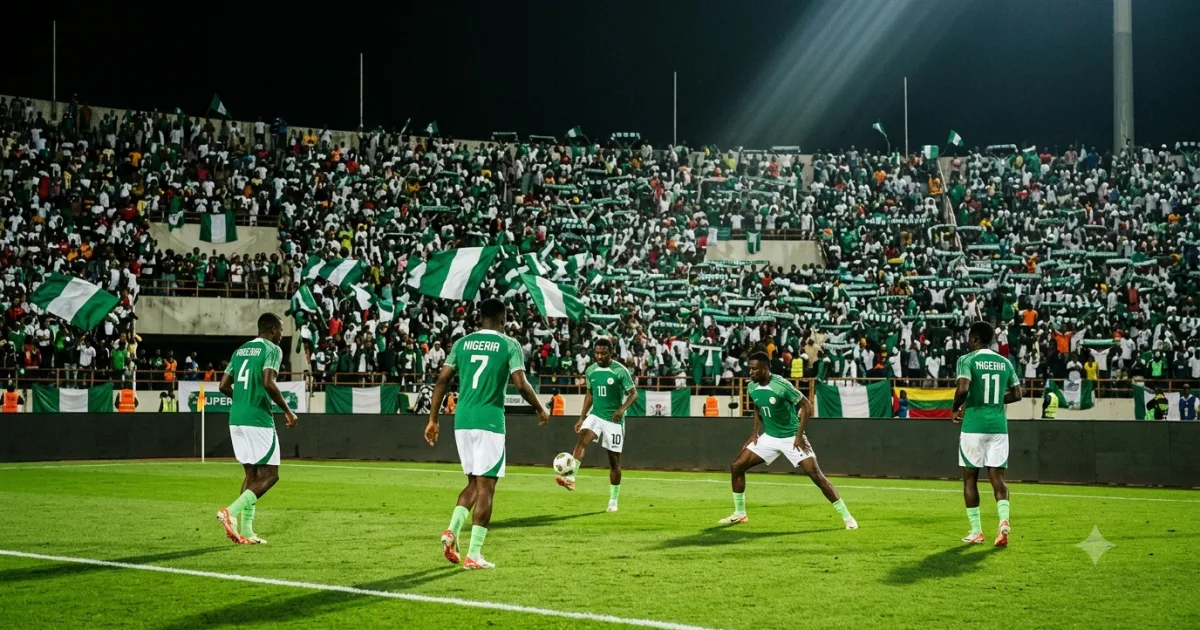
📌 Quick Summary: The Super Eagles’ 2027 AFCON qualifying campaign begins between 21 September and 6 October 2026. Nigeria are in Group L with Madagascar, Tanzania, and Guinea-Bissau. The critical twist: Tanzania are co-hosts of AFCON 2027 and already qualified — meaning Nigeria must finish first among the three non-hosts to book a place at the finals. There is no margin for second place. This guide covers the full qualifier schedule, all three opponents analysed, head-to-head records, what changes under Éric Chelle, how to watch on DStv and GOtv, and what Nigeria must do to qualify.
Three months after the heartbreak of losing the 2026 AFCON semi-final to Morocco on penalties, Nigeria’s Super Eagles begin again. The 2027 Africa Cup of Nations qualifying campaign kicks off in the last week of September 2026 — and for Nigerians who have been carrying that penalty shootout defeat since December 2025, the qualifiers offer both a chance to reset and a new pressure: the group structure means Nigeria cannot afford a slow start. One wrong result in this six-game qualifying series could end the three-time champions’ AFCON 2027 ambitions before Christmas. Here is everything you need to know.
Nigeria’s AFCON 2027 Qualifier Schedule — All Six Matchdays
| Matchdays | Window | What’s at Stake |
| Matchday 1 and 2 | 21 September – 6 October 2026 | Opening fixtures — sets the tone for the campaign |
| Matchday 3 and 4 | 9 – 17 November 2026 | Mid-campaign — position in group determined here |
| Matchday 5 and 6 | 22 – 30 March 2027 | Final round — qualification confirmed or denied |
| AFCON 2027 Finals | 19 June – 17 July 2027 | Co-hosted by Kenya, Tanzania, Uganda |
The specific match dates within each window — exact dates, home and away assignments, and confirmed kickoff times — will be published on the CAF official website (cafonline.com) as each window approaches. The NFF (Nigeria Football Federation) will announce Nigeria’s home venue for each qualifier through official NFF channels.
The Critical Rule: Only ONE Non-Host Qualifies From Group L
This is the most important fact Nigerian football fans must understand about Group L. Tanzania — one of Nigeria’s three opponents — is a co-host of AFCON 2027 alongside Kenya and Uganda. As a co-host, Tanzania has already been guaranteed a place at the finals regardless of their qualifying performance. They will play all six fixtures and their results count in the standings, but they cannot qualify or be eliminated through the points table.
The consequence: while the standard AFCON qualifier rule is that the top two teams from each group qualify, Group L operates differently. The top-placed non-host team qualifies. That means Nigeria must finish first among Madagascar and Guinea-Bissau — finishing second is not enough if Tanzania finishes above you in the overall standings. The margin for error is minimal. Nigeria cannot afford to drop significant points in the early matchdays, because a late charge to recover from a poor start may not be sufficient against a group where only one qualification ticket is effectively available to the three competing nations.
Nigeria’s Group L Opponents: Full Analysis
Tanzania — Already Qualified, But Still Dangerous
Tanzania’s presence in the group creates an unusual tactical dynamic. They have nothing to lose from a qualification standpoint — they are already at AFCON 2027. But that does not make them a free win. Tanzania reached their first U-17 AFCON final in June 2026, with midfielder Issa Chole named Player of the Tournament. Their senior team pushed Nigeria at the 2025 AFCON, losing 2-1 but not without testing Chelle’s squad. Their Taifa Stars have four AFCON appearances — they have never won a match at the finals, but their record of three draws and seven defeats from ten games shows they are competitive enough to take points. Simon Msuva and Feisal Salum — their two most effective forwards — give them pace and creativity in transition. In their own back yard in 2027, Tanzania will be motivated to prepare properly for the home tournament. Do not expect them to rest players against Nigeria in September.
| Nigeria vs Tanzania head-to-head | Record |
| Total meetings | Multiple encounters in AFCON qualifying and finals |
| 2025 AFCON Group Stage | Nigeria 2-1 Tanzania |
| Nigeria’s record vs Tanzania | Historically dominant — Nigeria have not lost to Tanzania in recent senior international football |
| Threat level | Moderate — dangerous on the counter, limited at home |
Madagascar — Nigeria’s Trickiest Opponent
Madagascar are the opponent Nigerian football analysts are most focused on, and for good reason. The Barea have form that demands respect. Nigeria defeated Madagascar home and away in the 2012 AFCON qualifiers — but that was 15 years ago. The more recent history is less comfortable. Madagascar beat Nigeria 2-0 in a 2019 AFCON qualifier in Antananarivo — a result that remains one of the more embarrassing results in recent Super Eagles history. Madagascar qualified for their first-ever AFCON in 2019 and performed creditably in the tournament. They have built on that platform since.
Madagascar’s strength is organisational discipline. They are compact, difficult to break down away from home, and technically capable of executing a game plan against opponents who lack the patience to break deep defences. Their danger in this qualifying campaign is specifically away from home — where they can frustrate Nigeria into conceding possession and hitting on the counter. Nigeria’s record against them is positive overall, but the 2019 result is a reminder that comfortable paper form does not always translate to comfortable results. Nigeria will need to be at their best, not merely competent, to guarantee the points from both Madagascar fixtures.
| Nigeria vs Madagascar head-to-head | Record |
| Total meetings | 5 (won 3, lost 1, drew 1) |
| Most recent result (2019) | Madagascar 2-0 Nigeria — away qualifier |
| Nigeria’s home record vs Madagascar | Won — but narrow margins in recent fixtures |
| Threat level | High — the most dangerous non-host in the group |
Guinea-Bissau — Experienced and Underestimated
Guinea-Bissau are the third opponent and on paper the most manageable — but they have stung Nigeria before. Nigeria’s record against them is three wins and one loss from four meetings. That loss — a 1-0 Guinea-Bissau victory in a 2023 AFCON qualifier away in Bissau — is the kind of result that happens when Nigeria underestimate smaller African nations and fail to execute away from home. Guinea-Bissau are not a collection of unknown players. They have a core of European-based professionals who compete in Portuguese, Spanish, and French football, and they have qualified for AFCON twice since 2019. They will be competitive in every fixture and will not concede easily at home. Nigeria beat them comfortably in group stage fixtures at AFCON 2021 (2-0) and 2023 (1-0), but qualifying away matches produce very different encounters than tournament group games.
| Nigeria vs Guinea-Bissau head-to-head | Record |
| Total meetings | 4 (won 3, lost 1) |
| Most recent qualifier loss | Guinea-Bissau 1-0 Nigeria (2023 qualifier — away) |
| AFCON group stage results | Nigeria 2-0 (2021), Nigeria 1-0 (2023) |
| Threat level | Moderate away, manageable at home — but not to be underestimated |
Éric Chelle: Nigeria’s New Coach and What He Changes
Éric Chelle was appointed Super Eagles head coach in 2025, taking over from Finidi George. The French-Malian former defender previously managed Mali at the 2021 AFCON — taking them to the quarter-finals — and has coaching experience in Ligue 2 and African football. His first major test with Nigeria was the 2025 AFCON, where the Super Eagles finished third — a respectable outcome that included the agonising penalty defeat to Morocco in the semi-finals. Chelle’s management style emphasises disciplined defensive organisation and structured attacking patterns. Under him, Nigeria have shown more tactical consistency than under recent coaches who relied more heavily on individual brilliance. The question for the qualifiers is whether that structure holds up across the compressed schedule of six games in three windows — particularly in the September and October away fixtures that will test Nigeria’s depth, form, and resilience on unfamiliar grounds.
How to Watch Super Eagles AFCON 2027 Qualifier Matches in Nigeria
| Platform | Channel | Package Required |
| DStv | SuperSport Football (various channels) | Compact Plus and above |
| GOtv | SuperSport Football Select | GOtv Jolli and above |
| Startimes | Sport channel — confirm closer to match day | Nova or Smart package |
| NTA (Free-to-Air) | NTA 2 or NTA Sports — where broadcast rights permit | Free — no subscription |
Specific broadcast channels and kickoff times for each individual fixture will be confirmed by SuperSport and NTA as each match window approaches. Check SuperSport’s official schedule at supersport.com/football for confirmed match listings closer to September 21.
What Nigeria Needs to Do to Qualify
The qualifying arithmetic is straightforward but unforgiving. Nigeria must finish first among the three non-hosts — Madagascar, Tanzania, and Guinea-Bissau. Tanzania is effectively a wildcard — their results count but they cannot qualify. Nigeria’s target is maximum points against Madagascar and Guinea-Bissau across the six matchdays, with the Tanzania fixtures serving as additional points opportunities. The away fixtures — particularly the trips to Madagascar and Guinea-Bissau — are where the campaign can be won or lost. Nigeria’s recent away form in AFCON qualifiers has been inconsistent. The compressed schedule of the first window (two matches between September 21 and October 6) means there is no time to recover from a poor first match before the second fixture arrives. Chelle must have his squad organised, fit, and tactically prepared for both opponents before the first whistle on September 21.
Frequently Asked Questions
When do Nigeria’s AFCON 2027 qualifier matches start?
Nigeria’s first two AFCON 2027 qualifier matches take place during the FIFA international window running from 21 September to 6 October 2026. The specific dates within that window will be confirmed on the CAF official website and through the NFF.
Who are Nigeria’s opponents in the AFCON 2027 qualifiers?
Nigeria are in Group L with Madagascar, Tanzania, and Guinea-Bissau. The group was drawn at the CAF headquarters in Cairo on 19 May 2026.
How many teams qualify from Nigeria’s group?
Only one non-host team qualifies from Group L. Tanzania are co-hosts of AFCON 2027 and are already guaranteed a place at the finals. Nigeria must therefore finish first among Madagascar and Guinea-Bissau to qualify — finishing second is not sufficient if Tanzania finishes above in the group standings.
Who is the Super Eagles coach for the AFCON 2027 qualifiers?
Éric Chelle — the French-Malian coach appointed in 2025. He previously managed Mali to the quarter-finals of AFCON 2021 and led Nigeria to a third-place finish at the 2025 AFCON.
Where is AFCON 2027 being held?
AFCON 2027 is being co-hosted by Kenya, Tanzania, and Uganda — the first edition of the tournament to be co-hosted by three countries. The tournament runs from 19 June to 17 July 2027.
How to watch Super Eagles AFCON 2027 qualifier matches in Nigeria?
On DStv (SuperSport Football channels — Compact Plus package and above), GOtv (SuperSport Football Select — Jolli package and above), and potentially free-to-air on NTA where broadcast rights permit. Specific channels and times will be confirmed as each match window approaches.
Sources
- CAF Official 2027 AFCON Qualifier Draw — cafonline.com — 19 May 2026
- CAF Official Qualifier Schedule — Matchdays confirmed in the CAF competition calendar
- NFF Official Communications — thenff.com
Last updated: 30 August 2026 · NaijaSabi Football Desk. Specific match dates within each window will be confirmed on cafonline.com and thenff.com as each FIFA international window approaches.
Nigeria’s AFCON History: Why 2027 Matters More Than Most Qualifiers
Nigeria have won the Africa Cup of Nations three times — in 1980, 1994, and 2013. The 13-year gap since the last title is the longest drought in the Super Eagles’ history for a generation that has watched Morocco, Senegal, and Ivory Coast lift trophies that once routinely came to Nigeria. The 2026 AFCON semi-final penalty defeat to Morocco — the eventual champions — was the fourth time in the past three tournaments that Nigeria had exited at the semi-final stage or earlier despite being among the tournament favourites. The 2027 AFCON carries specific significance: it is the first tournament on the continent since Nigeria’s dominant era to be co-hosted partly by a nation — Tanzania — that Nigeria have beaten in recent years. The draw, the schedule, and the opponent quality in Group L represent one of the more manageable qualification paths Nigeria have been given in recent AFCON cycles. There will not be an easier route than this. If Nigeria fail to qualify from a group containing Madagascar, Tanzania, and Guinea-Bissau, it will represent the most significant failure of Chelle’s tenure — and will intensify an already growing debate about the structural problems in Nigerian football development. Qualification is not optional. Maximum points is the target. September 21 is the beginning.


0 Comments
No comments yet. Be the first to share your thoughts!