




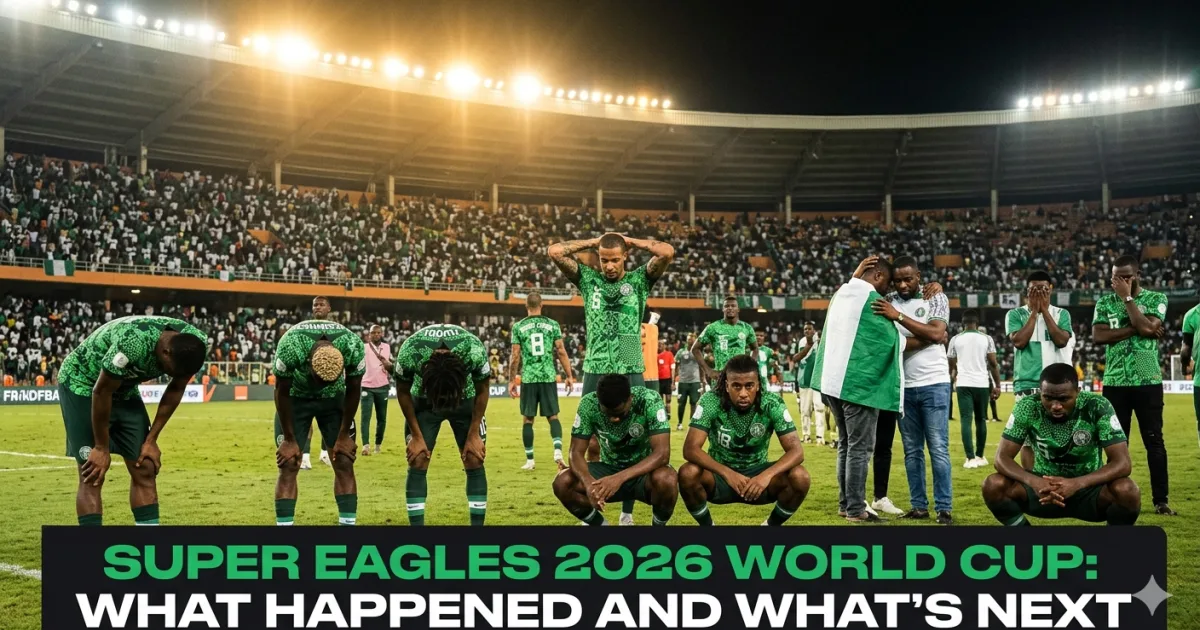
November 16, 2025. Prince Moulay Abdellah Stadium, Rabat, Morocco. 90 minutes plus extra time of tense, exhausting football. A 1-1 scoreline that would not shift. Then four penalty kicks — four heartbreaks — and the Super Eagles of Nigeria were out of the 2026 FIFA World Cup. Again. The nation that debuted at USA ’94 with three wins from three group games, that has qualified for six of the eight World Cups it was eligible for, would be watching the biggest football tournament in history from their sofas. Africa sends a record 10 teams to 2026. Nigeria is not one of them.
This is the complete story of what happened, what the NFF tried to do about it through FIFA’s judiciary, and what the experience of AFCON 2025 tells us about the Super Eagles’ actual quality — and the path forward for Nigerian football.
The 2026 World Cup Qualifying Campaign: Group C Summary
Nigeria were drawn in CAF Group C of the 2026 World Cup qualifiers alongside South Africa, Benin Republic, Rwanda, Zimbabwe, and Lesotho. Only the group winner qualified automatically for the World Cup. The runner-up entered a second-round African play-off for a chance at the intercontinental playoffs.
Nigeria’s campaign was, by any honest assessment, underperforming. With Victor Osimhen, Ademola Lookman, Alex Iwobi, Wilfred Ndidi, and Samuel Chukwueze available, Group C should have been manageable. Instead, as summarised by Afrik-Foot: the Super Eagles collected 4 draws, 1 loss, and only 2 wins in their opening seven group games — a record that left them in third place, trailing South Africa and Benin Republic. A draw against Zimbabwe (away, November 2023), a draw against Lesotho (home, November 2023), and a defeat to Rwanda in November 2024 were the low points of a campaign that never found consistent momentum.
Under coach Eric Chelle, who took over from interim Austin Eguavoen, Nigeria’s March 2025 window showed improvement — a 2-0 win over Rwanda away followed by a frustrating 1-1 home draw with Zimbabwe. But finishing the group as runners-up rather than group winners meant the fate of Nigeria’s World Cup journey would be decided in a play-off — and ultimately in a penalty shootout against one of Africa’s most underestimated sides.
The Night That Broke Nigeria: November 16, 2025
African Play-Off Final — 2026 FIFA World Cup
🏟️ Prince Moulay Abdellah Stadium, Rabat, Morocco
📅 November 16, 2025
🇳🇬 Nigeria 1–1 DR Congo 🇨🇩 (AET)
🎯 Penalties: Nigeria 3–4 DR Congo
⚽ Nigeria Goalscorer: Frank Onyeka (3′) — deflected effort
⚽ DR Congo Equaliser: Meschack Elia (31′) — after Ndidi dispossessed
🟡 Key moment: Victor Osimhen substituted at half-time through injury
Nigeria made the brighter start. Just three minutes in, a cross from Zaidu Sanusi found Frank Onyeka, whose shot deflected off a Congolese defender and wrong-footed goalkeeper Lionel Mpasi. 1-0 to the Super Eagles — a dream start. But DR Congo steadied. In the 31st minute, Meschack Elia punished a Wilfred Ndidi error in midfield, racing clear and slotting past Stanley Nwabali. 1-1.
The most consequential moment of the match came at half-time: Victor Osimhen, Nigeria’s most dangerous attacker and the player DR Congo feared most, was substituted through injury. Without him, Nigeria’s attack — Tolu Arokodare, Akor Adams, Moses Simon — struggled to find the decisive moment. DR Congo, sitting deeper and threatening on the counter, managed the game competently. Neither side could find a winner through 90 minutes or extra time.
In the penalty shootout, goalkeeper Stanley Nwabali — who would later become a national hero at AFCON 2025 — saved two kicks. But Nigeria missed enough of their own to lose 4-3 on penalties. DR Congo were through to the intercontinental playoffs. The Super Eagles were out of the 2026 World Cup.
The Nigeria Football Federation issued a public apology. In a statement addressed to President Bola Tinubu and football stakeholders, the NFF described the loss as “a moment of profound sadness for Nigerian football” and tendered an “unreserved apology” for the failure to qualify. Daily Post Nigeria quoted football analyst Adebari: “The Super Eagles had the chance to qualify via the regular qualification process and the African play-offs but they failed at both attempts.”
The NFF’s FIFA Case: Can Nigeria Still Get to the World Cup?
Within days of the November 16 defeat, the Nigeria Football Federation filed a formal petition with FIFA challenging the eligibility of several DR Congo players who featured in the decisive match. The NFF’s argument has a specific legal basis: DR Congo’s domestic law does not recognise dual citizenship for adults. The NFF argues that several Congolese players who hold European passports and played in the match were therefore ineligible under their own country’s laws — and that FIFA should not have cleared them to represent the Leopards.
NFF General Secretary Mohammed Sanusi explained the federation’s position in Premium Times: “As far as FIFA is concerned, once you have the passport of your country, you are eligible. But our concern is that FIFA may have been deceived into clearing them.” If FIFA upheld Nigeria’s complaint, the Super Eagles would theoretically replace DR Congo at the intercontinental playoffs, reopening a path to the World Cup.
The case dragged through December 2025, January 2026, and into March 2026 without a verdict, as noted by Within Nigeria’s detailed legal analysis. FIFA also handed out sanctions to both the NFF and DR Congo’s football association for separate disciplinary infractions during the match — the NFF was fined 1,000 Swiss Francs for objects thrown by spectators (Guardian Nigeria/Premium Times reporting). These sanctions were unrelated to the eligibility dispute but added to the complexity of the situation.
By April 2026, the prognosis for Nigeria’s FIFA case had become deeply pessimistic. Daily Post Nigeria quoted analyst Adebari bluntly: “We should forget about it. There is no hope.” Within Nigeria’s legal analysis explained why: “FIFA’s historical reluctance to overturn match results without clear evidence of deliberate fraud sets a high bar that Nigeria must clear.” The argument has theoretical legal merit but clearing FIFA’s evidentiary standard would require proof that DR Congo’s federation deliberately deceived FIFA — a much harder case to make than the citizenship law argument alone. The intercontinental playoffs in Mexico proceeded in March 2026, and DR Congo played their match. Nigeria did not participate.
The NFF confirmed as recently as February 2026 that FIFA had not yet issued any ruling on the matter (Premium Times). As of April 2026, the FIFA eligibility case has not changed Nigeria’s World Cup status. Nigeria will not be at the 2026 World Cup.
Africa at the 2026 World Cup: The 10 Countries Going
The 2026 FIFA World Cup is the first edition to feature 48 teams, expanding Africa’s allocation to a record 9+1 spots — nine direct qualifiers from group winners, plus one additional spot via the intercontinental playoff. Despite the historic expansion, Nigeria will not be among them. Pulse Sports Nigeria confirmed the full list of African qualifiers — 10 African nations going to the 2026 World Cup in the USA, Canada, and Mexico, with Nigeria’s absence noted as particularly striking given the team’s talent level.
This is only the third time Nigeria has missed a World Cup they were eligible for — the first was 2006 (after failing to qualify from Group 3), the second was 2022 (eliminated by Ghana on the away goals rule), and now 2026. Missing back-to-back World Cups represents a significant setback for Nigerian football’s continental reputation and commercial value, with Daily Post noting: “Money, opportunities and visibility will be lost for certain brands and sponsors.”
AFCON 2025: The Silver Lining — Nigeria Wins Bronze
Against the backdrop of World Cup heartbreak, the Super Eagles’ performance at the 2025 Africa Cup of Nations in Morocco provided genuine cause for pride — and evidence that the team’s talent is real, even if the results have been inconsistent.
Nigeria at AFCON 2025 — Morocco
| Group Stage | Won all 3 matches | Qualified first in group |
| Round of 16 | Beat Mozambique 4-0 | Dominant win |
| Quarter-final | Beat Algeria 2-0 | Goals from Osimhen and Akor Adams |
| Semi-final | Lost to Morocco (hosts) on penalties | No goals in regulation time or extra time |
| Bronze medal match | Beat Egypt 4-2 on penalties (0-0 after 90 + AET) | Bronze medal — Nigeria’s 8th third-place finish |
As Olympics.com’s AFCON 2025 round-up notes: “Nigeria finished the AFCON 2025 with a bronze medal after beating Egypt 4-2 on penalties following a 0-0 draw in Casablanca.” The hero of the bronze medal match — and the tournament more broadly — was goalkeeper Stanley Nwabali, whose penalty saves proved decisive both in the semi-final and the bronze medal match. Within Nigeria’s extended World Cup analysis noted Nwabali as “the undisputed hero, saving two crucial kicks” in the bronze medal win over Egypt.
The AFCON 2025 run — three wins from three in the group stage, beating Mozambique 4-0, Algeria 2-0, eventually losing only to hosts Morocco on penalties in a hotly contested semi-final — demonstrated that this Super Eagles squad is not short of quality. Within Nigeria’s analysis put it precisely: “The Super Eagles are not a team in decline by continental standards. The sting of the World Cup absence is sharpened precisely because the talent pool and competitive performances suggest a team capable of performing at that level.”
The Super Eagles Squad: Players to Watch
Eric Chelle’s October 2025 squad — confirmed by NJO (Not Just OK) — gives a clear picture of the talent pool available to Nigeria:
| Position | Key Players | Notes |
|---|---|---|
| Goalkeepers | Stanley Nwabali, Amas Obasogie, Adebayo Adeleye | Nwabali the clear No.1 after AFCON heroics |
| Defenders | William Troost-Ekong (captain), Calvin Bassey, Bright Osayi-Samuel, Semi Ajayi, Felix Agu, Bruno Onyemaechi | Troost-Ekong leads with international experience; Bassey one of Africa’s best CBs |
| Midfielders | Wilfred Ndidi, Alex Iwobi, Frank Onyeka, Alhassan Yusuf | Ndidi’s holding role critical; Iwobi creative engine; Onyeka scored the Rabat goal |
| Forwards | Victor Osimhen, Ademola Lookman, Samuel Chukwueze, Moses Simon, Tolu Arokodare, Cyriel Dessers, Terem Moffi, Akor Adams | Osimhen world-class when fit; Lookman AFCON 2023 final hat-trick hero; Adams first call-up after impressive form |
On paper, this is a squad that should be at the World Cup. Osimhen and Lookman form one of Africa’s most dangerous attacking partnerships when both are fit and motivated. The fact that this talent pool has missed back-to-back World Cups is a structural and administrative failure as much as a footballing one.
What Went Wrong: Honest Analysis
1. Slow Start to Qualifying
The draws against Lesotho and Zimbabwe in the opening matchdays were the original sin of Nigeria’s 2026 qualifying campaign. Against teams that should not have been capable of taking points off the Super Eagles, Nigeria failed to win. Those dropped points created a deficit that never fully recovered. When you are chasing in a qualifying group rather than leading it, everything becomes more difficult.
2. The Pay Dispute Before the DR Congo Match
Within Nigeria’s detailed post-mortem documented a bonuses and appearance fees dispute between NFF and the players that disrupted preparation for the critical DR Congo match. “Emergency negotiations between NFF president Ibrahim Gusau and the players produced enough of a resolution for training to resume,” the analysis notes — but the distraction of financial standoffs in the days before a winner-take-all playoff match is never without cost. This is an old and recurring problem in Nigerian football administration.
3. Osimhen’s Half-Time Injury
Losing your best attacker at half-time in a goalless draw is a significant tactical blow. DR Congo’s game plan was specifically designed around limiting Osimhen’s impact. When he went off injured, the pressure on DR Congo’s defence reduced substantially. Nigeria’s replacement attackers — Arokodare, Adams — did not have the same effect on the match. The margin between qualifying and elimination was, in part, about one player’s fitness.
4. Penalty Shootout Preparation
Nigeria has now lost multiple high-stakes penalty shootouts in recent tournament football. This is not coincidental. Penalty preparation — mental rehearsal, selection of takers, goalkeeper analysis of opponent tendencies — is a trainable skill. Nwabali’s saves show that Nigeria has a goalkeeper capable of being the hero. The missed penalties from outfield players are a preparation and psychological issue that the technical team must address systematically.
What Comes Next for the Super Eagles
2030 World Cup Qualification
CAF qualifying for the 2030 FIFA World Cup (to be hosted in Spain, Portugal, and Morocco, with celebration matches in Argentina, Uruguay, and Paraguay) will begin in late 2026 or early 2027. With Africa retaining a significant allocation in the expanded World Cup format, and Nigeria’s squad expected to remain competitive for the next 4–6 years (Osimhen would be 29 in 2030, Lookman 32, Bassey 29), the Super Eagles are in a strong position to qualify — if the administrative failures are addressed.
AFCON 2027
The 2027 Africa Cup of Nations is scheduled to be hosted in Kenya, Uganda, and Tanzania — East Africa’s first time hosting the continent’s biggest football tournament. Nigeria will qualify for and likely be among the favourites. The AFCON 2025 bronze medal performance — unbeaten in regulation time through the group stage, quarter-finals, and semi-final — suggests a team that is genuinely competitive for continental honours. Winning AFCON 2027 would be Nigeria’s fourth continental title and the Super Eagles’ first since 2013.
Structural Reforms Needed
Missing back-to-back World Cups demands honest structural reform, not just a change of coach. The persistent issues — player bonuses disputes before critical matches, inconsistent early qualifier performances, penalty shootout failures, political interference in coach selection and tenure — require systemic solutions, not cosmetic ones. The NFF’s ability to address these honestly will determine whether 2026’s pain becomes the catalyst for a rebuilt Nigerian football system or simply another painful chapter in an ongoing cycle.
Frequently Asked Questions
Did Nigeria qualify for the 2026 World Cup?
No. Nigeria did not qualify for the 2026 FIFA World Cup. The Super Eagles were eliminated by DR Congo on a 4-3 penalty shootout (following a 1-1 draw in regulation time and extra time) on November 16, 2025, at the Prince Moulay Abdellah Stadium in Rabat, Morocco. DR Congo advanced to the intercontinental playoffs, and all 10 African qualification spots are now filled. Nigeria will not be at the 2026 World Cup hosted by the USA, Canada, and Mexico.
What is the NFF’s FIFA case against DR Congo?
Following the November 16, 2025 defeat, the NFF filed a formal petition with FIFA arguing that several DR Congo players who featured in the decisive playoff match were ineligible. The argument is based on the fact that DR Congo’s domestic laws do not recognise dual citizenship for adults, raising questions about players holding European passports while representing the Leopards. NFF General Secretary Mohammed Sanusi said: “Our concern is that FIFA may have been deceived into clearing them.” As of April 2026, FIFA has not issued a verdict on this complaint, and the intercontinental playoffs in Mexico proceeded with DR Congo participating. Most football analysts consider the case unlikely to succeed, given FIFA’s high bar for overturning match results.
How did Nigeria do at AFCON 2025?
Nigeria reached the semi-finals of AFCON 2025 in Morocco without losing a single match in regulation time throughout the tournament. They won all three group games, beat Mozambique 4-0 in the Round of 16, and defeated Algeria 2-0 in the quarter-finals (goals from Osimhen and Akor Adams). They lost to hosts Morocco on penalties in the semi-final, then beat Egypt 4-2 on penalties (following a 0-0 draw) in the bronze medal match on January 17, 2026. The bronze medal win was Nigeria’s 8th third-place finish at the Africa Cup of Nations — a record unmatched by any other country. Goalkeeper Stanley Nwabali was the standout performer, saving crucial penalties throughout the tournament.
Who was Nigeria’s coach for the 2026 qualifiers?
Eric Chelle was appointed as Super Eagles head coach to lead the 2026 qualification campaign, taking over from interim coach Austin Eguavoen (who had managed the team during the disappointing 1-2 defeat to Rwanda in November 2024). Chelle’s October 2025 squad included a full complement of Nigeria’s best available players: Osimhen, Lookman, Troost-Ekong, Ndidi, Iwobi, Nwabali, Chukwueze, Bassey, and others.
🦅 Super Eagles 2026 — Key Facts Summary
- World Cup 2026 status: Not qualified — eliminated November 16, 2025
- How Nigeria was eliminated: Lost 4-3 on penalties to DR Congo (1-1 after 90+AET) in Rabat
- Nigeria’s goalscorer: Frank Onyeka (3rd minute deflected goal)
- DR Congo’s equaliser: Meschack Elia (31st minute, after Ndidi dispossession)
- Key loss: Victor Osimhen substituted injured at half-time
- NFF apology: Described result as “a moment of profound sadness for Nigerian football”
- FIFA eligibility case: NFF challenged DR Congo dual-nationality players; no verdict as of April 2026; regarded as unlikely to succeed
- Africa at 2026 World Cup: Record 10 teams — Nigeria not among them (Pulse Sports Nigeria)
- AFCON 2025: Nigeria won bronze medal (beat Egypt 4-2 on penalties, Jan 17, 2026); hero — Stanley Nwabali
- Nigeria’s World Cup record: Qualified 6 times (1994, 1998, 2002, 2010, 2014, 2018); failed to qualify in 2006, 2022, and 2026
- Next major tournament: AFCON 2027 (Kenya, Uganda, Tanzania) — Nigeria expected to qualify and contend
The pain of missing the 2026 World Cup is real and legitimate. So is the talent of this Super Eagles squad. These two facts are not contradictory — they are the definition of a team that has repeatedly failed to maximise what it has. The 2026 absence must be the moment that changes how Nigerian football is administered, prepared, and managed, not just another heartbreak to eventually move past. The players are good enough. The infrastructure around them must become worthy of them.
What do you think needs to change for the Super Eagles to consistently qualify for the World Cup? Share your thoughts in the comments. Also read our guide on the How to Watch UEFA Champions League 2025/26 in Nigeria and Top 10 Richest African Footballers 2026.


0 Comments
No comments yet. Be the first to share your thoughts!