




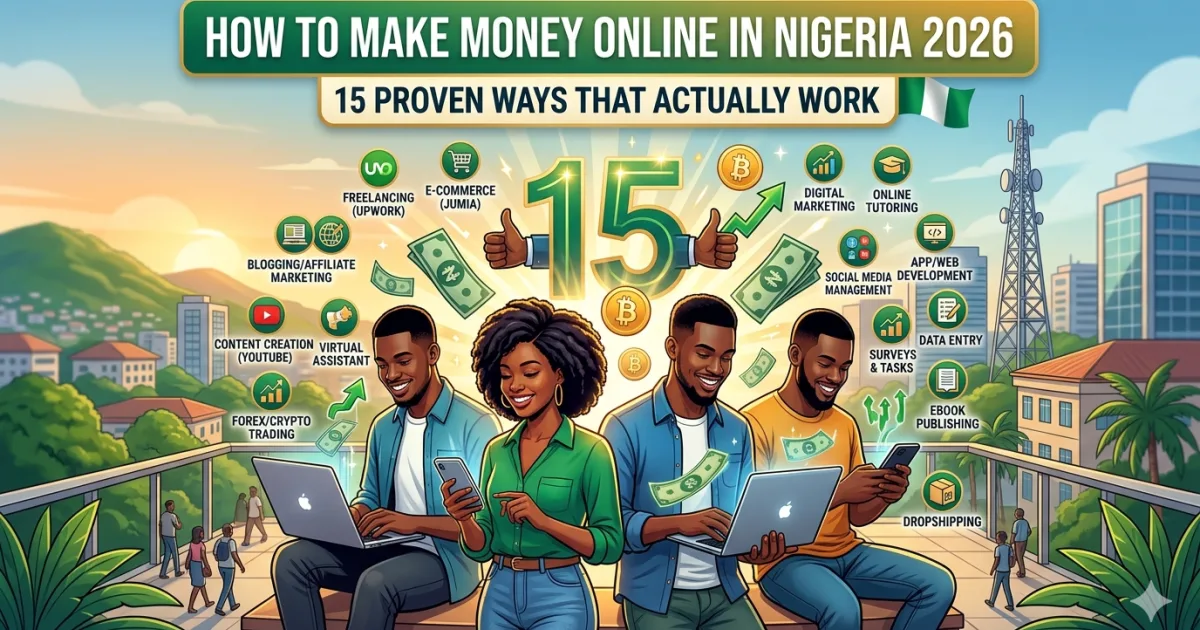
Making money online in Nigeria has never been more accessible — or more necessary. With the naira at ₦1,400 per dollar, a freelancer earning $500 monthly from international clients receives approximately ₦700,000 — more than 9 times the national minimum wage of ₦70,000. This exchange rate reality has transformed online income from a supplementary option to a primary career goal for millions of educated Nigerians. At the same time, the internet is saturated with fake “opportunities” — Ponzi schemes, pyramid schemes, and fraudulent investment platforms that take people’s money and disappear. This guide covers only legitimate, proven, sustainable ways to make real money online in Nigeria in 2026 — methods that can work for beginners with smartphones and data, and methods that can scale to full professional income with skill development.
15 Proven Ways to Make Money Online in Nigeria 2026
1. Freelance Writing and Content Creation
Content writing is one of the most accessible online income streams for Nigerians with strong English language skills. Companies, websites, and individuals worldwide need high-quality written content — articles, blog posts, product descriptions, website copy, email newsletters, and social media content. Nigerian writers are well-positioned in this market given Nigeria’s English-medium education, strong literary tradition, and the ability to offer competitive rates by international standards while earning significantly above Nigerian wage levels. Entry-level freelance writers charge $15–$50 per article; experienced writers specialising in technical, medical, financial, or legal content earn $100–$500+ per article. Platforms to get started: Fiverr (create a gig offering writing services), Upwork (apply for writing jobs posted by international clients), ProBlogger Job Board (specialist board for writing jobs), and LinkedIn (build a professional profile and connect with content managers at companies that regularly hire freelance writers).
2. Freelance Graphic Design
Graphic design — including logo design, brand identity, social media graphics, book covers, infographics, and presentation design — is one of the highest-paying creative freelance categories for Nigerians. With design tools like Canva (free), Adobe Illustrator, Photoshop, and Figma (free tier available), a Nigerian designer can create professional-quality work and deliver it to international clients who pay in dollars. Fiverr has consistently been the highest-volume marketplace for graphic design freelancers — Nigerian designers have built six-figure monthly earnings (in naira) from Fiverr alone. Starting point: create a Fiverr seller account, set up a professional gig with portfolio samples, and set competitive introductory pricing (₦0 per design = you charge in dollars; a logo gig starting at $15–$25 is competitive for beginners). Build reviews by delivering excellent quality on first orders, then progressively increase prices as your rating grows.
3. Web Development and Coding
Web development is the highest-earning technical freelance category available to Nigerians. A mid-level web developer charging $50 per hour for 20 billable hours per month earns $1,000 monthly — approximately ₦1,400,000 at current exchange rates. Entry barriers exist — you need to actually learn to code — but free resources (freeCodeCamp, The Odin Project, CS50 from Harvard) allow anyone with determination and internet access to acquire professional-level web development skills within 6–12 months of consistent study. The most in-demand skills in 2026 are: React.js and Next.js (front-end), Node.js and Python (back-end), WordPress development (accessible entry point), and mobile app development (Flutter and React Native). Get clients through Upwork, Toptal (premium platform for vetted developers), LinkedIn direct outreach to small businesses needing websites, and local Nigerian businesses upgrading their digital presence.
4. Social Media Management
Small and medium businesses worldwide — particularly in the UK, USA, Canada, and Australia — need consistent social media presence but lack the time or knowledge to manage their own accounts. Social media managers create content, schedule posts, respond to comments, run advertising campaigns, and report on performance metrics. This role requires strong communication skills, creativity, and knowledge of the major social platforms (Instagram, X/Twitter, Facebook, LinkedIn, TikTok). No programming skills required. Monthly retainer rates for social media management range from $200–$1,500 per client depending on deliverables. A Nigerian social media manager with 5 clients at $300 per month earns $1,500 monthly — ₦2,100,000 at current rates. Find clients through Fiverr, Upwork, LinkedIn outreach, and local Nigerian small business networks whose owners want to improve their social presence.
5. YouTube Content Creation
YouTube remains one of Nigeria’s fastest-growing income streams — and the naira exchange rate makes YouTube AdSense earnings exceptionally valuable. A Nigerian YouTube channel earning $1,000/month from AdSense receives approximately ₦1,400,000. Successful Nigerian YouTube niches in 2026 include: tech reviews and tutorials, cooking and food (Nigerian and international cuisine), travel and lifestyle, personal finance and investment advice, education and tutorials (WAEC/JAMB prep, coding, language learning), entertainment and comedy, and real estate advice. Monetisation requires 1,000 subscribers and 4,000 watch hours in the past 12 months for the YouTube Partner Programme. Once monetised, income comes from AdSense (ads), channel memberships, Super Thanks, sponsored content from brands, and affiliate commissions. Building to meaningful income takes 6–18 months of consistent publishing — but YouTube income is passive once established, continuing to generate revenue from old videos.
6. Remote Work / International Remote Jobs
Securing a fully remote job with an international company — receiving a monthly salary in dollars, pounds, or euros while living in Nigeria — is the highest-income online opportunity available to Nigerians with relevant professional experience. Remote roles for Nigerians in international demand include: software engineers ($3,000–$10,000+ monthly), data analysts ($2,000–$5,000 monthly), UX/UI designers ($2,000–$5,000 monthly), digital marketing managers ($1,500–$4,000 monthly), content strategists ($1,500–$3,500 monthly), customer support specialists ($800–$2,500 monthly), and virtual assistants ($500–$2,000 monthly). Platforms to find remote international jobs: Remote.co, We Work Remotely, AngelList Talent (now Wellfound), LinkedIn (filter by “Remote” location), Andela (places African tech talent in international companies), and Turing.com (AI-matching for software engineers). The key differentiator for Nigerians competing for these roles is having a demonstrable portfolio, strong English communication skills, and relevant certifications or degrees.
7. Dropshipping
Dropshipping is an e-commerce model where you sell products online without holding any inventory. When a customer buys from your online store, you purchase the product from a supplier who ships directly to the customer. Your profit is the difference between your selling price and the supplier’s cost. For Nigerians, two dropshipping models work: (1) selling internationally using Shopify or WooCommerce, sourcing from AliExpress or US/UK suppliers, selling to US/UK/EU customers and earning in dollars/pounds/euros; or (2) selling domestically within Nigeria, sourcing from Alibaba/Aliexpress or local suppliers, and fulfilling orders to Nigerian customers via Jumia, Konga, or a personal Instagram/WhatsApp shop. The international model is more lucrative at current exchange rates but requires more setup (Shopify subscription, PayPal or Payoneer for receiving payments, international ad spend on Meta or Google). The domestic model is more accessible for beginners. Profit margins of 20–50% on product cost are achievable in well-chosen niches.
8. Blogging and Affiliate Marketing
A blog — a website with regularly published articles on a focused topic — can generate income through multiple streams: display advertising (Google AdSense pays per impression and click), affiliate marketing (earning commissions by recommending products or services), sponsored content (brands paying to feature their products in your articles), digital product sales (e-books, courses, templates), and consulting offers. The most profitable blogging niches for Nigerians targeting international traffic are: personal finance, health and wellness, technology, digital marketing, and education. Affiliate marketing is particularly powerful — recommending products through Amazon Associates (3–10% commission), Clickbank, or high-ticket affiliate programmes (SaaS tools, online courses) can generate passive income once articles rank on Google search. Building a profitable blog requires 12–24 months of consistent content creation before significant income materialises — but the long-term passive income potential makes it one of the most sustainable online income models available.
9. Online Tutoring and Teaching
Nigerians with strong academic qualifications in science, mathematics, English, music, or other subjects can earn significant income tutoring students online — both locally and internationally. Local online tutoring (connecting Nigerian students with Nigerian parents via WhatsApp, Zoom, or dedicated tutoring platforms) is growing rapidly as parents seek supplementary academic support for WAEC/JAMB preparation and secondary school subjects. International tutoring platforms like Preply, Italki (for language teaching), Chegg Tutors, and VIPKid connect tutors with students in the USA, UK, Europe, and Asia. A Nigerian English tutor on Italki can earn $15–$40 per hour from international students learning English — $400–$1,000 per month from 2–4 hours of daily teaching. No investment required beyond a smartphone, stable internet, and a quiet space for sessions.
10. Selling Digital Products
Digital products — items that are created once and sold repeatedly without production cost per sale — represent some of the highest-margin income possible online. For Nigerians, viable digital products include: e-books (on business, cooking, personal development, relationship advice, or any expertise area), Canva templates (social media templates, resume templates, pitch deck templates), stock photography and video (selling Nigerian street scenes, cultural images, and nature photography on Shutterstock, Getty, and Adobe Stock), Notion templates (for productivity, project management, habit tracking), Excel/Google Sheets templates (budgeting, business tracking), online courses (teaching a skill via Udemy, Teachable, or Selar — Nigeria’s leading digital product marketplace), and music production beats and sound effects (on BeatStars, Airbit, or AudioJungle). Selar.co is specifically designed for Nigerians and allows digital product sales in naira with direct Nigerian bank account payouts — an excellent starting point for selling courses, e-books, and templates to Nigerian customers.
11. Virtual Assistant Services
Virtual assistants (VAs) provide remote administrative and business support to entrepreneurs, executives, and small businesses. Tasks include: email management, calendar scheduling, data entry, research, travel booking, customer service, social media posting, and document preparation. The role requires organisation, communication skills, and attention to detail — no technical coding skills needed. International VA rates range from $10–$30 per hour; working 20 hours per week at $15/hour generates $1,200 monthly — approximately ₦1,680,000. Find international VA clients through Upwork, Fiverr, Remote.co, and virtual assistant Facebook groups and communities. Many Nigerian VAs build long-term relationships with clients in the UK and USA who prefer time-zone overlap with Nigerian working hours.
12. Transcription and Captioning
Audio and video transcription — converting spoken content to text — is one of the most accessible online income streams for Nigerians with good listening skills and fast, accurate typing. Platforms including Rev.com, TranscribeMe, and GoTranscript hire transcriptionists globally, paying $0.45–$1.50 per audio minute. Working 4 hours daily on audio transcription can generate $200–$600 monthly depending on speed and accuracy. More specialised (and better-paying) is captioning and subtitling video content — captioners on platforms like Rev earn higher per-minute rates than transcriptionists. This is a legitimate, accessible starting point for Nigerians entering the online income space without any existing marketable skill — the only requirements are a computer (or fast-typing smartphone), good English listening comprehension, and accuracy.
13. Stock Trading and Investing (Nigerian Exchange)
The Nigerian Exchange Group (NGX) allows Nigerians to invest in publicly listed Nigerian companies through stockbroker apps and platforms. Trading and investing in Nigerian stocks is an online activity that, while not strictly “income” in the employment sense, can generate returns that supplement other income streams. Platforms including Chaka, Bamboo, and Trove allow Nigerians to invest in both Nigerian stocks (NGX) and US stocks (NYSE, NASDAQ) through their smartphones. Bamboo and Trove also enable Nigerian investors to invest in US stocks and ETFs in dollars — a hedge against naira depreciation. This is a medium-to-long-term wealth-building strategy rather than a short-term income stream, and carries investment risk. Always invest only money you can afford to leave invested for at least 12–24 months and can afford to lose partially.
14. Podcasting
Nigerian podcasting is growing rapidly in 2026 — with Spotify, Apple Podcasts, and local platforms like Afripods expanding African audio content. Podcasters generate income through sponsorships and brand partnerships (companies pay to advertise on your show — rates typically ₦50,000–₦500,000 per episode sponsorship for shows with 1,000–10,000+ listeners), Patreon subscriptions (loyal listeners pay monthly for bonus content and access), affiliate marketing in show notes, and consulting or coaching services promoted through the show. The most viable podcasting niches for Nigerians include: personal finance (how to manage money, invest, and build wealth in Nigeria), career and professional development, entrepreneurship and startups, health and wellness, true crime and storytelling, relationships and faith. Building a podcast audience takes time — typically 6–18 months of consistent publishing before meaningful monetisation — but the audience and brand you build provides leverage across multiple other income streams.
15. TikTok Creator Fund and Brand Deals
TikTok has created a new generation of Nigerian content creators earning significant income from short-form video. Income comes from: the TikTok Creator Fund (pays per view — rates vary but $0.02–$0.04 per 1,000 views is approximate); brand deals and sponsored content (Nigerian creators with 10,000+ followers command ₦50,000–₦500,000+ per sponsored post); live streaming gifts (TikTok users send virtual gifts to creators during live streams, which convert to real money); and TikTok Shop affiliate commissions (promoting products available on TikTok Shop and earning commissions per sale). Successful Nigerian TikTok niches include: comedy skits, Afrobeats and Nigerian music content, beauty and fashion, food and cooking, finance education, and motivation/personal development. Building to 10,000+ engaged followers requires 3–6 months of consistent daily posting with good content quality — the algorithm rewards consistency and engagement rate over absolute follower count.
Online Money-Making Scams to Avoid in Nigeria 2026
For every legitimate online income opportunity, there are multiple fraudulent schemes targeting Nigerians. Protect yourself by recognising the patterns common to online scams:
- Ponzi/pyramid investment schemes: Promise fixed daily or weekly returns (e.g., “invest ₦50,000 and receive ₦5,000 daily”) — mathematically impossible to sustain; always collapse taking all invested funds
- “Click to earn” apps: Promise payment for clicking ads, watching videos, or completing surveys at rates that don’t add up — most are scams; the few legitimate survey platforms (Swagbucks, Survey Junkie) pay very small amounts not worth significant time investment
- Cryptocurrency pump-and-dump groups: Promote obscure coins, coordinate buying to pump prices, then dump holdings on new entrants causing massive losses
- Fake freelance platforms: Imitate real platforms (fake “Fiverr” or “Upwork” sites) that collect registration fees and personal information without ever providing legitimate work
- Online store scams: Collect orders and payments for products that are never shipped
The golden rule: If an online income opportunity promises high returns with little or no effort, requires an upfront payment to “activate” your account or “buy a starter package,” or pressures you to recruit others to earn — it is a scam. Legitimate income always requires genuine value delivery: a skill applied, a product sold, content created, or a service rendered. There is no shortcut to sustainable online income — but the legitimate pathways described in this guide can generate life-changing naira income for Nigerians who commit to developing their skills and building their online presence consistently.
How to Receive International Payments in Nigeria 2026
Receiving dollar, pound, and euro payments from international clients is one of the most important practical challenges for Nigerian online earners. Here are the most reliable payment receiving options in 2026:
- Payoneer: The most widely used platform for receiving international freelance payments in Nigeria. Payoneer provides USD, EUR, and GBP “receiving accounts” (virtual US, EU, and UK bank details) that international clients can pay into. Withdraw to your Nigerian bank account in naira. Payoneer is accepted by Upwork, Fiverr, Amazon, Airbnb, and hundreds of other international platforms
- Wise: Offers virtual USD/GBP/EUR accounts for receiving international payments. Strong conversion rates when withdrawing to Nigerian naira. Increasingly accepted by international clients as an alternative to PayPal
- Grey.co: Nigerian fintech that provides USD and EUR account details, designed specifically for Nigerians receiving international payments. Withdraw to Nigerian bank account at competitive rates
- Selar.co: For selling digital products to Nigerian customers — direct naira payouts to Nigerian bank accounts. No international payment infrastructure needed
- Flutterwave / Paystack: Nigerian payment processors that allow receiving card payments from international customers on your website — useful for e-commerce and digital product sales
Frequently Asked Questions — Making Money Online Nigeria 2026
What is the fastest way to make money online in Nigeria?
The fastest legitimate online income for Nigerians with existing skills is freelancing on Fiverr or Upwork — you can create a profile today and receive your first client within days if your skills (writing, design, programming, voice-over, etc.) are in demand. For those without existing marketable skills, transcription is the most accessible entry point — sign up at Rev.com or GoTranscript, pass their test, and start earning within a week. No income that promises to be fast AND requires no skill or effort is legitimate.
How much can I realistically earn online in Nigeria?
At the dollar-naira rate of ₦1,400/$1, a Nigerian freelancer earning $500/month receives ₦700,000 — nearly 10× the minimum wage. $1,000/month = ₦1,400,000. $3,000/month (achievable for experienced developers, designers, and marketers) = ₦4,200,000. Domestic online income (Nigerian customers, naira payments) varies widely by platform and niche — successful Selar.co digital product creators and Nigerian YouTubers report monthly naira earnings of ₦200,000–₦2,000,000. The range is genuinely wide, but the potential is real for those who invest in skills and consistency.
Is online money-making in Nigeria legitimate?
Yes — the 15 methods in this guide are all legitimate, legal, and practised by thousands of Nigerians. The key distinction is between legitimate income (requires skill, effort, and value delivery) and fraudulent schemes (promises income with no skill or effort required, typically requires an upfront payment). Every scam has a pattern: easy money, no real work, recruitment required. Legitimate online income takes effort to build but generates sustainable, scalable real earnings.
💻 How to Make Money Online Nigeria 2026 — Top 15 Summary
- 1. Freelance writing — Fiverr, Upwork, ProBlogger
- 2. Graphic design — Fiverr, Canva, Adobe
- 3. Web development — Upwork, Toptal, Andela
- 4. Social media management — Fiverr, Upwork, LinkedIn
- 5. YouTube — AdSense, brand deals, memberships
- 6. Remote jobs — We Work Remotely, LinkedIn, Andela
- 7. Dropshipping — Shopify + AliExpress; Jumia local
- 8. Blogging + affiliate marketing — Google AdSense + Amazon Associates
- 9. Online tutoring — Preply, Italki, Chegg
- 10. Digital products — Selar.co, Udemy, Shutterstock
- 11. Virtual assistant — Upwork, Fiverr, Remote.co
- 12. Transcription — Rev.com, GoTranscript, TranscribeMe
- 13. Stock investing — Bamboo, Trove, Chaka (NGX + US stocks)
- 14. Podcasting — Spotify, Apple Podcasts + sponsors
- 15. TikTok — Creator Fund, brand deals, TikTok Shop
- Receive payments: Payoneer, Wise, Grey.co, Selar.co
- Avoid: Any scheme promising fixed returns with no work
Also read: Dollar to Naira Rate Today 2026 | NYSC Allowance 2026 | Cost of Living Lagos vs Abuja 2026
Getting Started: A 30-Day Action Plan for Nigerian Online Earners
The most common obstacle to online income in Nigeria is not ability — it is starting. Analysis paralysis, fear of failure, and indecision between the many available options prevent capable people from taking the first steps. Here is a concrete 30-day action plan that any Nigerian with a smartphone and data can execute:
Week 1: Pick One Method and Set Up
Choose one method from the 15 above that matches your current skills. If you write well — freelance writing. If you are visually creative — graphic design. If you are organised and communicative — virtual assistant. If you have a technical background — web development. Create your account on the relevant platform (Fiverr, Upwork, or the specific platform for your chosen method). Complete your profile to 100% — professional photo, compelling bio, and if applicable, upload 2–3 portfolio samples. Even beginners can create sample work specifically for the portfolio — write 3 sample articles, design 3 sample logos, or build 1 sample website. Do not wait to be “ready” before setting up — imperfect action beats perfect inaction.
Week 2: Learn and Improve Rapidly
Dedicate 1–2 hours daily to improving the skill you chose. YouTube has comprehensive free tutorials for every online income skill — search for “Fiverr writing gig tutorial,” “Canva logo design for beginners,” or “how to land your first Upwork client.” Google’s free Digital Skills for Africa course covers digital marketing fundamentals. freeCodeCamp covers web development from zero to professional. This week is about rapid skill upgrading while your profile is live and potentially attracting early views.
Week 3: Submit Proposals or Applications Aggressively
On Upwork: submit 5–10 proposals per day to relevant job postings. On Fiverr: your gig is passive — focus on sharing it in relevant communities, Facebook groups, and LinkedIn. For remote jobs: apply to 3–5 positions daily on Remote.co, We Work Remotely, and LinkedIn. The Nigerian tendency to submit one application and wait is counterproductive in competitive online markets — volume with quality is the approach that generates results fastest. Each proposal or application is a learning opportunity even when it doesn’t immediately convert.
Week 4: Deliver Excellence and Build Reviews
By week 4, if you have executed weeks 1–3 properly, you should have at least one or two client interactions — even if not all converted to paid work. For any order or contract you do receive: overdeliver. Give the client more than they paid for. Respond within hours. Fix revisions cheerfully and promptly. A 5-star review on Fiverr or a positive recommendation on Upwork is worth more than the fee from that first job — it is the compounding asset that generates all future clients. Your first month of online income in Nigeria may be modest (₦10,000–₦50,000), but the foundations you build in month one determine whether month six generates ₦200,000 or ₦1,000,000.
Tax Considerations for Nigerian Online Earners
As online income grows in Nigeria, the Federal Inland Revenue Service (FIRS) has been increasing its focus on taxing digital and freelance income. Nigerians earning income online — whether from international freelancing, YouTube, blogging, or digital product sales — are legally obligated to file annual tax returns and pay income tax on their earnings above the personal income tax threshold. The practical reality in 2026 is that enforcement of freelance and gig income taxation is still developing in Nigeria, but the direction is clearly toward greater enforcement. Register for your Tax Identification Number (TIN) through FIRS at tin.jtb.gov.ng or at any FIRS tax office with your BVN and NIN. File your annual self-assessment return through FIRS’s e-filing system. Keeping records of your income (Payoneer statements, Fiverr payment history, Upwork earnings reports) is both good business practice and the documentation you need for accurate tax filing. Being proactive about tax compliance protects you from penalties and positions your online business for growth — companies and high-value clients in some markets require tax compliance documentation before paying freelancers.
How Long Does It Take to Start Earning Online in Nigeria?
One of the most honest questions anyone can ask about online income is: how long before I earn real money? The answer varies dramatically by method and by the effort invested. Here is a realistic timeline for each major category:
| Method | Time to First Income | Time to Meaningful Income (₦100k+/month) |
|---|---|---|
| Transcription (Rev.com, GoTranscript) | 1–2 weeks (after passing test) | 1–2 months (with consistent hours) |
| Virtual assistant | 2–4 weeks (to land first client) | 3–6 months (multiple clients) |
| Freelance writing (Fiverr/Upwork) | 2–6 weeks (first gig/order) | 3–9 months (established profile with reviews) |
| Graphic design (Fiverr) | 2–6 weeks (first order) | 3–9 months |
| Social media management | 4–8 weeks (first retainer client) | 3–6 months (2–3 clients) |
| Web development | 6–12 months (skill building first) | 12–18 months (established client base) |
| Dropshipping | 1–3 months (store setup + first sales) | 6–12 months (proven winning products) |
| YouTube | 6–12 months (to monetisation threshold) | 12–24 months (consistent viewership) |
| Blogging | 6–18 months (organic Google traffic) | 18–36 months (established authority) |
| Digital products (Selar/Udemy) | 1–4 weeks (after product creation) | 3–12 months (audience building) |
The fastest-to-income methods (transcription, virtual assistance, freelance services) require existing skills or the ability to learn quickly. The highest-income potential methods (web development, YouTube, blogging) require the most upfront time investment before revenue materialises. The most rational approach for most Nigerians is a two-track strategy: start with a fast-income method (freelancing or transcription) to generate immediate online income while simultaneously building toward a higher-ceiling opportunity (web development, YouTube, digital products) for long-term income growth. Do not wait to start the long-term track — begin it in parallel with your short-term income generation.
Free Tools Every Nigerian Online Earner Needs in 2026
Starting an online income stream in Nigeria requires almost zero capital — the tools that matter most are either free or available at low cost on a monthly subscription. Here are the essential free tools for Nigerian online earners:
- Canva (free tier): Professional graphic design for social media, presentations, YouTube thumbnails, and digital products — no design background needed. The free tier is genuinely sufficient for most Nigerian freelancers starting out
- Google Docs/Sheets/Slides: Full-featured word processing, spreadsheets, and presentations — completely free, cloud-based, and shareable with clients without any software purchase
- Grammarly (free tier): AI-powered writing assistant that catches grammar errors, improves clarity, and enhances professional writing quality — essential for freelance writers and anyone communicating with international clients
- Zoom (free tier): Video calls up to 40 minutes with international clients — sufficient for most initial client meetings and ongoing check-ins without a paid subscription
- Trello or Notion (free tier): Project and task management — keeps your client deliverables, deadlines, and communications organised as your workload grows
- LinkedIn (free): Professional networking, job applications, content publishing, and client outreach — your most powerful free career and business development platform
- freeCodeCamp / The Odin Project (free): World-class web development education at zero cost — the foundation for Nigeria’s growing community of internationally competitive software developers





0 Comments
No comments yet. Be the first to share your thoughts!