




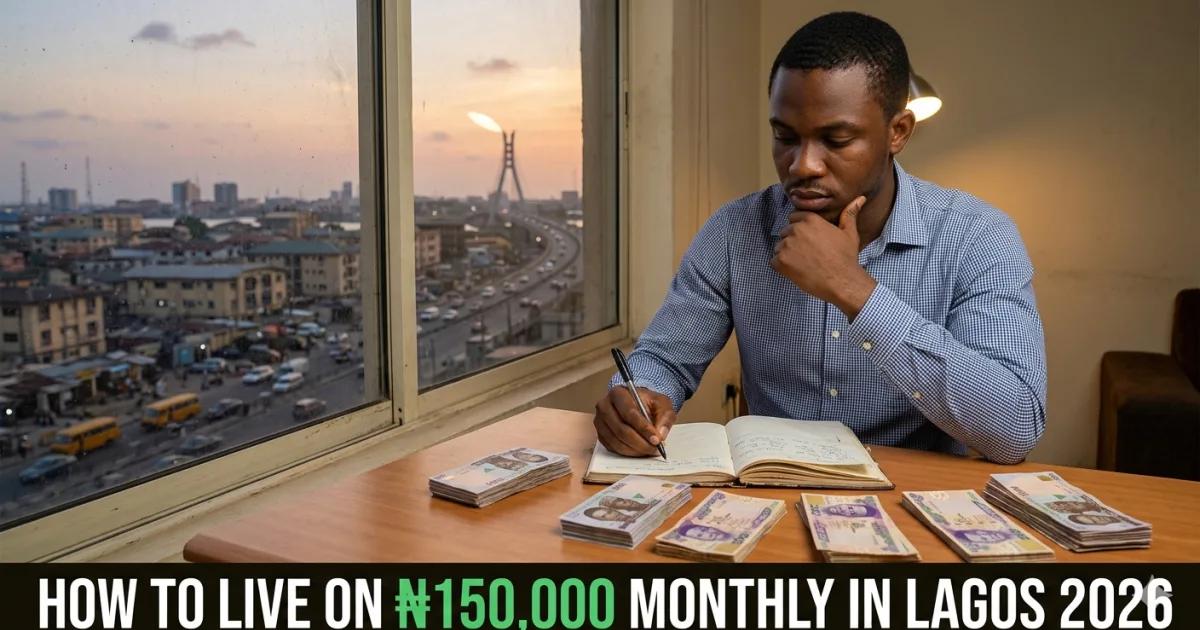
Let us be honest from the start: ₦150,000 per month in Lagos in 2026 is tight. Very tight. Nigeria Housing Market’s 2026 analysis confirms that living costs in Lagos have risen approximately 15% year-over-year, and Vibena Lifestyle’s research showed a grocery basket that cost ₦25,225 in 2020 now costs ₦147,050 — a 582% increase over five years. Cash Bank’s 2026 Lagos cost of living guide puts a comfortable single-person budget at ₦700,000–₦800,000 per month including rent.
So is ₦150,000 enough? For a single person making very specific, deliberate decisions — yes. Not comfortably, not without sacrifice, but survivable and even functional. The key word is deliberate. Every single spending decision matters when ₦150,000 is your entire monthly budget. This guide shows you exactly how to make it work — with a real itemised budget, the specific locations and strategies that make the difference, and the honest truth about which sacrifices are worth making and which ones are not.
The Honest Reality: What ₦150,000 in Lagos Actually Covers
Before the budget breakdown, some important context from current Lagos cost data:
- Lagos costs have increased 15% year-over-year in 2026 (Nigeria Housing Market analysis)
- Rent alone in even a modest mainland single room costs ₦300,000–₦600,000 per year (₦25,000–₦50,000/month equivalent)
- Food inflation has been severe — the ₦147,050 grocery basket (Vibena Lifestyle, 2026 data)
- Lagos transport costs for daily commuters are ₦2,000–₦5,000 per day in some cases
- Power infrastructure unreliability adds ₦15,000–₦50,000/month in generator and electricity costs (Aspire Homes data)
The single biggest lever on whether ₦150,000 works in Lagos is location. Living on the Island (Victoria Island, Ikoyi, Lekki Phase 1) on ₦150,000 is essentially impossible for a single person. Living on the deeper Mainland (Ikorodu, Badagry axis, Agbara) is much more feasible but creates punishing commutes. The sweet spot for a ₦150,000 budget is the mid-Mainland — areas like Iyana-Ipaja, Agege, Abule-Egba, Oshodi-Mafoluku, Ilasamaja, Badagry/Mile 2 corridor — where rents are genuinely affordable and commute to Mainland workplaces is manageable.
The ₦150,000 Monthly Lagos Budget — Line by Line
| Expense Category | Budget Allocation | How to Achieve It |
|---|---|---|
| Rent | ₦35,000–₦45,000/month equivalent | Single room self-contain on the Mainland (Agege, Iyana-Ipaja, Abule-Egba, Oshodi area). Annual rent ₦420,000–₦540,000 — save aggressively for this in months 1–3 |
| Food (cooking at home) | ₦30,000–₦40,000/month | Cook 90%+ of meals at home. Shop at Oshodi, Mile 12, Oyingbo, or local market — not supermarkets. Weekly: ₦8,000–₦10,000 for staples |
| Transportation | ₦20,000–₦30,000/month | Danfo (₦300–₦500/trip), keke napep, BRT. Walk when within 15–20 minutes. Avoid Uber/Bolt for daily commutes — use only for late night safety |
| Data/Internet | ₦3,000–₦5,000/month | Glo ₦3,000/month for 10.5GB; supplement with office/café WiFi; use data-lite apps |
| Electricity (NEPA prepaid) | ₦8,000–₦15,000/month | Load as needed; manage consumption carefully; avoid AC and high-wattage appliances |
| Generator fuel | ₦5,000–₦10,000/month | Share generator with neighbours (very common in budget accommodation); use generator only for evenings; invest in a power bank for phone |
| Airtime/calls | ₦2,000–₦3,000/month | Use WhatsApp/calls over data for most communication; airtime for essential calls |
| Toiletries and hygiene | ₦5,000–₦8,000/month | Budget brands from Oshodi, Balogun; buy in bulk where possible; avoid imported brands |
| Household items / sundries | ₦3,000–₦5,000/month | Cleaning products, small repairs, household needs |
| Emergency/savings | ₦5,000–₦10,000/month | Non-negotiable — even ₦5,000/month in a savings app builds a buffer over time |
| Entertainment / social | ₦5,000–₦7,000/month | Very limited — occasional outing, buying credit for friends, small social expenses |
| TOTAL | ₦121,000–₦173,000 | Achievable at the lower end with strict discipline; tight at the upper end |
The budget works — but only at the lower end of each range, and only with active management. Notice that entertainment, savings, and emergencies are squeezed. This is the reality of ₦150,000 in Lagos: you can survive, but unexpected expenses (medical, equipment breakdown, transport emergency) will break the budget. That is why even ₦5,000/month in savings is not optional — it is your emergency buffer.
Rent in Lagos on ₦150,000: Where to Live and What to Expect
Rent is paid annually in Lagos — not monthly. This means your first year requires a lump sum that may be 3–4 months of salary. Plan for this by saving aggressively from your first salary or negotiating a 6-month rent option (increasingly common in budget accommodation). Here is what different rent levels look like in 2026:
| Area | Accommodation Type | Annual Rent (approx.) | Monthly Equivalent | Commute Reality |
|---|---|---|---|---|
| Agege / Abule-Egba / Iyana-Ipaja | Single room self-contain | ₦350,000–₦500,000 | ₦29,000–₦42,000 | 30–60 min to Ikeja/Lagos Island by danfo/BRT |
| Oshodi / Ilasamaja / Mushin | Single room self-contain | ₦400,000–₦600,000 | ₦33,000–₦50,000 | 45 min to Island; 20 min to Ikeja |
| Ikorodu | Single room or mini-flat | ₦250,000–₦400,000 | ₦21,000–₦33,000 | 1.5–3 hours to Island (a punishing commute) |
| Badagry / Mile 2 corridor | Single room self-contain | ₦200,000–₦350,000 | ₦17,000–₦29,000 | Long commute; less Lagos-connected |
| Yaba / Surulere | Shared apartment / face-me-I-face-you | ₦400,000–₦700,000 | ₦33,000–₦58,000 | Well-connected; good for those working on the Island |
| Lekki / Ajah | Single room (very basic) | ₦600,000–₦1,200,000 | ₦50,000–₦100,000 | Not realistic for ₦150k budget unless shared |
Nigeria Housing Market’s 2026 analysis confirms that living costs in Lagos are “almost entirely determined by which side of the bridge you live on” — the Island–Mainland divide. For a ₦150,000 budget, the Mainland is your only realistic option. The mid-Mainland (Agege, Iyana-Ipaja, Oshodi) represents the best balance of affordable rent and manageable commute to most Lagos workplaces.
Food on a ₦150,000 Budget: How to Eat Well in Lagos
Food is the second-largest expense and the area where the most savings are possible through smart choices. The fundamental rule: cook at home as much as possible. A plate of restaurant food in Lagos costs ₦1,500–₦3,500; a home-cooked meal of the same nutritional value costs ₦300–₦600 in ingredients. Over a month, this difference alone can save ₦30,000–₦60,000.
Sample Weekly Grocery Budget: ₦8,000–₦10,000
| Item | Quantity | Cost (approx.) | Notes |
|---|---|---|---|
| Rice or yam or garri | 2kg rice / 1 medium yam | ₦1,200–₦2,000 | Buy in bulk monthly to save 15–20% |
| Palm oil / groundnut oil | 1 bottle | ₦800–₦1,500 | Buy in larger quantities for better price |
| Tomatoes, pepper, onions | Weekly supply | ₦1,500–₦2,000 | Buy from Mile 12 or local market — not supermarket |
| Fish (titus/croaker/sardines) | 500g–1kg | ₦1,500–₦2,500 | Buy fresh/frozen from market; sardines in tin for budget weeks |
| Beans / black-eyed peas | 1kg | ₦600–₦1,000 | Cheap, high-protein, filling |
| Vegetables (ugwu, spinach, cabbage) | Weekly supply | ₦400–₦800 | Season-dependent; ugwu is consistently affordable |
| Eggs | 6–12 eggs | ₦600–₦1,200 | Affordable complete protein; versatile |
| Seasoning / condiments | Weekly | ₦500–₦800 | Maggi, salt, crayfish, Knorr |
| Weekly total | — | ₦7,100–₦11,800 | Budget end: ₦7,000–₦8,500 |
Food Buying Strategy for Lagos on a Budget
- Buy from open markets, not supermarkets. Oshodi Market, Mile 12 Market, Oyingbo Market, and local neighbourhood markets have the same produce at 30–60% less than Shoprite or Ebeano. The quality is often better — fresher produce with higher turnover.
- Shop weekly, not daily. Daily small purchases at local kiosks are consistently more expensive per unit than weekly market shopping. Plan your week’s meals, write a list, and stick to it.
- Cook in batches. Cook large pots of stews, soups, and beans and refrigerate portions. A large pot of egusi soup on Sunday feeds you through Wednesday–Thursday.
- Embrace Nigerian staples. Garri (eba), beans, yam, akamu/ogi, unripe plantain, sweet potatoes, and local greens are the most nutritious and most affordable foods in Lagos. These are not “poverty foods” — they are the foundation of Nigerian cuisine and form the basis of very healthy, filling, affordable meals.
- Limit restaurant eating to once or twice per week maximum. If you eat at a buka or local restaurant, the cheapest decent meal (rice + stew + protein) costs ₦1,500–₦2,000. At two meals per week, that is ₦12,000–₦16,000/month just in restaurant eating. Cut to once per week for special occasions, and cook every other meal.
Transport: The Lagos Budget-Killer and How to Tame It
Transport is often underestimated in Lagos budget planning. Vibena Lifestyle’s 2026 Lagos cost guide puts monthly danfo/BRT budgets at ₦30,000–₦50,000 for daily commuters. At ₦150,000 total income, ₦30,000+ on transport is painful. Here is how to minimise it:
- Live as close to your workplace as your budget allows. Every kilometre of commute costs money — in direct fare and in time you could spend on side income activities. If relocating to cut a 2-hour commute to 30 minutes saves you ₦15,000/month in transport, it is worth paying ₦10,000 more in rent.
- Use danfo and BRT, not Bolt/Uber for daily commutes. A danfo trip costs ₦300–₦500. An equivalent Uber costs ₦2,000–₦5,000. For daily commuting, this difference is ₦6,000–₦12,000 per month. Use Bolt/Uber only for late nights (safety) or genuine emergencies.
- Use the BRT Lagos (Bus Rapid Transit) whenever routes allow. LAMATA’s BRT is one of the best value transport options in Lagos — subsidised, relatively reliable, and air-conditioned. Vibena Lifestyle noted a February 2025 BRT fare increase of 18% but it remains far cheaper than alternatives.
- Walk when it is safe and reasonable. If your destination is within 15–20 minutes walk, walk. Not just for savings — walking reduces the mental fatigue of Lagos traffic and has genuine health benefits.
- Plan errands in clusters. Do all your shopping, admin, and errands in a single trip rather than multiple daily trips. Every extra danfo ride is ₦500 you did not need to spend.
Power: Managing Lagos’s Biggest Hidden Cost
Power is Lagos’s most underestimated budget item. Nigeria Housing Market’s 2026 analysis calls it “a defining feature of living expenses in Lagos Nigeria often underestimated by newcomers” — with residents spending ₦40,000–₦100,000 per month on alternative power. On a ₦150,000 budget, you cannot afford anywhere near that range. Here is how to manage power costs at the low end:
- Choose accommodation with NEPA as the primary power and a shared generator. Many budget self-contain apartments come with a landlord-managed shared generator. You pay a monthly contribution (usually ₦3,000–₦8,000) for shared generator use rather than running your own. This is much more cost-effective than a personal generator.
- Invest in a high-capacity power bank early. A good power bank (10,000–20,000 mAh, ₦8,000–₦15,000) means your phone, hotspot, and small LED lights work during power cuts without needing the generator. Over months, the savings in generator fuel are significant.
- No air conditioning. On a ₦150,000 budget in Lagos, air conditioning is financially impossible. A fan (₦5,000–₦15,000 one-time) is your cooling solution. Choose accommodation with adequate ventilation and natural airflow.
- Load NEPA prepaid carefully. Load small, frequent amounts (₦2,000–₦5,000) and track your consumption. Know your highest-consumption appliances and manage their use — a water heater, an electric hot plate, and an iron can eat through a ₦2,000 NEPA token in days.
- Consider a small solar setup over time. A basic solar phone-charging and fan setup (₦30,000–₦60,000 initial investment) can be assembled over 3–4 months of small savings and will eliminate a significant portion of your ongoing power costs. Even a ₦15,000 solar phone charger reduces airtime and power bank costs meaningfully.
Income Strategies: Why ₦150,000 Alone Is Not Enough
The hard truth: ₦150,000 in Lagos in 2026 is a survival income, not a thriving income. The budget above works on paper with extreme discipline — but it leaves virtually no room for medical emergencies, equipment replacement, unexpected transport costs, or any upward mobility. The smartest strategy for someone earning ₦150,000 in Lagos is not just to manage the budget better — it is to actively work on increasing income while keeping expenses controlled.
Side Income Options That Work on a Lagos Budget
| Side Income Option | Startup Cost | Realistic Monthly Addition | Notes |
|---|---|---|---|
| Freelance writing/content (Upwork, Fiverr) | Near zero (use phone/café) | ₦20,000–₦100,000+ | Takes 2–6 months to build; very scalable |
| Airtime and data reselling | ₦5,000–₦20,000 capital | ₦10,000–₦30,000 | Low margin but very accessible; scales with capital |
| Tutoring / lesson teaching | Near zero | ₦15,000–₦50,000 | Maths, English, science — consistent demand in Lagos |
| Social media management for SMEs | Near zero (phone-based) | ₦20,000–₦80,000 per client | 1–2 clients changes everything; takes time to find them |
| Thrift/Okrika clothing reselling | ₦10,000–₦30,000 | ₦15,000–₦50,000 | Buy from Katangua/Yaba markets; sell via WhatsApp/Instagram |
| Food preparation (small chops/meals) | ₦5,000–₦20,000 | ₦20,000–₦60,000 | Weekend cooking and delivery; proven Lagos side hustle |
| Graphic design (Canva-level) | Near zero | ₦15,000–₦60,000 | Church programmes, business cards, social media graphics |
Mental Health: Managing the Pressure of Tight Lagos Living
Living in Lagos on a tight budget is genuinely stressful. The noise, the traffic, the hustle, the constant pressure to appear to be doing better than you are — all of it compounds. A few things that make a real difference:
- Build a community deliberately. Your neighbours, coworkers, and church/mosque/social group are your social infrastructure. They cost nothing and provide a genuine support network. Nigerians are historically excellent at informal community support — leverage this.
- Free Lagos. The Bund Carnival, beach visits to Bar Beach (free entry), public parks, local football watching parties, church activities, and community events provide real social life at minimal cost.
- Track your spending consistently. Not as a punishment exercise, but as information. Knowing exactly where every naira goes removes the anxiety of “where did my money go?” Use a simple notebook or the free version of any budgeting app.
- Celebrate small wins. Finishing a month without going into debt is worth acknowledging. Lagos at ₦150,000 requires real skill and discipline — give yourself credit for managing it.
- Keep your “why” in focus. For most people on a tight Lagos budget, this is temporary — they are building skills, saving for a business, waiting for career growth. Know what you are working toward and let that anchor your daily decisions.
Frequently Asked Questions
Is ₦150,000 enough to live in Lagos in 2026?
For a single person making very deliberate housing, food, and transport choices — yes, barely. You will need to live in mid-Mainland areas like Agege, Iyana-Ipaja, or Oshodi; cook almost all meals at home; use danfo and BRT exclusively for commuting; and have no significant unexpected expenses. Cash Bank’s 2026 Lagos cost guide notes that a comfortable life in Lagos requires ₦700,000–₦800,000/month including rent, so ₦150,000 is well below the comfort threshold. But “survival” and “manageable” are achievable with the right decisions.
What is the cheapest area to rent in Lagos in 2026?
The most affordable rent in Lagos is found in Ikorodu (₦250,000–₦400,000/year for a self-contain), followed by the Badagry/Mile 2 corridor and outer Mainland areas like Agbara and Mowe (though these are technically outside Lagos). In terms of affordability combined with reasonable commute, Agege, Iyana-Ipaja, Abule-Egba, and the Oshodi-Mafoluku area offer the best balance for budget-conscious Lagosians who still need to reach workplaces within reasonable commute time. Aspire Homes’ data confirms that many families are increasingly moving to emerging towns near Lagos (Agbara, Mowe, Epe) to cut costs.
How much does food cost in Lagos per month in 2026?
For a single person cooking at home, a realistic food budget in Lagos in 2026 is ₦30,000–₦40,000 per month. This buys a nutritious, varied diet of Nigerian staples (rice, yam, garri, beans, vegetables, fish, eggs) when shopping at open markets rather than supermarkets. Vibena Lifestyle’s 2026 data documents how severely food costs have risen — the same grocery basket cost ₦25,225 in 2020 and now costs ₦147,050. Shopping smart (open markets, bulk buying, cooking in batches) is how you keep food costs manageable despite inflation.
How do I save money in Lagos on a low income?
The most impactful savings strategies for Lagos on a tight budget, in order of impact: (1) Choose the right location — reducing rent and transport costs is worth more than any other spending cut; (2) Cook every meal at home — restaurant eating is the single biggest discretionary expense for most Lagos residents; (3) Use danfo and BRT exclusively for daily commuting; (4) Share accommodation and generator costs with a trusted roommate or co-tenant; (5) Save automatically — even ₦5,000/month on PiggyVest SafeLock before you see your balance; (6) Build a side income — the ₦150,000 budget works but does not leave room for growth. The answer to a tight Lagos budget is usually found in earnings as much as spending.
💡 ₦150k Lagos Budget 2026 — Your Survival Playbook
- ✅ Live on the Mainland — Agege, Iyana-Ipaja, Oshodi. Island living on ₦150k is not possible.
- ✅ Annual rent ₦350,000–₦500,000 — Single room self-contain; save your first 3 months for the lump sum
- ✅ Food ₦30,000–₦40,000/month — Shop at Oshodi/Mile 12/local market; cook 90%+ of meals at home
- ✅ Transport ₦20,000–₦30,000/month — Danfo + BRT only; no Uber for daily commutes
- ✅ Power: share generator costs with building; use power bank; no AC
- ✅ Save ₦5,000–₦10,000/month minimum — even this tight; emergencies will come
- ✅ Build side income — reselling, tutoring, freelancing; ₦150k alone is a survival income, not a thriving one
- ✅ Live costs have risen 15% year-on-year (Nigeria Housing Market 2026) — active management is not optional
Lagos on ₦150,000 in 2026 demands resourcefulness, discipline, and community. It is not comfortable, but it is survivable — and for many Nigerians building toward better, it is the chapter they are in right now. Manage it well, build your side income aggressively, and keep your eyes on the next level. Lagos rewards persistence.
What is your biggest expense challenge in Lagos? Share in the comments — your experience might help someone else. Also read our guide on Best Savings Apps in Nigeria 2026 to make every naira you save work harder.


0 Comments
No comments yet. Be the first to share your thoughts!