




⚕️ Medical Disclaimer: This article is for educational purposes only. Fibroids are a medical condition requiring proper diagnosis and treatment planning by a qualified gynaecologist. Do not self-diagnose or delay seeking medical care based on this article.
📌 Quick Summary: Uterine fibroids (also called leiomyomas or myomas) are non-cancerous growths of the uterine muscle wall. They affect an estimated 30 to 40 percent of Nigerian women of reproductive age — one of the highest prevalence rates globally. Most fibroids cause no symptoms. When symptoms occur, they include: heavy or prolonged menstrual bleeding, abdominal pain and pressure, frequent urination, and difficulty conceiving. Key facts: fibroids are almost always non-cancerous (the risk of malignant transformation is less than 0.1 percent), they typically shrink after menopause, and treatment is needed only when they cause significant symptoms or affect fertility. Treatment options available in Nigeria: medication (GnRH agonists, tranexamic acid, hormonal), uterine fibroid embolisation (UFE), myomectomy (surgical removal), and hysterectomy. This guide covers types, symptoms, diagnosis, treatment options, fertility implications, and what questions to ask your gynaecologist.
Fibroids are extraordinarily common among Nigerian women — and remain extraordinarily misunderstood. The word “fibroid” carries significant fear in Nigeria, often triggering assumptions about infertility, imminent surgery, or cancer that are, in most cases, unfounded. The reality is more nuanced: most fibroids cause no symptoms and require no treatment. A significant minority cause symptoms ranging from mildly inconvenient to severely debilitating. A small proportion affect fertility. The challenge for Nigerian women — and the reason accurate information matters — is that cultural stigma, misinformation on social media and in WhatsApp groups, herbal remedy industry exploitation of fibroid fear, and sometimes inadequate medical communication all contribute to Nigerian women making poorly informed decisions about a very common condition. This guide aims to change that.
What Are Fibroids and Why Are They So Common in Nigerian Women?
Uterine fibroids (leiomyomas) are benign (non-cancerous) tumours composed of the same smooth muscle tissue as the uterine wall, but growing in an abnormal, uncontrolled way. They range in size from microscopic (too small to detect without a microscope) to very large (filling the entire pelvic cavity — cases of fibroids weighing 10 to 20kg have been documented, though these are extreme outliers). They can occur singly or in multiples — some women have one fibroid; others have dozens. Why are fibroids so prevalent in Nigerian and Black African women specifically? The honest answer is that the reason is not fully understood. Genetic factors clearly play a role — women with first-degree relatives who have fibroids are at significantly higher risk. Hormonal factors are central — fibroids grow in response to oestrogen and progesterone and are rare before puberty and after menopause. Vitamin D deficiency (very common among Black Africans despite abundant sunlight — due to higher melanin blocking skin synthesis) is associated with higher fibroid risk in multiple studies. Other proposed factors — diet, stress, chemical exposures — are the subject of ongoing research. What is clear is that the disparity in fibroid prevalence between Black African women and other populations is real, significant, and not fully explained by any single factor.
Types of Fibroids: Location Determines Symptoms
| Type | Location | Symptoms |
| Submucosal | Grows into the uterine cavity (the space inside the uterus) | Most likely to cause heavy bleeding, prolonged periods, and fertility problems. Smallest submucosal fibroids can cause the most symptoms. |
| Intramural | Grows within the muscular wall of the uterus — the most common type | Heavy bleeding, pelvic pressure, abdominal enlargement when large. Can affect fertility when large or numerous. |
| Subserosal | Grows on the outer surface of the uterus | Pelvic pressure, back pain, pressure on bladder (frequent urination) or bowel (constipation). Less likely to cause bleeding or fertility problems. |
| Pedunculated | Attached to the uterus by a stalk (either inside the cavity or on the outer surface) | Can cause intermittent pain if the stalk twists (torsion). If inside the cavity, similar to submucosal. |
Symptoms of Fibroids in Nigeria
The most important fact about fibroid symptoms: approximately 50 percent of women with fibroids have no symptoms at all. Fibroids found incidentally on an ultrasound scan done for another reason, in a woman with no complaints, typically require no treatment — they are observed and monitored. When fibroids cause symptoms, the most common in Nigerian women. Heavy menstrual bleeding (menorrhagia): the most common fibroid symptom — bleeding so heavy that it soaks through pads or tampons within an hour, requires double protection, causes flooding, or passes large clots. Heavy fibroid bleeding is one of the most common causes of iron-deficiency anaemia in Nigerian women. Prolonged periods: periods that last longer than 7 days, or spotting between periods. Abdominal swelling and pressure: large fibroids cause visible abdominal enlargement — many Nigerian women are first aware of a fibroid when they notice their abdomen growing or when a partner or family member notices. Urinary frequency and urgency: fibroids pressing on the bladder cause the urge to urinate frequently. Constipation or difficulty with bowel movements: fibroids pressing on the rectum. Pelvic pain and pressure: a constant feeling of heaviness or fullness in the pelvis, or deep pelvic pain during menstruation. Back or leg pain: from fibroid pressure on nerves. Difficulty conceiving or recurrent miscarriage: see fertility section below.
Diagnosis in Nigeria
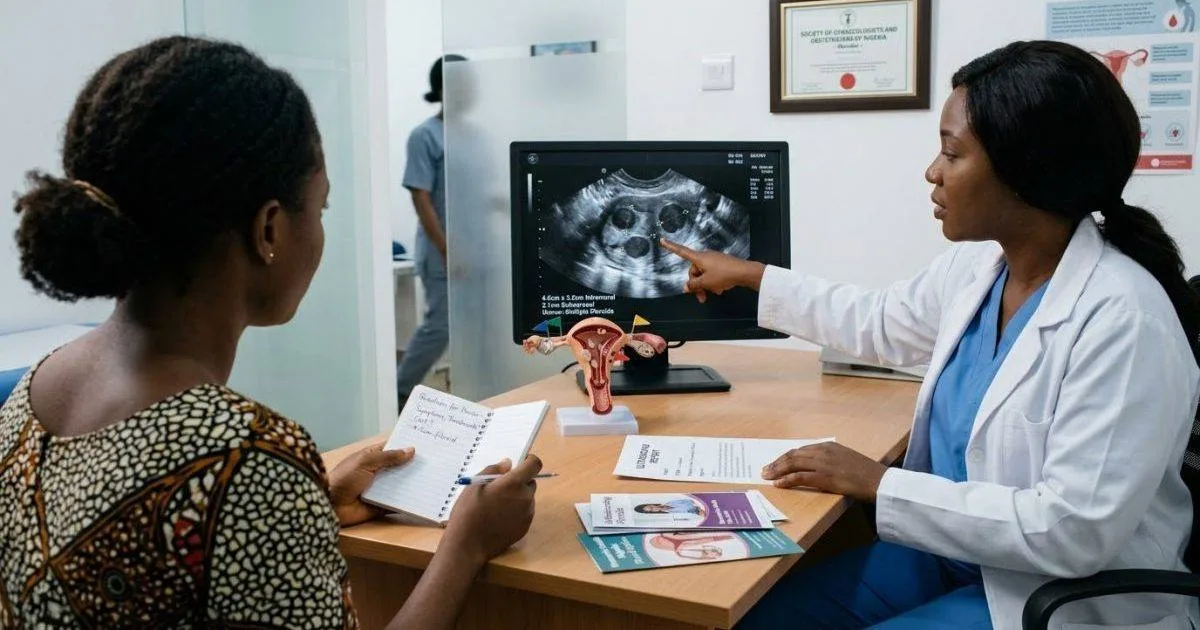
Pelvic ultrasound is the primary diagnostic tool for fibroids in Nigeria — widely available, inexpensive (₦5,000 to ₦20,000 at private hospitals and diagnostic centres), and sufficiently accurate for most fibroid diagnosis and monitoring purposes. A gynaecological examination can identify large fibroids by feel (bimanual palpation) but cannot assess size, number, or location as precisely as ultrasound. MRI (Magnetic Resonance Imaging) provides more detailed fibroid mapping and is used when surgery is being planned, when the ultrasound picture is unclear, or when differentiation from adenomyosis (a related condition where uterine tissue grows into the muscle wall) is needed. MRI is more expensive (₦40,000 to ₦150,000) and available primarily at major private hospitals and federal teaching hospitals.
Treatment Options Available in Nigeria
Watch and Wait (for asymptomatic fibroids)
For fibroids that cause no symptoms, the recommended approach is monitoring — ultrasound every 6 to 12 months to check for significant growth. No treatment is required. Many fibroids remain stable for years; some grow slowly; some shrink spontaneously. After menopause, most fibroids shrink significantly as oestrogen levels fall.
Medical Treatment
Tranexamic acid (available at Nigerian pharmacies): reduces heavy menstrual bleeding by 40 to 50 percent. Taken during the period only. Does not treat the fibroid — treats the symptom. GnRH agonists (goserelin/Zoladex, leuprorelin): injections that induce a temporary menopause state, significantly shrinking fibroids and stopping bleeding. Used for 3 to 6 months before surgery to shrink fibroids and reduce blood loss during operation, or as short-term relief. Cannot be used long-term due to bone density loss. Iron supplementation: essential for Nigerian women with fibroid-related anaemia — haemoglobin must be restored before surgery. Hormonal contraceptives (combined pill, progestogen-only pill, hormonal IUD): reduce menstrual bleeding and pain but do not reliably shrink fibroids. The Mirena IUS (hormonal coil) is particularly effective at reducing fibroid-related heavy bleeding.
Uterine Fibroid Embolisation (UFE)
A minimally invasive procedure in which a radiologist passes a catheter through the femoral artery into the blood vessels supplying the fibroids, and injects small particles that block blood flow to the fibroids, causing them to shrink. UFE preserves the uterus and has significantly shorter recovery than surgery (1 to 2 weeks versus 4 to 6 weeks for open myomectomy). Available at a small number of specialist centres in Nigeria including Lagos University Teaching Hospital (LUTH) and some major private hospitals. A significant option for women who want to avoid surgery but have symptomatic fibroids.
Myomectomy (Surgical Removal)
The surgical removal of fibroids while preserving the uterus — the standard option for women who want to retain fertility. Can be performed by open surgery (laparotomy), laparoscopic (keyhole) surgery, or hysteroscopy (for submucosal fibroids inside the uterine cavity). Available at all federal teaching hospitals and most major private hospitals in Nigeria. Recovery: 2 to 6 weeks depending on surgical approach. Important: fibroids can recur after myomectomy — approximately 25 to 30 percent of women will develop new fibroids within 5 years of myomectomy.
Hysterectomy
Surgical removal of the entire uterus — a permanent solution that eliminates fibroids entirely and prevents recurrence. Appropriate for women with very severe symptoms who have completed childbearing and have not responded to other treatments. Not appropriate for women who wish to preserve fertility. Available at all major Nigerian hospitals.
Fibroids and Fertility
Not all fibroids affect fertility. Submucosal fibroids (inside the uterine cavity) have the strongest evidence for impairing fertility and increasing miscarriage risk — they distort the cavity where an embryo implants. Large intramural fibroids (particularly those greater than 4 to 5cm) may affect fertility. Subserosal fibroids generally do not affect fertility unless very large. Nigerian women diagnosed with fibroids who are trying to conceive should have a fertility consultation with a gynaecologist who can assess which (if any) fibroids are relevant to fertility and whether myomectomy would improve conception chances. Not all fibroids found in women struggling with infertility are the cause of the infertility — careful assessment is required.
Frequently Asked Questions
Do fibroids cause cancer in Nigeria?
Virtually never. The risk of a uterine fibroid undergoing malignant transformation to leiomyosarcoma (uterine muscle cancer) is less than 0.1 percent — less than 1 in 1,000 fibroids. A rapidly growing fibroid (growing significantly over a 3 to 6 month period) warrants investigation to exclude the rare possibility of malignancy, but the overwhelming majority of fibroids, even large ones, are benign. Fibroid fear in Nigeria is disproportionate to this actual cancer risk.
Can fibroids be treated without surgery in Nigeria?
Yes. Medical treatment (tranexamic acid, hormonal therapy, GnRH agonists), uterine fibroid embolisation (UFE), and watchful waiting for asymptomatic fibroids are all non-surgical options. Surgery (myomectomy or hysterectomy) is appropriate only when medical treatment is insufficient, when fertility preservation requires fibroid removal, or when fibroid burden is very severe.
Do herbal remedies cure fibroids in Nigeria?
No herbal remedy has been scientifically proven to cure or meaningfully shrink uterine fibroids. Many herbal products marketed in Nigeria as fibroid cures contain unapproved compounds, are unregulated by NAFDAC, and may cause harm. Some women report symptom improvement using certain herbal products — this may reflect placebo effect, normal fibroid behaviour (fibroids fluctuate), or symptom management rather than fibroid resolution. Do not delay effective medical treatment while using herbal products for fibroids.
The Fibroid Conversation Nigerian Women Need to Have With Their Doctors
One of the most important steps any Nigerian woman with a fibroid diagnosis can take is to ask her gynaecologist a specific set of questions — rather than accepting a surgical recommendation without understanding her full range of options. The Nigerian health system, under significant resource pressure, sometimes defaults to hysterectomy as the most definitive solution for symptomatic fibroids without fully exploring less radical alternatives that might be appropriate for the individual patient. Questions worth asking. Are my fibroids actually causing my symptoms, or could there be another explanation? (Heavy bleeding and pelvic pain have other causes — endometriosis, adenomyosis, polyps — that should be excluded.) What would happen if we monitored without treating? How large are my fibroids and how many are there? (Small, few fibroids behave very differently from large, numerous ones.) Have you considered uterine fibroid embolisation (UFE) for my case? (Some Nigerian gynaecologists do not routinely offer UFE as it is relatively new; it is worth asking about at a specialist centre.) If you are recommending myomectomy, what surgical approach will you use — open, laparoscopic, or hysteroscopic? (Laparoscopic myomectomy has faster recovery than open surgery for appropriate cases.) If I have myomectomy, what is the recurrence rate and what monitoring will we do? Do I need to treat this fibroid if I want to get pregnant, or can I try to conceive first? These questions empower Nigerian women to be active participants in their own fibroid management rather than passive recipients of a single treatment recommendation. A gynaecologist who welcomes these questions and answers them clearly is one who respects the patient’s right to informed decision-making.
Living with Fibroids: Practical Nigerian Guidance
For Nigerian women with symptomatic fibroids who are managing while awaiting treatment or choosing to watch and wait, several practical strategies reduce the impact on daily life. For heavy bleeding: always carry adequate sanitary protection. Iron supplementation is essential if periods are very heavy — anaemia from fibroid bleeding is insidious and significantly affects energy, cognitive function, and quality of life. Tranexamic acid (available at Nigerian pharmacies without prescription in some states — check with your pharmacist) taken during the period meaningfully reduces bleeding volume. For pelvic pain and pressure: over-the-counter NSAIDs (ibuprofen, naproxen) taken at the onset of menstrual pain, before it becomes severe, are more effective than taking them after pain is established. Heat (a hot water bottle on the lower abdomen) provides symptomatic relief. For the psychological burden: the diagnosis of fibroids carries anxiety that is often disproportionate to the actual medical risk — particularly in a Nigerian cultural environment where fibroids are whispered about, associated with infertility, and sometimes attributed to spiritual causes rather than biology. Connecting with other Nigerian women who have fibroids — through support groups, social media communities, and patient advocacy organisations — provides perspective, accurate information, and the reassurance that fibroids are common, manageable, and in the vast majority of cases, not life-threatening.
Sources
- Okolo SO — Incidence, aetiology and epidemiology of uterine fibroids in Nigeria — Best Practice and Research Clinical Obstetrics and Gynaecology, 2008
- British Fibroid Trust — patient education resources
- Royal College of Obstetricians and Gynaecologists — Uterine Fibroids Green-top Guideline
- Original health guide — NaijaSabi Health Desk, September 2026
Last updated: 30 September 2026 · NaijaSabi Health Desk. Educational purposes only. Always consult a qualified gynaecologist for diagnosis and treatment of fibroids.




0 Comments
No comments yet. Be the first to share your thoughts!