




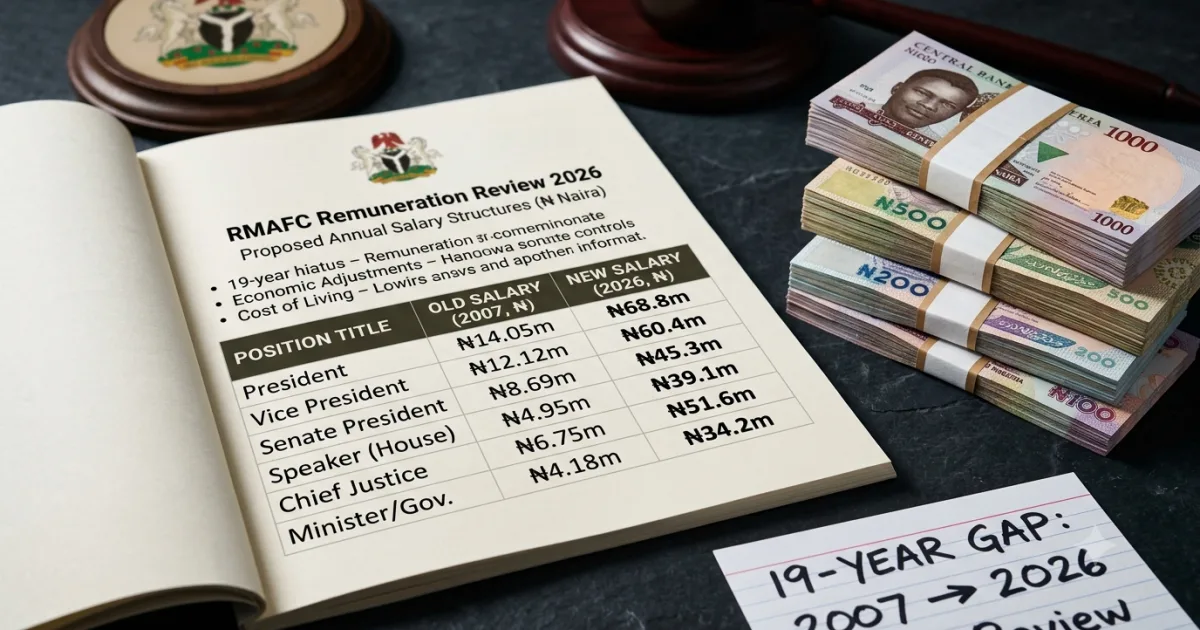
📌 Status (checked 13 October 2026): The Revenue Mobilisation Allocation and Fiscal Commission (RMAFC) has completed its review of pay for the President, governors, ministers, lawmakers and other political office holders, the first since the 2007/2008 law, and sent it to President Tinubu through the Secretary to the Government of the Federation. No new figures have been published or approved, and no start date has been announced. The President must send a new Act to the National Assembly; RMAFC says it expects the bill before the end of 2026. Until then, the old salaries below still apply.
Nigeria’s political office holders have not had their salaries reviewed since 2007 — the year Umaru Musa Yar’Adua was inaugurated as President. In the 19 years since, the naira has lost over 95% of its value against the dollar, the minimum wage has moved from ₦7,500 to ₦70,000, and the cost of living for every Nigerian — including elected officials — has transformed beyond recognition. Now, the Revenue Mobilisation Allocation and Fiscal Commission (RMAFC) has completed what it describes as a long-overdue upward review of the remuneration packages for Nigeria’s President, Vice President, governors, senators, House of Representatives members, ministers, and other political office holders. The review has completed and is awaiting implementation. Here is every figure you need to know.
What Is RMAFC? Why It Sets Political Salaries
The Revenue Mobilisation Allocation and Fiscal Commission (RMAFC) is a federal constitutional body established under the Third Schedule of the 1999 Constitution of the Federal Republic of Nigeria. Its mandate includes monitoring accruals to and disbursements from the Federation Account, advising on revenue allocation formulas, and — most relevantly — determining the remuneration packages for political office holders across all three tiers of government. RMAFC’s salary determinations have the force of law — political office holders cannot legally pay themselves more than RMAFC specifies, and in theory cannot legally pay themselves less either. The commission is chaired by Mohammed Bello Shehu.
Current Salaries: What Nigeria’s Political Office Holders Earn Now
| Office | Annual Salary (Current) | Monthly Equivalent | Last Reviewed |
| President | ₦14,058,820 | ₦1,171,568 | 2007 |
| Vice President | ₦12,137,652 | ₦1,011,471 | 2007 |
| Senate President | ₦8,905,560 | ₦742,130 | 2007 |
| Speaker, House of Reps | ₦8,905,560 | ₦742,130 | 2007 |
| Governor | ₦8,894,820 | ₦741,235 | 2007 |
| Senator | ₦8,105,600 | ₦675,467 | 2007 |
| House of Reps Member | ₦7,980,000 | ₦665,000 | 2007 |
| Minister | ₦7,884,000 | ₦657,000 | 2007 |
| Deputy Governor | ₦7,660,820 | ₦638,402 | 2007 |
| State House of Assembly Member | ₦4,436,280 | ₦369,690 | 2007 |
These are basic salary figures only. What Nigerian politicians actually receive is dramatically higher when you add running costs, constituency allowances, utility allowances, domestic staff allowances, entertainment allowances, personal assistant allowances, vehicle allowances, and other perks that RMAFC also regulates. In 2018, then-senator Shehu Sani said each senator received ₦13.5 million a month in “running costs” on top of salary and allowances. The salary figures above are the tip of a very large iceberg.
The RMAFC Review: What Is Changing
RMAFC chairman Mohammed Bello Shehu confirmed the completion of the review exercise, stating that the commission worked with relevant data on Nigeria’s current economic realities — including the current inflation rate, the naira’s current value, and the cost-of-living adjustments made to civil service pay scales — to arrive at revised figures. The commission has submitted its recommendations to the appropriate authorities for implementation. The specific new figures have not been publicly gazetted at the time of publication, but multiple sources within the commission have confirmed the review represents a substantial upward adjustment from the 2007 baseline.
Why 19 Years Without a Review Is Extraordinary
Consider what ₦14 million meant in 2007 versus what it means in 2026. In 2007, the dollar exchanged for approximately ₦117. In October 2026 the official rate was about ₦1,332. A salary of ₦14 million was worth roughly $120,000 in 2007; today the same ₦14 million is worth about $10,500, a fall of more than 90% in dollar terms. The case for review is mathematically straightforward. The political controversy — that any increase in politician pay is obscene when 63% of Nigerians live in multidimensional poverty — is equally straightforward.
The Comparison That Every Nigerian Will Make
| Who | Monthly Income | Annual Income |
| Nigeria President (current salary) | ₦1,171,568 | ₦14,058,820 |
| Nigeria Governor (current salary) | ₦741,235 | ₦8,894,820 |
| Senator (current salary) | ₦675,467 | ₦8,105,600 |
A senator’s basic salary is already nearly 10 times the national minimum wage. When allowances are included, the multiple rises to 30 or more. The RMAFC review — which will increase these figures — will widen this gap further. This is the political arithmetic that makes any political salary review in Nigeria one of the most emotionally charged governance stories of any year it occurs.
What Nigerians Are Saying: The Political Debate
The RMAFC review has generated fierce debate across Nigerian civil society, labour organisations, and social media. The arguments on both sides are as follows.
The Case For the Review
Supporters of the review argue that paying political office holders properly — particularly at state and local government level — reduces the incentive for corruption. An elected official earning ₦369,690 per month as a state legislator faces impossible financial pressure given the cost of constituency service, office maintenance, and the expectations of their community. The review also applies to civil servants and judges at the top of the federal pay scale — groups that are chronically underpaid relative to their responsibilities and whose underpayment has driven brain drain and corruption throughout the public service.
The Case Against
Critics, including civil society groups such as SERAP, which asked a court in September 2025 to stop the proposed increase, argue that any upward review of political office holder pay — before a meaningful review of the national minimum wage and civil service pay scales — is morally indefensible. Their position: increase the minimum wage first, reduce the allowance packages that dwarf official salaries, and implement the RMAFC review only as part of a comprehensive public sector pay reform rather than as a standalone political pay rise.
When Will the New Salaries Take Effect?
The new pay takes effect only after the President sends a new remuneration Act to the National Assembly and it is passed. RMAFC says the Federal Ministry of Justice has drafted the bill and expects it to be ready before the end of 2026. Earlier reviews in 2013 and 2022 stalled because they were never sent to the National Assembly. Given the political sensitivity of the exercise — any government that implements a political pay rise faces immediate public backlash — implementation timelines are typically slower than the review process itself. The review is complete. Implementation is a political decision. Watch for the Federal Gazette and any Presidential directive in the coming weeks and months for the effective date.
Frequently Asked Questions
What is RMAFC and what does it do?
RMAFC (Revenue Mobilisation Allocation and Fiscal Commission) is a federal constitutional body that determines the remuneration packages — salaries and allowances — for all political office holders in Nigeria, from the President down to state assembly members. Its determinations have constitutional force.
What is Tinubu’s salary as President of Nigeria?
President Tinubu’s current annual basic salary is ₦14,058,820 — equivalent to approximately ₦1,171,568 per month. This figure has not been officially reviewed since 2007. The RMAFC review will increase this amount, but new figures have not been publicly gazetted.
What is a Nigerian senator’s salary?
A Nigerian senator’s current annual basic salary is ₦8,105,600 — approximately ₦675,467 per month. On top of salary and allowances, then-senator Shehu Sani said in 2018 that senators received ₦13.5 million a month in running costs.
When was the last RMAFC salary review for political office holders?
The last RMAFC review of political office holder salaries was in 2007 — nearly two decades ago. The 2026 review is the first upward revision since then.
Will Nigerian governors’ salaries increase in 2026?
RMAFC has completed the review and submitted recommendations. Governors currently earn ₦8,894,820 annually. New figures will take effect when the Federal Government formally gazettes the RMAFC recommendations — a timeline that has not been officially confirmed.
Sources
- Vanguard, “18 years after: RMAFC moves to review president, governors, lawmakers’ pay”, 16 August 2026 (RMAFC chairman Mohammed Bello Shehu; next steps).
- Legit.ng, “Hardship allowance for Nigerian president emerges amid new salary review”, 31 August 2026 (submission to the President; no implementation date).
- Nairametrics, “RMAFC submits political office holders’ pay review to Tinubu”, 1 July 2026.
- Revenue Mobilisation Allocation and Fiscal Commission: rmafc.gov.ng. Current salary figures are from the Certain Political, Public and Judicial Office Holders (Salaries and Allowances, etc.) Act.
Last updated: 13 October 2026 · NaijaSabi Civic Desk. We will update this article when new figures are published.





0 Comments
No comments yet. Be the first to share your thoughts!