




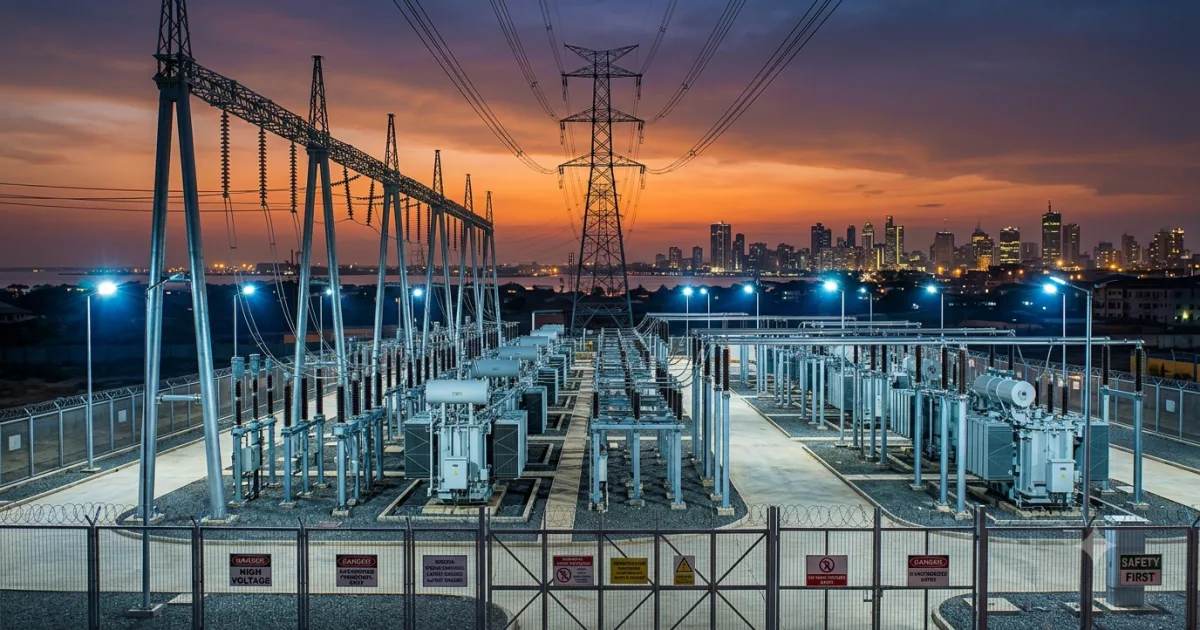
📌 Quick Summary: The Federal Government has commissioned upgraded transmission facilities at four Lagos substations — Ijora, Apapa Road, Alausa, and Lekki — adding a total of approximately 360 megawatts (MW) of transmission capacity to Lagos’s electricity grid. The Alausa upgrade alone serves 70,000 households and 180,000 people. The Lekki upgrade benefits 100,000 customers and 400,000 people. Here is exactly what was done at each substation, which communities benefit, and the honest assessment of what this means for your electricity supply.
The substations that carry electricity to Lagos have not been significantly upgraded in over 25 years. At the commissioning ceremony, Minister of Power Joseph Tegbe described the infrastructure plainly: “These infrastructures have been here for over 25 years. What we are doing is commissioning new power transformers in Apapa, Ijora, Alausa and Lekki transmission substations. This is important as it will increase our wheeling capacity and also improve our delivery to end-users.” Lagos — Nigeria’s commercial capital, home to 22 million people, and responsible for an estimated 30% of Nigeria’s GDP — has been operating on electricity transmission infrastructure built for a city that did not yet exist at its current scale. That changes now. The Federal Government has commissioned upgraded transmission facilities at four major substations in Lagos, adding about 360 megawatts of transmission capacity to strengthen electricity supply across the state.
The Four Substations: What Was Done and Who Benefits
| Substation | Upgrade Done | MW Added | DiscoServed</ td> | Who Benefits |
| Ijora | Two new 100MVA transformers — capacity from 90MVA to 230MVA | +112MW | Eko (EKEDC) | Lagos Island, Apapa corridor, commercial waterfront |
| Apapa Road | New Gas Insulated Substation (GIS) — capacity from 60MVA to 180MVA | +96MW | Eko (EKEDC) | Apapa port area, Tin Can Island, industrial corridor |
| Alausa | Existing 30MVA transformer replaced with 100MVA — total up from 135MVA to 205MVA | +56MW | Ikeja (IKEDC) | 70,000 households, ~180,000 people — Ikeja axis |
| Lekki | Two 60MVA transformers + one 300MVA transformer + nine additional 33kV feeders — capacity from 120MVA to 240MVA | +96MW | Eko (EKEDC) | 100,000 customers, ~400,000 people — Lekki corridor |
| Total | Four substations upgraded | ~360MW | Both EKEDC and IKEDC | Millions of Lagos residents |
Ijora Substation: Lagos Island and the Commercial Waterfront
At the Ijora substation, two new 100MVA transformers lifted the substation’s capacity from 90MVA to 230MVA — an additional 112MW. Minister Tegbe said the projects would strengthen electricity supply to some of Lagos’ most economically important corridors, supporting port operations, manufacturing, logistics, commercial activities and millions of consumers. Ijora feeds the EKEDC network — meaning Lagos Island, Victoria Island’s approaches, and the commercial waterfront that drives billions of naira in daily economic activity. The 112MW addition removes the single most constraining bottleneck in this corridor’s power supply.
Apapa Road Substation: Nigeria’s Most Economically Important Power Load Centre
At the Apapa Road substation, a new Gas Insulated Substation added 96MW, raising capacity from 60MVA to 180MVA. The Apapa Road facility replaces an outdoor transformer that had served as a temporary arrangement after the original substation, commissioned in 1985, was decommissioned. Minister Tegbe said: “Apapa is not an ordinary electricity load centre. It is one of the commanding heights of the Nigerian economy.” Apapa port handles the majority of Nigeria’s containerised cargo imports — every hour of electricity failure at Apapa costs Nigeria measurable economic losses in port throughput, cold chain storage failures, and logistics delays. The new GIS substation eliminates the makeshift arrangement that has powered West Africa’s busiest port since 1985.
Alausa Substation: 70,000 Households on the Ikeja Axis
At Alausa, an existing 30MVA transformer was replaced with a 100MVA unit, increasing the substation’s total capacity from 135MVA to 205MVA and adding about 56MW. The additional capacity has also increased power allocation to Ikeja Electricity Distribution Company to 80MW. The Alausa intervention alone has the capacity to serve about 70,000 households, representing approximately 180,000 people. Alausa feeds the IKEDC network that covers Ikeja, Agege, Ojodu, Ogba, and surrounding densely populated Mainland communities. For residents of these areas, the Alausa upgrade is the most directly relevant of the four projects.
Lekki Substation: 400,000 People in Lagos’s Fastest-Growing Corridor
At Lekki, the Transmission Company of Nigeria (TCN) commissioned two 60MVA transformers, one 300MVA transformer and nine additional 33kV feeders. The intervention doubled transformation capacity at the 132/33kV level from 120MVA to 240MVA. The Lekki project was expected to benefit about 100,000 customers, representing an estimated 400,000 people. The Lekki project, executed by Shanghai Electric Group Company Limited with support from the World Bank, also includes an additional 300MVA, 330/132kV transformer expected to be energised in November 2026. Lekki is Lagos’s fastest-growing residential and commercial district — the electricity demand from Lekki Phase 1, Ajah, Sangotedo, Chevron, VGC, and the Lekki Free Trade Zone has for years outpaced the transmission infrastructure that serves it. The doubled capacity addresses that structural deficit directly.
Who Executed the Projects?
| Project | Contractor | Funding |
| Ijora and Apapa Road | Federal Government (TCN) | Federal capital budget |
| Alausa | Shanghai Electric Limited | World Bank-funded initiative |
| Lekki | Shanghai Electric Group Company Limited | World Bank support |
TCN Managing Director and CEO Sule Ahmed Abdulaziz said the upgrades would strengthen grid stability while enabling more bulk power to reach distribution companies for onward supply within their franchise areas, describing it as proof that “TCN remains resolute in its mandate of building and sustaining a robust transmission network.”
The Honest Assessment: What This Actually Means for Your Light
Here is the critical distinction every Lagos electricity consumer must understand: transmission capacity and distribution capacity are different things. The four substations upgraded are transmission infrastructure — they carry bulk electricity from the national grid to the distribution companies (EKEDC and IKEDC). The distribution companies then carry that electricity through the lower-voltage network to your street and your home. Adding 360MW of transmission capacity does not automatically mean your neighbourhood gets better electricity tomorrow.
What it means is that the ceiling on how much electricity Lagos can receive from the national grid has risen significantly. Whether you feel this improvement depends on: whether the national grid is generating enough electricity to fill the new transmission capacity (Nigeria’s generation capacity remains constrained); whether your local distribution network — the transformers and cables in your neighbourhood — is adequate to carry the additional power once it arrives at EKEDC or IKEDC; and whether your DisCo is billing, collecting, and reinvesting revenue into the last-mile network improvements that determine your daily electricity experience.
The 360MW transmission upgrade is necessary but not sufficient. It removes one major bottleneck. The other bottlenecks — generation capacity, distribution infrastructure, commercial losses — remain active constraints that require separate interventions.
Frequently Asked Questions
What is the Lagos 360MW power boost about?
The Federal Government commissioned upgraded transmission facilities at four Lagos substations — Ijora (+112MW), Apapa Road (+96MW), Alausa (+56MW), and Lekki (+96MW) — adding approximately 360MW of total transmission capacity to carry more electricity from the national grid into Lagos’s distribution network.
Which areas of Lagos benefit from the power upgrade?
Ijora and Apapa Road upgrades benefit Lagos Island, Apapa, and the port corridor (EKEDC network). Alausa benefits 70,000 households on the Ikeja axis — Ikeja, Agege, Ojodu, Ogba (IKEDC network). Lekki benefits 400,000 people in Lekki, Ajah, Sangotedo, VGC, and Chevron (EKEDC network).
Will my electricity supply improve after the Lagos substation upgrade?
The upgrade removes a transmission bottleneck — it raises the ceiling on how much power Lagos can receive. Whether you personally experience improvement depends on national generation levels, your local distribution network quality, and your DisCo’s operational performance. Residents in the Alausa/Ikeja and Lekki corridors are most likely to see the earliest improvement.
Who funded the Lagos substation upgrades?
The Ijora and Apapa Road projects were funded by the Federal Government through TCN. The Alausa and Lekki projects were executed by Shanghai Electric Limited and Shanghai Electric Group Company Limited under World Bank-funded initiatives.
When will the Lekki substation be fully complete?
The additional 300MVA, 330/132kV transformer at Lekki is expected to be energised in November 2026, adding further capacity beyond what was commissioned in August 2026.
How does this affect Apapa port operations?
The Apapa Road substation upgrade — replacing a 1985 decommissioned facility with a modern Gas Insulated Substation — directly benefits port operations, cold chain logistics, manufacturing, and the commercial businesses dependent on reliable power in Nigeria’s busiest port corridor.
Sources
- Vanguard News — “Lagos gets 360MW boost as FG upgrades four substations.” vanguardngr.com — 19 August 2026
- Leadership Nigeria — “FG Boosts Lagos Power Supply With 208MW Transmission Upgrade.” leadership.ng — 18 August 2026
- Opinion Nigeria — “Lagos Gets 360MW Boost As FG Upgrades Four Transmission Substations.” opinionnigeria.com — 20 August 2026
- ThisNigeria — “FG adds 208MW transmission capacity to boost industries in Lagos.” thisnigeria.com — 18 August 2026
- The Whistler — “FG Tackles Lagos Power Constraints With 272MW Transmission Boost.” thewhistler.ng — 19 August 2026
Last updated: 22 August 2026 · NaijaSabi Civic Desk.
More From NaijaSabi Civic Desk
NaijaSabi tracks every development in Nigerian governance, law, politics and public policy with depth and honesty. From court filings to power infrastructure, from election results to constitutional questions — we cover every story that shapes Nigeria’s democratic life and your daily experience as a Nigerian. Bookmark naijasabi.com.ng/, subscribe to the Morning Brief newsletter trusted by 52,000+ daily readers, and return for updates as stories develop.



0 Comments
No comments yet. Be the first to share your thoughts!