




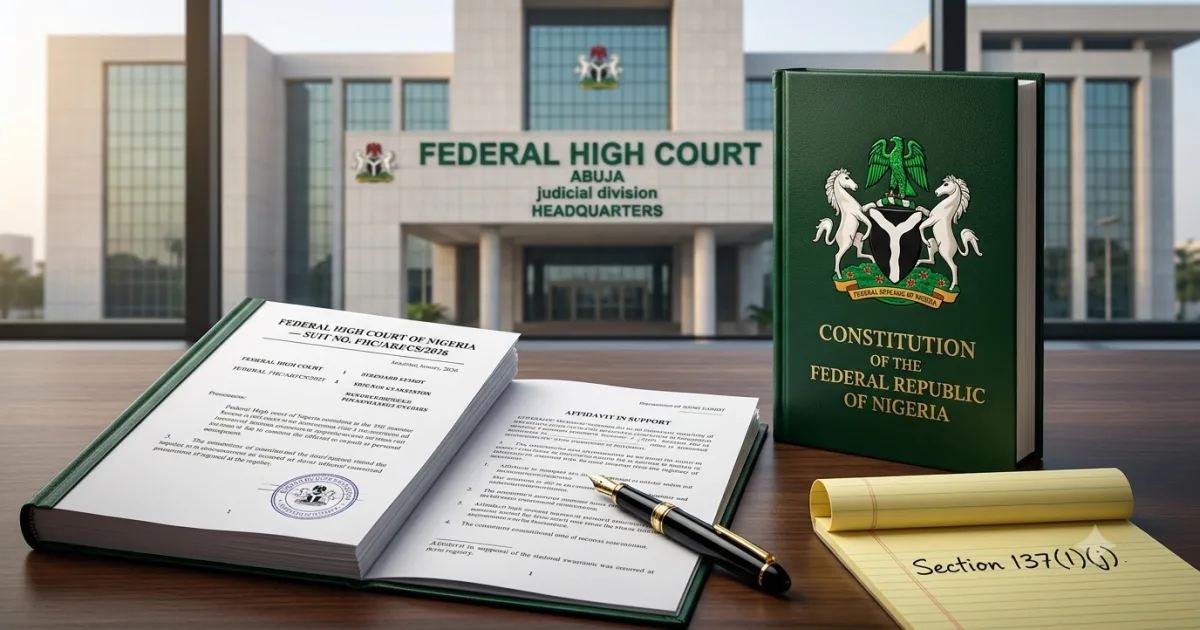
📌 Quick Summary: Former Vice President Atiku Abubakar personally appeared at the Federal High Court in Abuja on Friday 14 August 2026, filing a suit alongside the African Democratic Congress (ADC) seeking the disqualification of President Bola Tinubu from the 2027 presidential election over an allegedly forged NYSC discharge certificate. The case centres on Section 137(1)(j) of the 1999 Constitution. The defendants are Tinubu, the APC, and INEC. Here is the complete plain-language guide to what the case alleges, what the law says, and what it means for 2027.
On Friday 14 August 2026, Atiku Abubakar did something no 2023 presidential challenger did: he walked into the Federal High Court registry in Abuja himself, in person, and swore an affidavit to support a lawsuit against President Bola Tinubu. Atiku, the presidential candidate of the African Democratic Congress (ADC), filed the suit alongside the party. The All Progressives Congress (APC) and the Independent National Electoral Commission (INEC) are joined as defendants. The case challenges Tinubu’s qualification to contest the 2027 presidential election over alleged forgery of an NYSC certificate. It is the most significant pre-election legal challenge filed against a sitting Nigerian president ahead of a general election in recent memory — and it has divided Nigerian legal opinion, political opinion, and ordinary citizens in ways that will shape the political conversation through to February 2027.
The Atiku vs Tinubu Case: Key Facts
| Case Filed | Friday, 14 August 2026 |
| Court | Federal High Court, Abuja |
| Plaintiffs | Atiku Abubakar + African Democratic Congress (ADC) |
| Defendants | President Bola Tinubu, All Progressives Congress (APC), INEC |
| Core Allegation | Tinubu submitted a forged NYSC discharge certificate to INEC |
| Relief Sought | Disqualification of Tinubu and APC from 2027 presidential election |
| Constitutional Basis | Sections 137(1)(j), 139(1)(a)(i), 285(14)(c) of the 1999 Constitution |
| Additional Challenge | Electoral Act 2026 provisions restricting pre-election qualification challenges |
| Name Discrepancy | Certificate allegedly bears “Tinubu Bola Adekunle” vs President’s name “Bola Ahmed Tinubu” |
What Exactly Is Atiku Alleging?
The lawsuit rests on one central allegation and one secondary constitutional challenge.
The Central Allegation: The NYSC Certificate Name Discrepancy
According to the affidavit filed by Atiku, the disputed NYSC discharge certificate allegedly bears the name “Tinubu Bola Adekunle” instead of “Bola Ahmed Tinubu.” Atiku’s legal team argues that this name difference — between the certificate submitted to INEC and the President’s officially recognised name — establishes that the certificate either does not belong to the President or was falsified. Atiku put the question to the court directly: “If the certificate belongs to Bola Ahmed Tinubu, let that be established before the court. If ‘Tinubu Bola Adekunle’ and ‘Bola Ahmed Tinubu’ are one and the same person for the purpose of that certificate, let the evidence establish it.”
Atiku is also asking the court to compel INEC to produce Tinubu’s Form CF001 — the official candidate declaration form submitted for both the 2023 and 2027 presidential elections — so that the court can examine what documents were actually submitted.
The Secondary Challenge: The Electoral Act 2026
Beyond the certificate, Atiku and the ADC are also challenging aspects of the Electoral Act 2026, which they argue restricts pre-election challenges to a candidate’s qualification. They contend that no law can override the Constitution. Atiku said: “Can an Act of the National Assembly be used as a shield against an express provision of the Constitution?… Our position is that the Constitution remains supreme.” This is the more technically significant legal argument — because if the court agrees that the Electoral Act cannot restrict who can challenge a candidate’s qualification, it opens the door to a broader range of pre-election challenges by any party ahead of 2027.
What the Constitution Says: Section 137(1)(j) Explained
At the centre of the suit is Section 137(1)(j) of the Constitution, which provides that a person is not qualified to contest the presidency if they have presented a forged certificate to INEC. This provision is unambiguous: if it is established in court that a candidate submitted a forged certificate to INEC in connection with a presidential election, that candidate is constitutionally disqualified — regardless of whether they subsequently won the election or whether years have passed. The burden of the case therefore rests on Atiku establishing, through evidence, that: the NYSC certificate submitted is not genuine, and that Tinubu was responsible for its submission.
The History: Why This Case Is Not New — But Why It Is Different
The certificate controversy surrounding President Tinubu is not new. It dates to the 2023 election campaign, when multiple challengers raised questions about his academic and professional credentials. The 2023 presidential election petition — heard by the Presidential Election Petitions Court — admitted certified copies of Chicago State University, NYSC, and Mobil Nigeria certificates as evidence during proceedings. The Supreme Court ultimately upheld Tinubu’s election. None of those proceedings resulted in disqualification.
What makes the 2026 filing different is its timing and its framing. A Lagos-based PDP official published an open letter calling on party members to abandon Tinubu’s certificate controversy ahead of 2027, arguing that the certificate strategy has failed in court repeatedly since 1999 and is costing the opposition valuable ground. Atiku’s direct personal appearance — swearing an affidavit in person at the registry — is a deliberate signal that he is treating this case with personal seriousness, not delegating it to party lawyers. The framing as a pre-election challenge under the 2027 cycle is strategically different from the 2023 petition: it seeks disqualification before the election rather than after.
What the Presidency Has Said
The Presidency has not issued a detailed formal response to the specific case filing as of this publication. The APC has characterised the suit as politically motivated harassment designed to distract from the 2027 campaign rather than a genuine legal challenge. Tinubu’s legal team is expected to file a formal response in court within the prescribed procedural timeline.
What This Means for 2027: Four Scenarios
Scenario 1 — Court dismisses the case procedurally: The most likely outcome based on Nigerian pre-election litigation history. The court may find that the Electoral Act 2026 restrictions are valid, or that the case does not meet procedural requirements, and dismiss without going to the merits. Tinubu proceeds to 2027 unaffected by this case specifically.
Scenario 2 — Court upholds the Electoral Act challenge: If the court agrees that the Electoral Act 2026 cannot restrict pre-election qualification challenges, the constitutional argument becomes available to all opposition candidates — opening a new legal front in the 2027 campaign that goes beyond just Atiku and the certificate.
Scenario 3 — Court goes to the merits and orders INEC disclosure: If the court compels INEC to produce Form CF001 and the associated certificate records, the documents themselves become the story — regardless of the court’s ultimate ruling. Document disclosure in this case would generate enormous political and media attention.
Scenario 4 — Full disqualification: The least likely outcome in the Nigerian judicial context, given the 2023 precedents. Would require the court to make findings that directly contradict what the Supreme Court implicitly accepted in upholding the 2023 election. Theoretically possible; practically improbable given the established legal record.
Frequently Asked Questions
What is Atiku’s lawsuit against Tinubu about?
Atiku Abubakar has sued President Bola Tinubu at the Federal High Court in Abuja over alleged forgery of his NYSC discharge certificate, seeking his disqualification from the 2027 presidential election. The case also challenges Electoral Act 2026 provisions that restrict pre-election qualification challenges.
What is the name discrepancy in Tinubu’s NYSC certificate?
Atiku’s affidavit alleges the disputed NYSC discharge certificate bears the name “Tinubu Bola Adekunle” instead of the President’s name, “Bola Ahmed Tinubu.” Atiku argues the court should determine whether these names belong to the same person through evidence.
What law does Atiku’s case rely on?
The case relies primarily on Section 137(1)(j) of the 1999 Constitution, which disqualifies a presidential candidate who has presented a forged certificate to INEC. It also invokes Sections 139(1)(a)(i) and 285(14)(c), as well as provisions of the Electoral Act 2026.
Has Tinubu faced this certificate allegation before?
Yes — the certificate issue was raised during the 2023 election petition proceedings. The Presidential Election Petitions Court admitted certificate documents as evidence. The Supreme Court upheld Tinubu’s election. Atiku’s 2026 filing is a new pre-election challenge under the 2027 cycle, framed differently from the 2023 petition.
Can Atiku actually disqualify Tinubu from the 2027 election?
Legally possible under Section 137(1)(j) of the Constitution if the court finds the certificate was forged. Practically unlikely given the 2023 judicial precedents and Nigeria’s pre-election litigation history. The case is more likely to generate political pressure and document disclosure than an outright disqualification ruling.
Which court is hearing the Atiku vs Tinubu NYSC case?
The case was filed at the Federal High Court in Abuja on 14 August 2026. Atiku personally appeared at the registry and swore an affidavit in support of the suit.
Sources
- TheCable — “Atiku sues Tinubu over NYSC certificate forgery, seeks disqualification from 2027 election.” thecable.ng — 14 August 2026
- Tribune Online — “2027: Atiku drags Tinubu to Court over certificate.” tribuneonlineng.com — 14 August 2026
- Legit.ng — “Breaking: Atiku files suit to disqualify Tinubu from 2027 election.” legit.ng — 14 August 2026
- Lawyard — “Atiku Files Affidavit Challenging Tinubu’s Eligibility for 2027 Presidency.” lawyard.org — 14 August 2026
- Chronicle.ng — “2027: Atiku court disqualify Tinubu NYSC certificate.” chronicle.ng — 14 August 2026
Last updated: 22 August 2026 · NaijaSabi Civic Desk.
More From NaijaSabi Civic Desk
NaijaSabi tracks every development in Nigerian governance, law, politics and public policy with depth and honesty. From court filings to power infrastructure, from election results to constitutional questions — we cover every story that shapes Nigeria’s democratic life and your daily experience as a Nigerian. Bookmark naijasabi.com.ng/, subscribe to the Morning Brief newsletter trusted by 52,000+ daily readers, and return for updates as stories develop.





0 Comments
No comments yet. Be the first to share your thoughts!