




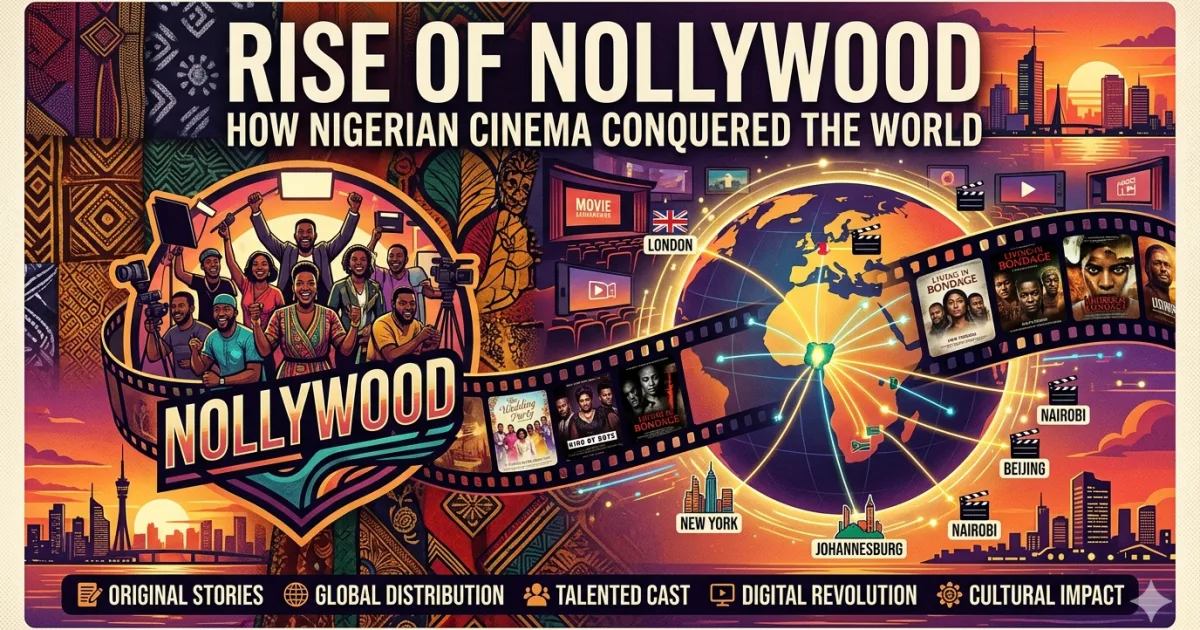
In 1992, a Lagos electronics trader named Kenneth Nnebue found himself with 60,000 unsold blank VHS cassettes and a simple idea: sell them pre-loaded with a film. The result was Living in Bondage — a low-budget, Igbo-language drama about a desperate man who joins a blood money cult and pays a terrible price. Filmed in days, distributed through street markets, and sold for less than the cost of a cinema ticket, it sold over 750,000 copies. Nigerian audiences had never seen themselves so clearly on screen, and they could not get enough.
That single moment — a blank tape, a VHS camera, and a story ripped from Nigerian life — was the accidental birth of the world’s most unlikely film industry. Three decades later, Nollywood is the second-largest film industry in the world by output, producing over 2,500 films per year, employing more than one million Nigerians, generating approximately $6.4 billion in annual revenue, and contributing meaningfully to Nigeria’s GDP. In 2025, Nigerian films beat Hollywood at Nigerian cinemas for the first time in recorded history. Nigerian stories are on Netflix, Amazon Prime, BBC Studios, and the Cannes Film Festival. The industry that started in a Lagos market stall has, against every conceivable odd, conquered the world.
This is the story of how it happened.
Nollywood by the Numbers: 2026 Snapshot
| Metric | Figure | Source / Context |
|---|---|---|
| Annual film output | 2,500+ films per year | Second highest in the world after Bollywood |
| Annual revenue (total) | ~$6.4 billion | Including all formats: cinema, streaming, home video, TV |
| Nigerian entertainment industry size (projected 2025) | $14.8 billion | NECLive / Statista; up from $4 billion in 2013 |
| GDP contribution | ~1.1% – 2.3% of Nigeria’s real GDP | NBS data; film + music + arts and entertainment combined |
| Direct jobs created | 1 million+ workers | Projected to reach 2.7 million by 2026 with digital expansion |
| 2025 domestic box office revenue | ₦15.64 billion (~$9.5M) | FilmOne / Comscore; +34.7% year-on-year |
| 2025 Nollywood market share (Nigeria) | 49.4% vs Hollywood’s 48.8% | First time Nollywood topped Hollywood in Nigerian cinemas |
| Cinema admissions 2025 | 2.8 million | +48% from 2024’s 1.9 million |
| Highest-grossing Nollywood film (all time) | Behind the Scenes — ₦1.32B (2025) | Funke Akindele / FilmOne; surpassed Everybody Loves Jenifa |
| International revenue (annual) | $100 million+ | UK, USA, Canada, Germany, Ireland diaspora markets |
| Target by 2030 (govt. “Destination 2030”) | $100 billion in creative exports | Nigerian government Creative Industry Financing Initiative (CIFI) |
Chapter 1: The Accidental Industry (1960s–1992)
Before Nollywood had a name, it had a spirit. Nigerian cinema began not in 1992 but in the 1960s, when pioneering filmmakers like Hubert Ogunde, Ola Balogun, Moses Olaiya, Jab Adu, and Eddie Ugboma began making Nigerian stories for Nigerian screens. These were celluloid films — proper cinema, screened in theatres — that focused on Nigerian history, mythology, and lived experience. Ogunde’s Yoruba-language films toured the region’s theatres like theatrical roadshows. Ola Balogun brought a more modernist sensibility, co-producing films with international partners. This first generation of Nigerian cinema had ambition, craft, and cultural resonance — but it reached limited audiences, constrained by the high cost of celluloid production and the limited theatre infrastructure of the time.
The 1980s brought a new medium: television. With the expansion of NTA (Nigerian Television Authority) and state broadcast networks, Nigerian storytelling found a new home. Soap operas and drama series like The Village Headmaster (1968), Cock Crow at Dawn (1980), and Mirror in the Sun (1983) reached audiences the cinema could never have served — in their homes, in their languages, reflecting their own realities. The appetite for Nigerian stories was immense. The infrastructure to serve it commercially, at scale, had not yet been invented.
Then came the VHS cassette — and Kenneth Nnebue.
Chapter 2: The VHS Revolution and the Birth of Nollywood (1992–2000)
Living in Bondage (1992) did not just start an industry — it defined its DNA. Produced for minimal cost, distributed through the informal market economy of Alaba International Market and Idumota in Lagos, and consumed with passionate intensity by audiences who saw their own moral universe reflected in its story of greed and spiritual consequence, it was the proof of concept for a new kind of cinema. The cassette format meant no cinemas were needed. No distributors. No studios. No international investors. A filmmaker needed a camera, a cast who would work for a credit, some money for tape and editing — and a story that Nigerians recognised as their own.
Within months, dozens of filmmakers had replicated the model. Within years, hundreds had. Lagos, then Onitsha, Aba, and Ibadan became production centres for a film industry that operated on entirely different terms from Hollywood, Bollywood, or any other model in the world. Films were shot in days — sometimes 72 to 96 hours — on consumer-grade cameras with no script revisions, minimal rehearsals, and budgets that would not cover a single Hollywood catering bill. What they lacked in production value they compensated for with raw narrative intensity: stories of juju and betrayal, love and loss, wealth and consequence, family and tradition — the real emotional vocabulary of Nigerian life.
By the late 1990s, Nollywood was producing more films per year than any country except India. The industry had no formal name yet — that would come later, courtesy of a 2002 New York Times article by journalist Norimitsu Onishi, who coined the term “Nollywood” by analogy with Hollywood and Bollywood. But the phenomenon already existed at full force. Nigerian films were sold at markets from Lagos to Accra, from Nairobi to Johannesburg, from London’s Dalston to New York’s Brooklyn. The African diaspora, hungry for stories from home, provided an early international market that had never been formally accounted for in any industry analysis.
Chapter 3: Growing Pains — Quality, Piracy, and the DVD Era (2000–2010)
By 2000, Nollywood’s extraordinary output had made it globally visible — but its reputation was split. On one side, industry champions celebrated the sheer democratic vitality of an industry that had invented itself without outside help. On the other, critics — both within and outside Nigeria — pointed to recurring quality problems: repetitive storylines, poor audio, inconsistent lighting, and a reliance on familiar horror and juju narratives that felt increasingly limiting. The volume was extraordinary; the craft, inconsistent.
The decade also brought a crisis that would reshape the industry’s economics: piracy. As cassettes gave way to DVDs and then to digital files, Nigerian films became trivially easy to copy and redistribute without the producer seeing a naira of revenue. The Alaba and Idumota markets — which had been Nollywood’s distribution backbone — became hotbeds of piracy, with counterfeit copies of new releases circulating within hours of the original going on sale. By 2015, the Nigerian film industry was estimated to be losing over ₦7.5 billion annually to piracy — roughly $46 million at the prevailing exchange rate. Filmmakers who had built careers on home video distribution found their business model collapsing under them.
But crises force innovation. As the home video market contracted under piracy pressure, a new generation of Nigerian filmmakers began looking toward the cinema — a distribution channel that piracy could not easily penetrate. The expansion of multiplex cinema chains — Silverbird Cinemas (founded 2004), Genesis Deluxe Cinemas, and later FilmOne Entertainment and Filmhouse Cinemas — began creating the infrastructure for a theatrical Nollywood that would become the industry’s commercial engine. The shift from home video to cinema was not just commercial. It changed what kind of films got made.
Chapter 4: New Nollywood — Cinema, Ambition, and Global Quality (2010–2018)
The term “New Nollywood” was coined around 2010 to describe a generation of filmmakers who brought a different set of ambitions to Nigerian cinema: higher budgets, professional crews, international production standards, and stories crafted for a cinemagoing audience rather than a home video viewer. These were directors and producers trained at film schools — in Nigeria, in the UK, in the United States — who understood both the craft and commerce of cinema at a global level.
The Filmmakers Who Changed Everything
| Filmmaker / Company | Key Contribution | Landmark Work |
|---|---|---|
| Kunle Afolayan | Redefined production values in Yoruba-language cinema; brought cinematic craft to indigenous stories | The Figurine (2009), Phone Swap (2012), October 1 (2014), Citation (2020) |
| Kemi Adetiba | Master of high-concept commercial cinema; Lagos wealth and crime aesthetics | The Wedding Party (2016), King of Boys (2018, 2021) |
| Funke Akindele | Transformed herself from actress to Nigeria’s highest-grossing producer-director; three consecutive billion-naira films | A Trip to Jamaica (2016), Omo Ghetto (2020), Everybody Loves Jenifa (2024), Behind the Scenes (2025) |
| EbonyLife Films / Mo Abudu | First Nigerian producer to partner with Netflix and BBC Studios; elevated international co-production | Fifty (2015), The Wedding Party (2016), Death and the King’s Horseman (Netflix, 2023) |
| FilmOne Entertainment | Built Nigeria’s leading cinema distribution infrastructure; co-produced the ELFIKE Film Collective slate | The Wedding Party, Nnebe, Ile Owo |
| Muyiwa Ademola | Proved Yoruba-language cinema can dominate theatrical charts; cultural depth over commercial compromise | Ori (2004), Ori: The Rebirth (2025) — highest-grossing indigenous film ever |
| Niyi Akinmolayan | Technical sophistication and narrative maturity; one of Nigeria’s most respected writer-directors | The CEO (2016), Elevator Baby (2019), My Mother Is a Witch (2025) |
| Biodun Stephen | Female-led storytelling; strong cultural and commercial sensibility | Charge and Bail (2020), Labake Olododo (2025) |
| Toyin Abraham | Actor turned director; mass-market instinct + cultural authenticity; made directorial debut with ₦480M hit | Omo Ghetto (2020), Iyalode (2025), Oversabi Aunty (2025) |
| Kayode Kasum | Most commercially consistent director of the new generation; every major release a certified hit | Sugar Rush (2019), Reel Love (2025) |
The landmark film of this era was The Wedding Party (2016) — co-produced by EbonyLife Films and FilmOne Entertainment, directed by Kemi Adetiba, and featuring an all-star cast including Adesua Etomi, Banky W, Richard Mofe-Damijo, and Sola Sobowale. It became the highest-grossing Nigerian film at the time of release, demonstrating conclusively that Nigerians would pay cinema prices for a properly made, culturally authentic Nigerian story. The film was internationally distributed, screened in the United Kingdom and the United States, and entered the Netflix catalogue — becoming one of the first Nollywood films to be treated by an international streaming platform as a genuine library title rather than a novelty acquisition.
The Wedding Party was also the moment that the word “Nollywood” began to shed its association with low quality in international media coverage. If a film this polished, this funny, and this Nigerian could come from Lagos — what else was possible?
Chapter 5: The Streaming Revolution — Netflix, Amazon, and the Global Audience (2018–2023)
When Netflix launched in Nigeria in January 2016 as part of its global expansion to 130 countries simultaneously, few people predicted how transformative its presence would be for Nollywood. The platform was initially cautious — licensing existing titles from Nigerian studios rather than commissioning originals. But as Nigerian content began performing disproportionately well with diaspora audiences in the United States, United Kingdom, France, Canada, and Germany, the platform’s data made an unmistakable argument: Nigerian stories had a global audience that the industry had never been able to fully serve.
The acceleration came in 2019–2021. Netflix signed a landmark production deal with EbonyLife Films — Mo Abudu’s Lagos-based production house — for a slate of original Nigerian dramas. Amazon Prime Video, simultaneously building its African content library, followed with exclusive deals with major Nigerian studios. The BBC expanded its Africa content partnerships. For Nigerian filmmakers, the arrival of streaming giants meant two transformational things: access to production budgets that made cinematic quality achievable at scale, and access to global distribution that made the Nigerian diaspora (and curious international audiences) a commercially significant market for the first time.
The titles that emerged from this period remain benchmark achievements in Nollywood’s history:
| Film / Series | Platform | Year | Significance |
|---|---|---|---|
| Lionheart | Netflix Original | 2018 | First Netflix Original from Nigeria; Genevieve Nnaji directs and stars; submitted for Oscar consideration |
| Oloture | Netflix | 2020 | Bold investigative drama on sex trafficking; Mercury Filmworks + EbonyLife co-production; international attention |
| Fate of Alakada | Netflix | 2020 | Toyin Abraham; comedy; strong Netflix Nigeria performance |
| Jagun Jagun | Netflix | 2023 | Yoruba epic; record 14 million Netflix views in 3 days; demonstrated scale of global appetite for Nigerian historical drama |
| A Tribe Called Judah | Netflix Original | 2023 | Funke Akindele; crime drama; one of the most-watched Nigerian titles in Netflix history |
| Shanty Town | Netflix | 2023 | Hilda Dokubo; gritty Lagos drama; strong diaspora performance |
| Death and the King’s Horseman | Netflix | 2023 | Wole Soyinka adaptation; EbonyLife Films; global literary prestige milestone for Nollywood |
| Behind the Scenes | Netflix | 2026 (Apr 3) | Funke Akindele; highest-grossing Nigerian film ever (₦1.32B theatrical); arrived on Netflix April 3, 2026 |
Jagun Jagun — the 2023 Yoruba-language epic directed by Tope Adebayo Salami and Niyi Akinmolayan and starring Femi Adebayo — was arguably the single most significant data point in Nollywood’s global argument. Fourteen million Netflix views in its first three days, driven by diaspora excitement, TikTok clips, and word of mouth from Nigerians around the world. It was not just the scale of the number that mattered — it was what it told streaming platforms about the audience for Nigerian stories globally. After Jagun Jagun, the conversation in international entertainment about Nollywood changed permanently.
Chapter 6: The Historic Milestone — Nollywood Beats Hollywood (2024–2025)
The data point that will define this era of Nollywood’s history arrived in two consecutive years. In 2024, for the first time, Nigerian films earned over 50% of domestic box office revenue in Nigeria — beating Hollywood imports. Then, in 2025, the margin became official and incontrovertible: Nollywood held 49.4% market share against Hollywood’s 48.8%, with total Nigerian box office revenue reaching a record-breaking ₦15.64 billion — a 34.7% jump from 2024’s ₦11.58 billion. Cinema admissions reached 2.8 million people, up 48% from the year before.
Consider what this means in context. In 2022, Hollywood held 69% of Nigeria’s box office revenue, with Nollywood at 30%. In 2023, Nollywood crossed 40%. In 2024, it crossed 50%. In 2025, it crossed 49.4% of a much larger total pie. The trend is not cyclical — it is structural. Nigerian audiences are making a deliberate, sustained, year-on-year choice to watch their own stories over imported ones. And the stories that Nollywood is now offering them are good enough to justify that choice at cinema ticket prices of ₦2,500 to ₦5,000.
📊 Nigerian Box Office Market Share: The Historic Reversal
| Year | Nollywood Share | Hollywood Share | Total Revenue |
|---|---|---|---|
| 2022 | ~30% | ~69% | ~₦7 billion |
| 2023 | ~40% | ~57% | ₦7.2 billion |
| 2024 | ~50%+ | ~48% | ₦11.58 billion |
| 2025 | 49.4% | 48.8% | ₦15.64 billion (record) |
The engine of this reversal was a generation of filmmakers — led by Funke Akindele, Toyin Abraham, Muyiwa Ademola, Yemi Morafa, Kayode Kasum, and Biodun Stephen — who understood the Nigerian cinema audience in ways their predecessors did not. They understood that Nigerians watch films in community — as social events — and so stories that generate communal emotion (humour, recognition, cultural pride, love) outperform individual prestige projects. They understood that the December holiday window, the Easter weekend, the Eid El Kabir period, and the Workers’ Day long weekend are commercial opportunities equivalent to the American summer blockbuster season. And they understood that authenticity — stories that could only be Nigerian — is not a limitation but a competitive advantage.
Chapter 7: Nollywood Goes to Cannes — Global Critical Recognition (2025)
Commercial dominance is one kind of arrival. Critical recognition is another. In 2025, Nollywood achieved both simultaneously — and the critical milestone was in some ways the more symbolically significant. My Father’s Shadow became the first Nigerian film to be selected in the official section of the Cannes Film Festival — one of cinema’s most prestigious gatekeeping institutions, whose official selection is a global statement of artistic merit that no marketing budget can manufacture.
Its mere selection at Cannes generated $2.5 million in pre-festival international distribution deals — a direct commercial translation of critical prestige into financial value. It signalled to European and North American distributors that Nigerian cinema was no longer an acquired taste for diaspora audiences but a legitimate participant in the global auteur tradition. Nigerian films have always told great stories. Cannes 2025 was the moment the world’s most influential film gatekeepers formally agreed.
At AFRIFF 2025 (the Africa International Film Festival), Nwamaka Chikezie’s To Adaego With Love — a post-war romance set in Eastern Nigeria — won both Best Film and Best Writing, and the festival introduced a dedicated film market for the first time: a business-to-business event where rights holders, international distributors, and streaming platform commissioners could transact directly. This structural development — moving from “festival” to “film market” — is one of the most consequential steps Nollywood can take toward sustainable international commercial scale.
Chapter 8: The Streaming Wars — New Platforms, New Power (2025–2026)
By 2025, the streaming landscape for Nollywood had become significantly more complex — and more interesting. The early phase of Netflix and Amazon as generous commissioning partners willing to fund high-budget Nigerian originals had given way to a more selective, licensing-focused approach from the global giants, driven by concerns about Nigeria’s low streaming penetration rate. Despite being Africa’s most populous nation, Netflix had approximately 169,000 subscribers in Nigeria as of 2025 — a penetration rate far below expectations for a market of 220 million people. The primary driver was cost: ₦2,200 per month is a meaningful expense against Nigeria’s prevailing incomes, particularly for middle-class consumers managing economic pressure from inflation and currency depreciation.
This gap between Nigeria’s enormous cultural appetite for Nollywood content and its limited willingness to pay subscription prices drove a wave of indigenous platform building that may prove the most strategically significant development in the industry’s history:
| Platform | Launch / Development | Model | Key Content |
|---|---|---|---|
| Kava | Launched August 2025 (Filmhouse x Inkblot Studios) | Subscription + TVOD (transactional) | Alakada: Bad and Boujee, Owambe Thieves, 30+ premium titles |
| EbonyLife ON Plus | Launched November 2025 (Mo Abudu / EbonyLife) | Subscription | EbonyLife originals, lifestyle content, masterclasses |
| Circuit | 2024–2025 | Pay-per-view + short-term access (flexible pricing) | Nollywood catalogue; gaining traction among non-subscribers |
| KAP Stream (YouTube) | Launched 2025 (Kunle Afolayan) | Ad-supported (free) | Kunle Afolayan’s filmography; new releases |
| iROKOtv | Founded 2012 (Jason Njoku) — continuing evolution | Subscription + ad-supported | Largest dedicated Nollywood VOD catalogue |
| Showmax | MultiChoice (ongoing) | Subscription (DStv integration) | Mixed African + international; strong Nigerian catalogue |
| YouTube | Ongoing | Ad-supported | Omoni Oboli’s Love in Every Word: 20M+ views in 3 months; long-tail distribution |
The most sophisticated filmmakers have responded to this fragmented landscape with hybrid distribution strategies: theatrical window first (cinema remains the premium commercial event that drives buzz and licensing value), followed by a streaming licence window (selling to the highest bidder among competing platforms), followed by a YouTube release for long-tail ad revenue. This layered approach — which mirrors how Hollywood manages its own distribution windows — reflects a commercial maturity that Nollywood did not have a decade ago. The filmmaker who in 2010 had to sell their DVD to Alaba market and hope it was not pirated can now, in 2026, plan a 12-month revenue roadmap across multiple monetisation channels.
Chapter 9: The Nollywood Economy — Jobs, GDP, and the Creative Sector
Nollywood is not just an entertainment business — it is a significant component of Nigeria’s national economy. The data from Nigeria’s National Bureau of Statistics (NBS) is unambiguous: the arts, entertainment, and recreation sector grew by 4.74% in Q3 2024, accelerating from 0.29% in Q3 2023. Nollywood contributed ₦728.80 billion to GDP in Q1 2024 — up from ₦576.67 billion in Q1 2023 and ₦382.37 billion in Q2 2023. That represents 152.79% growth over the decade in the broader creative sector.
The industry directly employs over one million Nigerians — from producers, directors, and actors to cinematographers, makeup artists, costume designers, location managers, catering companies, transport operators, and post-production technicians. This employment figure is projected to reach 2.7 million by 2026 as digital platforms expand the volume of content required and the production infrastructure becomes more sophisticated. Beyond direct employment, Nollywood generates enormous indirect economic activity: the hotel stays and location fees when a film crew descends on a town, the fashion industry engagement when a film launches a costume trend, the music industry revenue when a song is synced to a film’s soundtrack.
The Nigerian government has recognised this potential with the Creative Industry Financing Initiative (CIFI) — a low-interest loan programme administered through the Bank of Industry (BOI) and Central Bank of Nigeria (CBN) that provides accessible capital to filmmakers, musicians, and other creative sector practitioners who would not qualify for conventional commercial loans. The programme has disbursed billions of naira to the sector, with Nollywood productions among the primary beneficiaries. Nigeria’s broader Destination 2030 plan targets $100 billion in creative exports — an ambitious figure that places Nollywood’s global expansion at the centre of national economic strategy.
Chapter 10: Nollywood’s Global Footprint — The Diaspora and Beyond
One of Nollywood’s most under-told stories is its diaspora market. Nigerian films do not just reach Nigeria — they reach the estimated 17 million Nigerians living outside the country, from London’s Peckham and Woolwich to New York’s Flatbush and Bronx, from Houston’s Missouri City to Toronto’s Brampton. The Nigerian diaspora is one of the most economically active overseas communities in the world, with remittances to Nigeria consistently exceeding $20 billion per year. And this diaspora does not just send money home — it consumes Nigerian culture with an intensity that makes it one of the most commercially attractive media audiences on the planet.
Nollywood films now receive theatrical releases in the United Kingdom, Ireland, the United States, Canada, Germany, and Norway — markets where Nigerian diaspora populations are large enough and engaged enough to drive meaningful box office revenues. Funke Akindele’s Everybody Loves Jenifa (2024) earned $100,000 in its opening weekend across the UK, Germany, Ireland, Canada, Norway, the United States, Australia, Sweden, and New Zealand — from diaspora theatres that are now a standard commercial component of major Nollywood releases. Behind the Scenes (2025) was similarly distributed internationally, and its arrival on Netflix in April 2026 will extend its reach to every country where the platform operates.
Beyond the Nigerian diaspora, Nollywood has a broader Pan-African audience. Nigerian films have been consumed across Sub-Saharan Africa since the VHS era — they resonated with Ghanaian, Kenyan, Ugandan, Cameroonian, and South African audiences who found in Nigerian stories a cultural familiarity that their own national film industries could not always provide. This Pan-African audience is now accessible through streaming platforms in ways that the VHS and DVD market never fully captured, and it represents one of the most significant untapped revenue opportunities for Nollywood’s commercial expansion.
The Challenges That Remain
Nollywood’s success story would be incomplete without acknowledging the structural challenges that continue to constrain the industry’s potential:
Piracy
Despite the Nigerian Copyright Act of 2022 — which introduced explicit protections for digital content, stringent penalties, and the ability for rights holders to request ISP blocks on infringing sites — piracy remains the industry’s most persistent economic wound. Estimates suggest that Nigerian filmmakers lose up to 40% of potential revenue to piracy annually. As films move from physical to digital distribution, piracy has followed them: illegal streaming sites, WhatsApp group file sharing, and unauthorised YouTube uploads remain significant problems. The shift to cinema-first distribution and premium streaming has partially mitigated this, but the home entertainment piracy problem is far from solved.
Production Financing
Despite the CIFI programme, access to production finance remains a major constraint for independent Nigerian filmmakers. Nigeria’s commercial banking sector does not consistently treat creative industry projects as bankable assets — film productions without pre-sales, streaming commitments, or significant personal collateral struggle to secure conventional loans. The result is a financing gap that concentrates production resources among a small number of established names (Funke Akindele, Inkblot Studios, EbonyLife) while emerging voices struggle to raise budgets that match their ambitions. Closing this financing gap — through dedicated creative industry funds, co-production treaties with international partners, and more structured pre-sales markets — is one of the most important infrastructure tasks facing the industry.
Cinema Infrastructure
Nigeria has approximately 120–130 cinema screens for a population of over 220 million people — a ratio of roughly one screen per 1.7 million people. The United States, by comparison, has roughly one screen per 8,000 people. This infrastructure gap means that even record-breaking films like Behind the Scenes are constrained in the audiences they can reach theatrically. Lagos accounts for over 53% of Nigeria’s entire box office revenue — a concentration that reflects the uneven distribution of cinema infrastructure across the country. Expanding cinema into Onitsha, Kano, Ibadan, Port Harcourt, Kaduna, and dozens of other major Nigerian cities is one of the highest-priority investments for the industry’s long-term growth. The CEAN (Cinema Exhibitors Association of Nigeria) president Ope Ajayi has projected that Nigerian box office revenue could reach ₦50 billion within four years if cinema infrastructure expands at the right pace.
Streaming Penetration
Nigeria’s Netflix subscription rate of approximately 169,000 in a population of 220 million reflects not a lack of interest in Nigerian content but the economic reality that subscription pricing is inaccessible for a large portion of the population. Solving this requires pricing innovation — circuit’s pay-per-view model and short-term access packages are early experiments — alongside broader economic conditions that expand disposable income. Until Nigeria’s streaming penetration rates increase substantially, the most commercially significant digital distribution channel for Nollywood will remain YouTube (ad-supported and free), not subscription streaming.
Nollywood vs. The World: How Nigeria Compares to Global Film Industries
| Industry | Country | Annual Output | Annual Revenue | Global Reach |
|---|---|---|---|---|
| Bollywood | India | ~2,000 films/year | ~$2.5B domestic | South Asia, Middle East, diaspora worldwide |
| Nollywood | Nigeria | 2,500+ films/year | ~$6.4B total | Sub-Saharan Africa, global diaspora, Netflix |
| Hollywood | USA | ~700–800 major films/year | ~$40B+ globally | Global — dominant in all English-language markets |
| Chinese cinema | China | ~1,000 films/year | ~$7B domestic | Strong domestically; limited international reach outside diaspora |
| French cinema | France | ~300 films/year | ~$1.5B domestic | Francophone world; prestigious international distribution |
By annual film output, Nollywood is number one in the world — producing more films per year than any other national cinema, including Hollywood and Bollywood. By revenue, it sits in a strong position relative to its production volume, with approximately $6.4 billion in total annual revenue — though this figure includes all formats (cinema, streaming, home video, broadcast) and should be compared to Hollywood’s similarly all-inclusive figures with caution. The critical distinction is market penetration: Hollywood distributes its content to virtually every country on earth with commercial infrastructure, while Nollywood’s primary commercial markets remain Nigeria, the African continent, and the Nigerian diaspora. Closing that gap — reaching general global audiences rather than primarily diaspora ones — is the commercial frontier that the next decade of Nollywood development must address.
Frequently Asked Questions
What is Nollywood and why is it called that?
Nollywood is the informal name for Nigeria’s film industry — coined in a 2002 New York Times article by journalist Norimitsu Onishi, who blended “Nigeria” and “Hollywood” by analogy with India’s “Bollywood.” The name stuck and is now the global standard term for Nigerian cinema. It is based primarily in Lagos, with significant production activity in Enugu (sometimes called “Asaba Nollywood” or “Igbo Nollywood”), Ibadan, and Abuja. By annual film output, it is the world’s second-largest film industry after Bollywood and produces over 2,500 films per year.
When did Nollywood start?
The modern Nollywood industry — defined by its VHS-distributed, low-budget, high-volume model — is conventionally dated to 1992, when Kenneth Nnebue produced Living in Bondage on VHS tape and distributed it through Lagos’s informal markets. The film sold over 750,000 copies and inspired the direct-to-video model that defined the first 15 years of Nollywood’s existence. However, Nigerian cinema has a longer history: pioneering filmmakers like Hubert Ogunde, Ola Balogun, and Eddie Ugboma were making Nigerian films in the 1960s and 1970s, and Nigerian television drama dates to the same era.
How big is Nollywood’s contribution to Nigeria’s GDP?
Nollywood contributes approximately 1.1% to 2.3% of Nigeria’s real GDP depending on the measurement methodology used. The NBS data shows that the arts, entertainment, and recreation sector contributed ₦728.80 billion to GDP in Q1 2024 alone — up 26% from ₦576.67 billion in Q1 2023 and representing 152.79% growth over the decade. The Nigerian entertainment industry as a whole (film plus music plus related creative sectors) is projected at $14.82 billion in 2025, up from $4 billion in 2013.
Is Nollywood bigger than Hollywood?
By annual film output, Nollywood (2,500+ films/year) surpasses Hollywood and is second only to Bollywood globally. By revenue, Hollywood remains significantly larger: Hollywood generates $40 billion+ in global box office alone, while Nollywood’s total revenue across all formats is approximately $6.4 billion. However, in Nigeria itself — the most important metric — Nollywood beat Hollywood at the box office for the first time in 2024 and repeated the feat in 2025 with a 49.4% vs 48.8% market share advantage. In that specific, essential market, Nollywood has arrived at parity and exceeded it.
Who are the most successful Nollywood directors?
By commercial box office performance, Funke Akindele is Nigeria’s most successful filmmaker — her last three major releases have each set or broken the all-time Nollywood box office record, with Behind the Scenes (2025) reaching ₦1.32 billion. Toyin Abraham had an exceptional 2025 with Iyalode and Oversabi Aunty collectively grossing nearly ₦790 million. Kemi Adetiba (King of Boys, The Wedding Party) is widely regarded as the most technically accomplished commercial director. Muyiwa Ademola made the highest-grossing indigenous (Yoruba-language) film of all time with Ori: The Rebirth. Kunle Afolayan remains the most cinematically serious auteur in Nigerian cinema, with a body of work that consistently challenges and elevates the form.
Which Nollywood films are on Netflix?
Netflix’s Nollywood catalogue includes both licensed titles and originals. Key titles available as of early 2026 include: Behind the Scenes (Funke Akindele, from April 3, 2026), A Tribe Called Judah (Funke Akindele, 2023 Netflix Original), Jagun Jagun (2023), Shanty Town (2023), Death and the King’s Horseman (EbonyLife, 2023), Oloture (2020), Lionheart (Genevieve Nnaji, 2018 — Netflix’s first Nigerian Original), The Wedding Party (2016), and dozens of additional titles in the general African catalogue.
What is the highest-grossing Nollywood film of all time?
As of early 2026, Behind the Scenes — produced and co-directed by Funke Akindele, released December 12, 2025 — is the highest-grossing Nollywood film at the Nigerian box office of all time, with a theatrical gross of ₦1.32 billion. It surpassed Everybody Loves Jenifa (₦1.07 billion, 2024, also produced by Funke Akindele) and reached ₦1 billion in just 19 days — the fastest any Nigerian film has ever achieved that milestone. By the time it arrived on Netflix in April 2026, its total earnings including international distribution had surpassed the theatrical figure significantly.
The Road Ahead: What Comes Next for Nollywood
The next chapter of Nollywood’s story is already being written — and its defining themes are clear. Infrastructure expansion: more cinemas in more Nigerian cities to capture the appetite that record admissions figures are proving exists far beyond Lagos. Financing innovation: structured co-production treaties, dedicated creative industry funds, and a functioning film market at AFRIFF and other Nigerian festivals that allows rights pre-sales before cameras roll. International distribution: moving beyond diaspora markets to general audiences in Europe, North America, and Asia who are discovering African stories through streaming and social media. Platform building: Nigerian-owned streaming platforms — Kava, EbonyLife ON Plus, Circuit — developing the commercial scale to match international platforms on their own terms. Continued quality escalation: the generation of filmmakers now in their 30s and 40s who are producing films good enough for Cannes, good enough for global streaming, and good enough to beat Hollywood at home are not done. They are just beginning.
And through all of it, the DNA of Living in Bondage endures: Nigerian stories, told by Nigerians, for Nigerians first — and resonating with the world because authentic human experience, wherever it originates, is universal. Kenneth Nnebue did not know, in 1992, that he was starting a global industry with 60,000 unsold cassettes and a story about greed and consequence. Nollywood has spent three decades proving that he did.
🎬 The Rise of Nollywood: Key Milestones at a Glance
- 1992 — Living in Bondage starts Nollywood on VHS; sells 750,000 copies
- 2002 — New York Times coins the name “Nollywood”
- 2004 — Silverbird Cinemas opens; cinema era begins
- 2009–2016 — New Nollywood rises: Kunle Afolayan, Kemi Adetiba, EbonyLife
- 2016 — The Wedding Party becomes highest-grossing Nigerian film; Netflix launches in Nigeria
- 2018 — Lionheart: first Netflix Nigerian Original; Kemi Adetiba’s King of Boys premieres
- 2019 — Netflix signs EbonyLife for original drama slate
- 2023 — Jagun Jagun: 14M Netflix views in 3 days; global appetite confirmed
- 2024 — Nollywood tops 50% Nigerian box office share for the first time ever
- 2025 — ₦15.64B record box office; 49.4% market share beats Hollywood; My Father’s Shadow goes to Cannes; Behind the Scenes hits ₦1.32B — new all-time record
- 2026 — Behind the Scenes arrives on Netflix; Kava and EbonyLife ON Plus launch indigenous streaming competition; Nigeria targets $100B in creative exports by 2030
What is your favourite Nollywood film of all time, and which filmmaker do you think will define the next decade of Nigerian cinema? Share your thoughts in the comments below. For more on the films making this history, read our full guide to the Best Nollywood Movies of 2025 — and for the music that soundtracks the culture, our Top Afrobeats Songs and Albums of 2025.



0 Comments
No comments yet. Be the first to share your thoughts!