




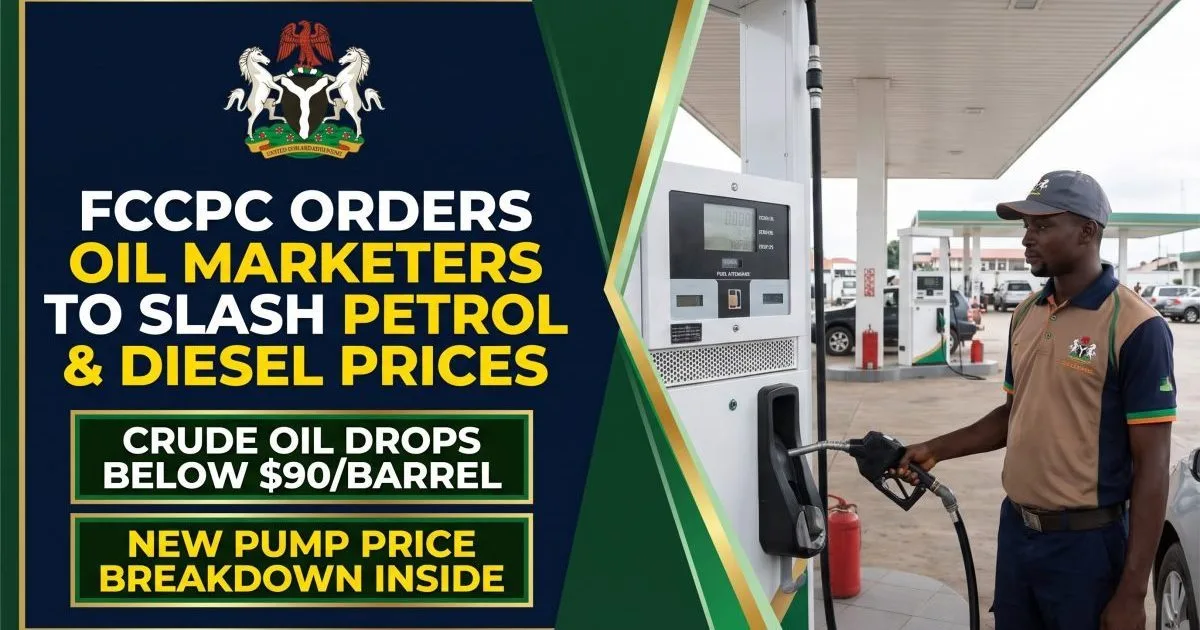
Key Takeaways: FCCPC Directive on Petrol (PMS) & Diesel (AGO) Pump Prices
- Urgent Federal Regulatory Warning: The Federal Competition and Consumer Protection Commission (FCCPC), led by Executive Vice Chairman/CEO Mr. Tunji Bello, has ordered petroleum marketers across Nigeria to immediately reduce retail pump prices of Premium Motor Spirit (PMS/petrol) and Automotive Gas Oil (AGO/diesel).
- Why Prices Must Drop Now: International benchmark Brent crude oil prices have fallen sharply from around $115 per barrel in September to below $90 per barrel on global energy markets, significantly lowering coastal landing costs and local ex-depot refinery prices.
- Ending “Rocket and Feather” Price Gouging: The FCCPC accused downstream marketers of raising pump prices within hours whenever global crude spikes (“going up like a rocket”), while refusing to lower retail prices weeks after crude oil and depot rates fall (“coming down like a feather”).
- Strict Anti-Cartel Enforcement Under the FCCPA: Under Sections 17, 107, and 108 of the Federal Competition and Consumer Protection Act (FCCPA) 2018, coordinated price-fixing by marketer associations or trade unions to keep fuel prices artificially high is a federal offence punishable by heavy fines up to 10% of annual turnover.
- Nationwide Station Monitoring Deployed: FCCPC state and zonal enforcement teams have commenced joint surveillance across Lagos, Abuja, Port Harcourt, Kano, Ibadan, and other major cities to sanction filling stations engaging in coordinated price manipulation or meter tampering.
For millions of Nigerian motorists, commercial transport operators, small business owners, and households who have endured punishing transportation and energy costs over the past several months, the Federal Competition and Consumer Protection Commission (FCCPC) has drawn a firm regulatory line in the sand. In an official directive issued by the Commission’s Executive Vice Chairman and Chief Executive Officer, Mr. Tunji Bello, the federal consumer watchdog warned major and independent petroleum marketers to immediately adjust their retail filling station pump prices downward to reflect the steep decline in global crude oil prices.
The regulatory intervention follows a dramatic shift in international energy benchmarks. After surging to roughly $115 per barrel in September—which oil marketers quickly used as justification to hike petrol (PMS) and diesel (AGO) prices across the country—benchmark Brent crude oil has tumbled to below $90 per barrel. Despite this substantial drop in raw feedstock and imported product landing costs, as well as downward ex-depot adjustments by domestic refiners, thousands of retail filling stations across Nigeria have stubbornly kept their digital pump displays locked at peak September rates.
Why does a deregulated downstream petroleum market still fall under the policing power of the FCCPC? How much should petrol and diesel prices realistically drop across Nigeria’s six geopolitical zones when crude oil falls by more than $25 per barrel? And how can everyday Nigerians report filling stations guilty of cartel price-fixing or pump under-dispensing? This comprehensive guide breaks down the full legal, economic, and consumer realities of the FCCPC directive.
Table of Contents
- Executive Summary Table: FCCPC Fuel Price Directive & Crude Oil Benchmark Shift
- Inside Tunji Bello’s Directive: Why the FCCPC Confronted Oil Marketers
- From $115 to Below $90/Barrel: How Global Crude Drops Lower Nigerian Depot & Landing Costs
- The “Rocket and Feather” Syndrome: Why Nigerian Pump Prices Rise Instantly But Fall Slowly
- Expected Petrol (PMS) & Diesel (AGO) Price Adjustments Across Nigerian Zones
- Deregulation Does Not Mean Cartel Price-Fixing: What Sections 107 & 108 of the FCCPA Say
- The “Old Stock” Argument Examined: How Long Does Tank-Farm Inventory Actually Last?
- Role of Dangote Refinery, NNPCL Retail & Modular Refineries in Forcing Prices Down
- How Lower Petrol & Diesel Prices Impact Transport Fares, Haulage & Food Inflation
- Consumer Action Guide: How to Report Price Gouging & Under-Dispensing Fuel Stations to FCCPC
- Permanent Protection Against Crude Oil Swings: Switching to ₦230/SCM Compressed Natural Gas (CNG)
- Frequently Asked Questions (FAQs)
1. Executive Summary Table: FCCPC Fuel Price Directive & Crude Oil Benchmark Shift
Examine the core economic and regulatory facts driving the Federal Competition and Consumer Protection Commission’s crackdown on retail fuel pricing across Nigeria:
| Regulatory / Market Metric | Official Verified Details (November 2026) |
|---|---|
| Enforcing Federal Agency | Federal Competition and Consumer Protection Commission (FCCPC) |
| Executive Vice Chairman / CEO | Mr. Olatunji Bello (Tunji Bello) |
| Peak Crude Benchmark (Sept 2026) | Approximately $115 per barrel (triggered immediate nationwide pump price hikes) |
| Current Crude Benchmark (Nov 2026) | Dropped below $90 per barrel (>21% drop in global crude feedstock cost) |
| Targeted Downstream Operators | Major Oil Marketers (MEMAN), Independent Petroleum Marketers (IPMAN), Depot Owners (DAPPMAN) & Retail Filling Stations |
| Covered Petroleum Products | Premium Motor Spirit (PMS / Petrol) and Automotive Gas Oil (AGO / Diesel) |
| Statutory Legal Authority | Sections 17, 107, 108 & 127 of the FCCPA 2018 and Section 207 of the Petroleum Industry Act (PIA) 2021 |
| Penalty for Cartel Price-Fixing | Administrative penalties up to 10% of annual corporate turnover + director prosecution |
2. Inside Tunji Bello’s Directive: Why the FCCPC Confronted Oil Marketers
In its official statement released in Abuja, the Federal Competition and Consumer Protection Commission expressed deep concern over the refusal of downstream petroleum marketers to pass the benefits of falling international oil prices on to Nigerian consumers.
According to FCCPC Executive Vice Chairman Mr. Tunji Bello, when international crude oil prices climbed toward $115 per barrel in September, oil marketers across Nigeria wasted zero time in adjusting their filling station pumps upward—citing replacement costs, international Platts benchmarks, and Naira-to-Dollar exchange dynamics. Consumers across Lagos, Abuja, Port Harcourt, Kano, and Enugu watched pump prices jump overnight, even for fuel stock that was already sitting inside underground station tanks weeks before crude prices rose.
Yet now that international crude prices have retreated sharply to below $90 per barrel—accompanied by corresponding reductions in wholesale ex-depot gantry prices and imported coastal landing costs—retail marketers have maintained artificially inflated pump prices, pocketing abnormal windfall margins at the expense of struggling commuters and businesses.
3. From $115 to Below $90/Barrel: How Global Crude Drops Lower Nigerian Depot & Landing Costs
To understand why the FCCPC is insisting on an immediate downward review of retail petrol and diesel prices, look at the three core cost components that determine a litre of fuel in Nigeria’s deregulated downstream sector:
- Crude Oil Feedstock & International Refined Platts Quotes (75%–80% of Total Cost): Whether petrol and diesel are refined domestically at the Dangote Petroleum Refinery in Lekki, produced at modular refineries in the Niger Delta, or imported via coastal vessels, crude oil represents roughly 75% to 80% of the final ex-refinery cost. A drop from $115/barrel to below $90/barrel slashes the underlying raw material cost by more than 21.7% per barrel.
- Foreign Exchange (Naira/USD Window Stability): Unlike earlier periods when sharp Naira depreciation offset falling crude prices, relative stability in the official NAFEM/EFEMS foreign-exchange window and the Naira-for-Crude domestic refinery settlement framework means the $25+ per barrel crude drop translates directly into lower Naira gantry prices per litre.
- Distribution, Bridging & Retail Margins (20%–25% of Cost): Because diesel (AGO) powers the 45,000-litre tanker trucks that haul petrol from Lagos, Warri, Calabar, and Port Harcourt depots to hinterland states, a reduction in diesel ex-depot prices simultaneously lowers the cost of transporting petrol nationwide.
4. The “Rocket and Feather” Syndrome: Why Nigerian Pump Prices Rise Instantly But Fall Slowly
In energy economics around the world, regulators use a famous phrase to describe asymmetric fuel pricing: “Prices rise like a rocket and fall like a feather.”
In Nigeria, this behaviour has become deeply entrenched among retail filling station operators:
- The “Rocket” Phase (When Crude Rises): The moment international Brent crude ticks up by $5 or $10 a barrel—or a rumour circulates of a depot adjustment—filling station managers immediately shut their gates for 30 minutes, recalibrate their digital dispensors upward by ₦100 to ₦200 per litre, and begin selling old, cheaper stock at the new peak price.
- The “Feather” Phase (When Crude Drops): Conversely, when crude oil plunges by more than $25 per barrel (from $115 to under $90) and depot owners cut wholesale gantry rates, the exact same filling stations claim for weeks on end that they are “still exhausting expensive old stock”—refusing to reduce their pump price by a single kobo until forced by regulatory intervention or competitor price wars.
The FCCPC directive explicitly warns marketers that this one-way, anti-consumer pricing asymmetry violates the spirit and letter of fair market competition under Nigerian law.
5. Expected Petrol (PMS) & Diesel (AGO) Price Adjustments Across Nigerian Zones
While Nigeria operates a deregulated downstream market where individual stations set prices based on logistics distance from coastal refineries and depots, energy analysts and downstream pricing trackers show how the drop in crude oil from $115/bbl to below $90/bbl impacts wholesale and retail pricing bands across the six geopolitical zones:
| Geopolitical Zone / Major Hub | Logistics Proximity to Refineries & Depots | Expected Downward Pump Adjustment Impact |
|---|---|---|
| 1. Lagos & South-West (Lagos, Ogun, Oyo, Osun, Ondo, Ekiti) |
Direct access to Lekki (Dangote Refinery), Apapa, Ibafon & Mosimi depots (Lowest haulage cost) | Fastest expected drop (₦80 – ₦150/litre reduction on PMS & AGO from September peaks) |
| 2. South-South (Niger Delta) (Rivers, Delta, Edo, Akwa Ibom, Cross River, Bayelsa) |
Proximity to Port Harcourt, Onne, Warri, Oghara, Calabar depots & modular refineries | Immediate coastal parity reduction once depot gantry adjustments filter to stations |
| 3. South-East (Anambra, Enugu, Imo, Abia, Ebonyi) |
Supplied via Port Harcourt, Warri, and Calabar coastal tank farms | Moderate bridging freight (+₦25–₦40/L above coastal rate), but must reflect lower depot base |
| 4. Abuja (FCT) & North-Central (FCT, Kwara, Kogi, Niger, Nasarawa, Benue, Plateau) |
Medium-distance road bridging from Lagos and Niger Delta depots via Lokoja corridor | Significant relief as NNPCL Retail & major marketers adjust benchmark FCT pump boards |
| 5. North-West & North-East (Kano, Kaduna, Sokoto, Borno, Bauchi, Adamawa, etc.) |
Longest road haulage distance (900km–1,300km from coastal refineries) | Dual benefit: Lower PMS gantry cost + cheaper AGO diesel for long-haul tanker trucks |
6. Deregulation Does Not Mean Cartel Price-Fixing: What Sections 107 & 108 of the FCCPA Say
Whenever the government calls out oil marketers over high pump prices, some trade associations quickly argue: “Nigeria’s downstream sector is deregulated under the Petroleum Industry Act (PIA) 2021, so the government cannot fix fuel prices!”
However, the FCCPC made a critical legal distinction that every marketer and consumer must understand: **deregulation means prices must be determined by free competition—not by secret WhatsApp group agreements or trade union cartels forbidding individual filling stations from lowering their prices!**
The Law on Collusive Price-Fixing in Nigeria:
• Section 107 & Section 108 of the Federal Competition and Consumer Protection Act (FCCPA) 2018: Strictly prohibit any formal or informal agreement among competitors or trade associations to directly or indirectly fix purchase or selling prices, limit supply, or punish members who sell at lower prices.
• Section 207 of the Petroleum Industry Act (PIA) 2021: Explicitly empowers the Nigerian Midstream and Downstream Petroleum Regulatory Authority (NMDPRA) in collaboration with the FCCPC to prevent anti-competitive behaviour, cartelization, and excessive profiteering in the downstream petroleum market.
7. The “Old Stock” Argument Examined: How Long Does Tank-Farm Inventory Actually Last?
The most common excuse given by retail filling station owners for refusing to reduce pump prices after crude oil falls below $90 per barrel is that they are still selling “old stock” purchased when crude was $115 per barrel.
Why did the FCCPC reject an indefinite “old stock” excuse? Look at the operational reality of Nigerian retail fuel stations:
- Average Underground Tank Turnover (3 to 10 Days): A typical busy urban filling station in Lagos, Abuja, Port Harcourt, or Kano holds between 33,000 and 90,000 litres of PMS in its underground storage tanks, which turns over completely every 3 to 10 days.
- Double Standard Exposed: When crude oil jumped toward $115/barrel in September, marketers did not wait 10 days to finish their cheaper August stock before raising pump prices—they raised prices the very same afternoon. Therefore, holding prices artificially high weeks after crude dropped below $90/barrel is pure profiteering, not inventory accounting.
8. Role of Dangote Refinery, NNPCL Retail & Modular Refineries in Forcing Prices Down
Unlike previous decades when Nigeria depended 100% on imported European petrol and diesel—which required 30 to 45 days of maritime shipping time before lower global crude prices reflected at Nigerian ports—Nigeria’s 2026 downstream architecture is anchored by domestic refining capacity:
- 650,000 bpd Dangote Petroleum Refinery (Lekki): Operating under the Federal Government’s Naira-for-Crude framework, domestic refining eliminates trans-Atlantic shipping freight, war-risk insurance, and ship-to-ship (STS) offshore lightering charges. When international crude drops below $90/barrel, the Naira cost of crude supplied to local refineries drops correspondingly.
- NNPCL Retail & Major Marketers (MEMAN) as Price Anchors: Whenever NNPCL Retail stations and major marketers (such as TotalEnergies, Ardova, Conoil, MRS, Bovas, and Matrix) adjust their pump boards downward to reflect lower gantry rates, independent marketers (IPMAN) in surrounding neighbourhoods are forced by consumer choice to lower their prices or lose daily sales volume.
- Niger Delta Modular Refineries (Waltersmith, Aradel, Duport, Edo Refinery): In the South-South and South-East corridors, modular refineries supplying diesel (AGO) directly to industrial and retail buyers provide immediate price competition against coastal depot cartels.
9. How Lower Petrol & Diesel Prices Impact Transport Fares, Haulage & Food Inflation
Why is the FCCPC treating fuel pump price compliance as a national economic emergency? Because in Nigeria, petroleum prices are the single biggest transmission mechanism for headline and food inflation:
- Agricultural Food Haulage From Northern Farms to Southern Markets: Over 90% of tomatoes, onions, yams, grains, and cattle transported from Kano, Sokoto, Plateau, Benue, and Taraba to markets in Lagos, Ibadan, Onitsha, and Port Harcourt move by diesel-powered heavy trucks. Every ₦100/litre reduction in diesel (AGO) saves hundreds of thousands of naira per truckload.
- Intra-City Commuter Fares (Danfo, Keke NAPEP, Mini-Buses & Ride-Hailing): Millions of urban workers spend 35% to 50% of their monthly disposable income on daily bus, tricycle, and bolt/uber fares fueled by PMS.
- SME Generator & Cold-Chain Operating Costs: Bakeries, cold rooms, pharmacies, barbershops, and telecom towers outside 24-hour Band A electricity feeders rely heavily on diesel and petrol generators to stay in business.
10. Consumer Action Guide: How to Report Price Gouging & Under-Dispensing Fuel Stations to FCCPC
Watch Out for “Hidden Price Gouging”: Meter Under-Dispensing Tricks
When regulatory pressure forces rogue filling stations to lower their displayed billboard price by ₦50 or ₦100 per litre, dishonest operators frequently resort to meter tampering (under-dispensing)—adjusting their pump calibration so that when you pay for 10 litres on the screen, only 8.2 litres actually enter your vehicle tank!
How to Protect Yourself & Report Offending Stations:
1. Always patronage stations with transparent digital price boards and verified NMDPRA calibration seals.
2. Keep your POS receipt showing the exact station name, address, pump number, litres purchased, and price per litre.
3. File a formal report with the FCCPC or NMDPRA using the verified channels below.
| Regulatory Agency | Official Complaint Portal / Contact | What to Report |
|---|---|---|
| FCCPC Consumer Portal | complaints.fccpc.gov.ng | contact@fccpc.gov.ng |
Coordinated cartel price-fixing, refusal to reflect price drops, and unfair trade practices. |
| FCCPC Direct Hotlines | 0805-600-2020 | 0805-600-3030 | Direct consumer protection enforcement desk across all 6 geopolitical zones. |
| NMDPRA Downstream Desk | nmdpra.gov.ng | Pump meter tampering (under-dispensing), fuel adulteration, and hoarding. |
11. Permanent Protection Against Crude Oil Swings: Switching to ₦230/SCM Compressed Natural Gas (CNG)
While the FCCPC’s intervention brings welcome relief whenever global crude drops below $90/barrel, international oil markets remain inherently volatile due to geopolitical tensions and OPEC+ production quotas. For commercial drivers, ride-hailing operators, and high-mileage private car owners seeking permanent insulation from petrol price swings, the Federal Government’s Presidential Compressed Natural Gas Initiative (PCNGi) offers a domestic alternative priced at roughly ₦230 per Standard Cubic Metre (SCM)—delivering up to 60%–70% savings on daily fuelling costs across more than 106 operational CNG refuelling stations nationwide.
12. Frequently Asked Questions (FAQs) About the FCCPC Fuel Price Directive
1. Why did the FCCPC order oil marketers in Nigeria to reduce petrol and diesel pump prices?
FCCPC Executive Vice Chairman Mr. Tunji Bello issued the directive because international Brent crude oil prices dropped sharply from around $115 per barrel in September to below $90 per barrel. While marketers immediately raised retail pump prices when crude rose in September, many have refused to lower pump prices now that crude oil and wholesale depot costs have fallen.
2. Can the FCCPC regulate fuel prices in a deregulated petroleum market?
While the FCCPC does not fix a single mandatory national pump price, Sections 17, 107, and 108 of the Federal Competition and Consumer Protection Act (FCCPA) 2018 (alongside Section 207 of the Petroleum Industry Act 2021) empower the Commission to dismantle price-fixing cartels, sanction trade associations that forbid members from lowering prices, and stop exploitative consumer price gouging.
3. What is the penalty for oil marketers caught engaging in cartel price-fixing?
Under the FCCPA 2018, companies or trade associations found guilty of collusive price-fixing or anti-competitive market manipulation face severe administrative penalties of up to 10% of their annual turnover in the preceding business year, alongside criminal prosecution of responsible directors.
4. Why do filling stations claim they are still selling “old stock” when crude oil prices drop?
Marketers often claim they must exhaust older, higher-priced inventory before reducing pump prices. However, because most urban filling stations turn over their underground tank stock within 3 to 10 days—and never wait to finish old cheap stock before hiking prices when crude rises—the FCCPC has warned that using “old stock” as a prolonged excuse to keep prices high is unacceptable.
5. How can I report a filling station that is under-dispensing fuel or engaging in price manipulation?
Consumers can report offending stations directly through the official FCCPC complaint portal at complaints.fccpc.gov.ng, via email at contact@fccpc.gov.ng, by calling 0805-600-2020, or by reporting pump meter tampering to the nearest state office of the NMDPRA.




0 Comments
No comments yet. Be the first to share your thoughts!