


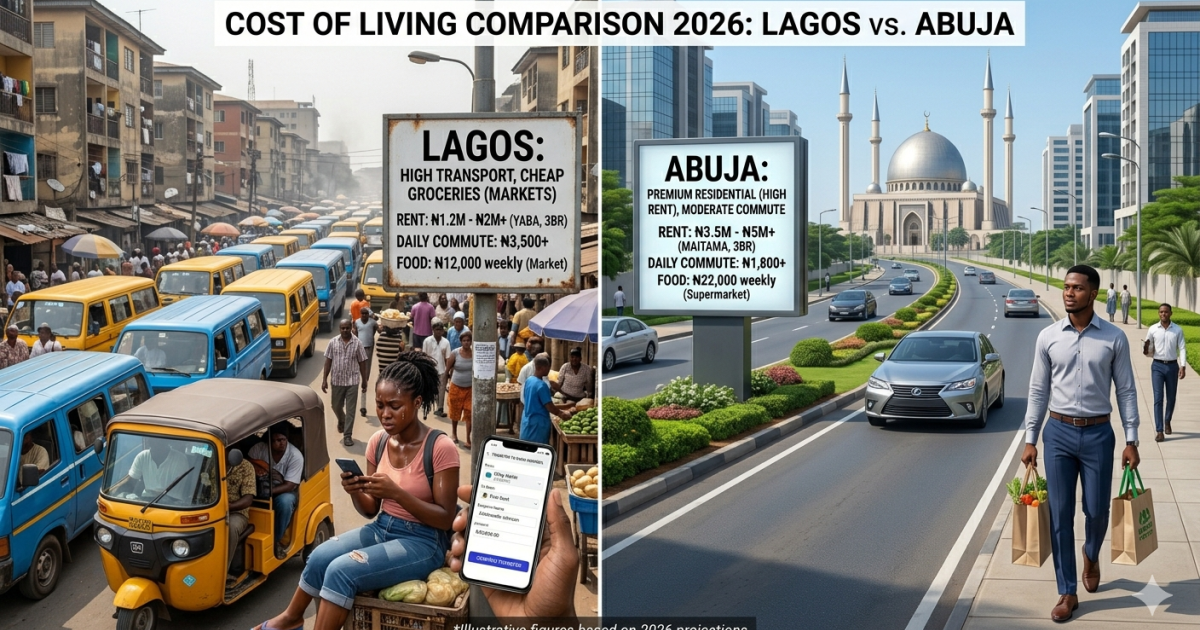
Whether you are deciding where to accept a job offer, planning a move, or simply curious about how Nigeria’s two major cities compare financially, the cost-of-living question between Lagos and Abuja is one of the most practically important economic comparisons a Nigerian can make. The headline answer is clear: Expatistan’s February 2026 cost-of-living comparison states definitively that “cost of living in Lagos is 29% more expensive than in Abuja.” But the full picture is more nuanced — Abuja can be dramatically more expensive for premium housing, and the income differential between the two cities is significant enough to change the real-terms advantage for many categories of workers. This guide gives you the complete, category-by-category breakdown.
Lagos vs Abuja Cost of Living — Full 2026 Comparison
| Expense Category | Lagos (₦ per month) | Abuja (₦ per month) | Cheaper City |
|---|---|---|---|
| 1-bed apartment (city centre) | ₦100,000 – ₦250,000 | ₦80,000 – ₦200,000 | Abuja |
| 1-bed apartment (suburbs/mainland) | ₦50,000 – ₦150,000 | ₦40,000 – ₦120,000 | Abuja |
| Premium (VI/Ikoyi vs Maitama/Asokoro) | ₦600,000 – ₦2,000,000+ | ₦500,000 – ₦1,500,000+ | Similar at top end |
| Monthly food (self-catering) | ₦100,000 – ₦200,000 | ₦100,000 – ₦180,000 | Broadly similar; Abuja slightly lower |
| Transportation (daily commuter) | ₦15,000 – ₦30,000 | ₦8,000 – ₦20,000 | Abuja — less congestion, shorter effective distances |
| Electricity (generator + PHCN) | ₦40,000 – ₦120,000 | ₦30,000 – ₦90,000 | Abuja slightly lower |
| Internet (home broadband) | ₦15,000 – ₦35,000 | ₦15,000 – ₦35,000 | Similar |
| Eating out (mid-range restaurant) | ₦5,000 – ₦15,000 per meal | ₦4,000 – ₦12,000 per meal | Abuja marginally cheaper |
| Domestic help (cleaner, monthly) | ₦30,000 – ₦60,000 | ₦25,000 – ₦50,000 | Abuja |
| School fees (private primary) | ₦80,000 – ₦500,000/term | ₦70,000 – ₦400,000/term | Abuja marginally |
Rent: The Biggest Cost Difference
Accommodation is the single largest monthly expense for most Nigerians living in major cities — and it is also where the Lagos vs Abuja difference is most dramatic at the mid and lower tiers of the market. Lagos rents have risen sharply due to housing demand from the city’s massive and growing population (estimated 20–25 million), extreme land scarcity particularly on Lagos Island and in desirable mainland locations, and the general economic pressure that pushes up all urban costs.
For a standard 1-bedroom apartment in a safe, reasonably convenient neighbourhood: Lagos ranges from ₦100,000–₦250,000 per month for city-centre or Island-area locations; Abuja ranges from ₦80,000–₦200,000 for equivalent quality and convenience in areas like Garki, Wuse, and Life Camp. The saving of ₦20,000–₦50,000 per month (₦240,000–₦600,000 per year) purely on rent is significant for an individual or couple managing on a single salary.
At the premium end, Lagos prices in Victoria Island, Ikoyi, and Lekki Phase 1 are genuinely extreme — monthly rents for a 3-bedroom apartment can reach ₦500,000–₦2,000,000. Abuja’s premium neighbourhoods (Maitama, Asokoro, Wuse 2, Jabi) are also very expensive but typically run 10–20% cheaper than the Lagos Island equivalent for comparable standards. Below the premium tier, Abuja consistently offers more space for less money than Lagos across virtually every neighbourhood comparison.
Transportation: Why Abuja Wins Decisively
Transport costs in Lagos are notoriously high — and this goes beyond the simple price per trip. The real cost of Lagos commuting is measured in time, fuel, stress, and lost productivity. Lagos traffic congestion is among the worst in Africa — a journey of 10 kilometres in peak hours can easily take 90 minutes. Workers who live in distant suburbs (Ikorodu, Agbado, Badagry) and commute daily to the Island or Ikeja effectively lose 3–4 hours per day to traffic — time that has real economic value. For vehicle owners, the fuel cost of Lagos stop-and-go traffic is dramatically higher per kilometre than free-flowing driving.
Abuja’s urban planning — with its structured zone system, wider roads, less population pressure, and more rational spatial layout — results in meaningfully lower real transport costs even when the price per ride is similar. A commuter in Abuja can often reach work in 20–30 minutes what would take 90 minutes in Lagos. This time advantage translates directly to lower transport expenditure (fewer trips, shorter distances, less fuel or ride-hailing cost) and significantly better quality of life.
Income: Where the Real Comparison Lies
The most important context for the cost-of-living comparison is income. A city’s affordability is only meaningful relative to what you earn there. Lagos — as Nigeria’s commercial capital and the hub of finance, media, tech, entertainment, and trade — typically pays significantly higher private-sector salaries than Abuja for equivalent roles. A marketing manager earning ₦500,000 per month in Lagos may find the same role pays ₦350,000–₦400,000 in Abuja. A software engineer commanding ₦700,000 in Lagos may earn ₦450,000–₦550,000 for the same job in Abuja. Even after accounting for Lagos’s higher cost of living, the net disposable income can be higher for high earners in Lagos private sector roles.
The calculation reverses for government workers. Federal civil servants, NNPC employees, and other federal government employees based in Abuja earn the same salary regardless of city but spend significantly less on accommodation and transport than Lagos-based equivalent earners. An FCT-based civil servant on ₦250,000 per month has a meaningfully different effective quality of life than the same person earning the same salary in Lagos — because Abuja accommodation and transport costs are lower.
Food: Surprisingly Similar
For self-catering food costs — buying ingredients at markets and cooking at home — Lagos and Abuja are more similar than many people expect. Both cities source food from the same national supply chains (northern grains, south-western vegetables, southern fish and protein) and both face the same transportation cost pressures driving up food prices. Market price data from 24HoursMarket (April 2026) shows broadly comparable food prices across both cities for staples like rice, beans, tomatoes, and vegetables.
The meaningful food cost difference between the two cities is in eating out. Lagos has a far more diverse and competitive restaurant scene — from roadside buka stalls to mid-range restaurants, the competition for customers is intense and keeps prices across the full spectrum accessible. Abuja’s more organised and spacious urban environment tends toward restaurant concepts that are slightly more expensive per meal, and the density of street food options in any given neighbourhood is lower than in comparable Lagos areas.
Quality of Life: The Non-Financial Comparison
Cost of living is only part of the decision framework for choosing where to live. Quality of life factors — which are harder to quantify but just as important — strongly favour Abuja in several dimensions:
- Air quality: Abuja’s lower population density, more green space, and better urban planning create meaningfully cleaner air than Lagos — particularly central Lagos, which has high vehicle exhaust, industrial activity, and waste management challenges
- Traffic and commute stress: As discussed, Abuja commutes are shorter and less congested — a quality-of-life advantage that affects daily mood, health, and family time profoundly
- Safety: Both cities have security challenges, but Abuja’s structured zone system and the security consciousness of a capital city with diplomatic presence tends to result in better-managed residential security in most neighbourhoods
- Recreation and culture: Lagos wins convincingly — the city has Nigeria’s richest entertainment ecosystem: live music venues, beach clubs (Elegushi, Inagbe Resort), nightlife, art galleries, international restaurants, food festivals, and a cultural vibrancy that Abuja simply cannot match at present
- Infrastructure: Abuja’s roads, urban planning, and public spaces are significantly better maintained than Lagos — wider roads, better drainage, less flooding, and more functional public facilities
- Networking and career opportunities: Lagos is Nigeria’s unquestioned centre of gravity for private sector career building, startup culture, media, finance, and creative industries — the professional network density and opportunity density in Lagos has no Abuja equivalent
Who Should Choose Lagos vs Abuja?
Choose Lagos If:
- Your career is in finance, tech, media, entertainment, fashion, or trade — sectors where Lagos pays significantly more and offers denser professional networks
- You are building a startup or small business — Lagos’s customer base, investor community, and entrepreneurial ecosystem are unmatched in Nigeria
- Cultural life — live music, dining variety, nightlife, beaches, art — matters greatly to your quality of life
- You are early in your career and need maximum exposure and opportunity for advancement
Choose Abuja If:
- Your career is in government, civil service, diplomacy, or NGOs — sectors concentrated in Abuja that pay government-scale salaries that go further there than in Lagos
- Family considerations — shorter commutes, cleaner environment, better urban infrastructure, and lower stress are significant advantages for families with children
- You value a more organised, predictable daily life with less chaos and less traffic stress
- Your budget is fixed (government salary or limited freelance income) — Abuja gives you more quality of life per naira at the mid and lower income levels
🏙️ Lagos vs Abuja Cost of Living 2026 — Summary
- Overall: Lagos 29% more expensive than Abuja (Expatistan February 2026)
- Biggest gap: Transportation — Abuja significantly cheaper due to less congestion
- Rent gap: 1-bed city centre — Lagos ₦100k–₦250k vs Abuja ₦80k–₦200k
- Food: Similar for home cooking; Lagos cheaper for eating out due to competition
- Salary offset: Lagos private sector pays 20–50% more for equivalent roles
- Quality of life (subjective): Abuja wins on traffic, air, planning; Lagos wins on culture and entertainment
- Best for government workers: Abuja — same federal salary, lower costs
- Best for private sector: Lagos — higher salaries offset higher costs; denser opportunities
Also read: Best Private Hospitals Abuja 2026 | Cheapest Flight Lagos to Abuja 2026 | Dollar to Naira Rate Today 2026
Utilities: Electricity, Water and Internet in Lagos vs Abuja
Utility costs represent a significant and often underestimated component of Nigerian household budgets — particularly electricity, where the combination of unreliable grid supply and mandatory generator backup creates double costs that most Western cost-of-living models don’t capture. Lagos and Abuja both suffer from inadequate electricity supply, though Abuja typically receives marginally more stable grid supply in most residential areas. Generator running costs — diesel consumption plus maintenance — typically add ₦30,000–₦120,000 per month to household budgets in both cities, on top of PHCN prepaid meter credits. Internet costs are similar in both cities: major providers (Spectranet, Smile, MTN FiberX, iPNX, GloBabal Connect) operate in both markets at comparable pricing for equivalent service levels. Water costs are also broadly similar — both cities have mixed municipal and private borehole systems with monthly costs ranging from ₦3,000–₦15,000 depending on the estate and water source.
Healthcare Costs in Lagos vs Abuja 2026
Healthcare is another significant cost variable between the two cities. Lagos has a larger and more competitive private healthcare market — more hospitals, clinics, and specialist practitioners competing for patients — which tends to moderate consultation fees and treatment costs more than in Abuja, where the premium private hospital market is less competitive. A routine GP consultation in a mid-tier private clinic in Lagos costs approximately ₦5,000–₦15,000; the same consultation in a comparable Abuja clinic may be ₦8,000–₦20,000. Premium healthcare (at institutions like Eko Hospital, St. Nicholas Hospital, or Reddington in Lagos; or Nisa Premier, Garki Hospital, or Cedarcrest in Abuja) carries premium pricing in both cities that is more similar than the mid-tier gap suggests. For those with National Health Insurance Scheme (NHIS) or employer-provided HMO coverage, both cities have adequate accredited HMO facilities — though the breadth of choice is wider in Lagos.
Education Costs: Private School Fees in Lagos vs Abuja 2026
For families with school-age children, private school fees represent one of the largest recurring expenses and can significantly affect the total cost-of-living calculation. Both cities have a wide range of private school options from budget to elite, but Lagos’s larger and more competitive private education market tends to offer more value at the mid-range price points. Budget private primary schools in Lagos: ₦60,000–₦150,000 per term. Mid-range: ₦150,000–₦400,000 per term. Elite (American International School, British School, Greensprings, etc.): ₦500,000–₦1,500,000+ per term. Abuja ranges: budget ₦50,000–₦120,000; mid-range ₦120,000–₦350,000; elite ₦400,000–₦1,500,000+. For university education, both cities have federal universities (UNILAG and LASU in Lagos; UniAbuja in Abuja) where fees are substantially lower than private alternatives, though accommodation and living costs for students in Lagos are higher.
Detailed Monthly Budget Comparison: Lagos vs Abuja 2026
To make the cost comparison concrete, here is a realistic monthly budget for a single professional renting a 1-bedroom apartment in a reasonably located neighbourhood in each city:
| Expense | Lagos (₦/month) | Abuja (₦/month) |
|---|---|---|
| Rent (1-bed, decent area) | ₦120,000 – ₦200,000 | ₦90,000 – ₦160,000 |
| Food (self-catering) | ₦80,000 – ₦130,000 | ₦75,000 – ₦120,000 |
| Transport (daily commute) | ₦20,000 – ₦35,000 | ₦10,000 – ₦20,000 |
| Electricity (grid + generator) | ₦40,000 – ₦80,000 | ₦30,000 – ₦65,000 |
| Internet | ₦15,000 – ₦25,000 | ₦15,000 – ₦25,000 |
| Airtime and mobile data | ₦5,000 – ₦10,000 | ₦5,000 – ₦10,000 |
| Eating out (2–3x weekly) | ₦20,000 – ₦40,000 | ₦15,000 – ₦35,000 |
| Personal care / toiletries | ₦8,000 – ₦15,000 | ₦8,000 – ₦15,000 |
| Entertainment / recreation | ₦10,000 – ₦30,000 | ₦8,000 – ₦20,000 |
| Total estimated range | ₦318,000 – ₦565,000 | ₦256,000 – ₦470,000 |
The midpoint of this comparison — approximately ₦440,000/month in Lagos versus ₦360,000/month in Abuja — represents an ₦80,000 per month (₦960,000 per year) cost advantage for Abuja. Whether this advantage is worth trading against Lagos’s higher salary potential, career opportunity density, and cultural vibrancy is ultimately a personal calculation that depends on your specific industry, career stage, family situation, and lifestyle priorities.
Real Estate: Buying vs Renting in Lagos and Abuja 2026
For Nigerians considering property purchase rather than renting, the Lagos vs Abuja comparison shifts significantly. Property prices in Lagos — particularly on the Island (Victoria Island, Ikoyi, Lekki) — are among the highest in Africa when measured in dollar terms, driven by extreme land scarcity and consistent demand from the corporate and diplomatic community. A 3-bedroom apartment on Lagos Island can cost ₦150,000,000–₦500,000,000+ ($111,000–$370,000+ at current rates). The mainland offers more accessible prices: a 3-bedroom flat in Surulere, Ojodu, or Gbagada ranges from ₦40,000,000–₦120,000,000. Abuja property prices, while also high, offer more space per naira than Lagos Island at comparable price points. A 4-bedroom detached house in a good Abuja neighbourhood (Lugbe, Lokogoma, Karsana) can be acquired for ₦35,000,000–₦80,000,000 — difficult to find comparable product in Lagos at those prices outside the most distant suburbs. For property investment purposes, Lagos has historically delivered stronger capital appreciation and rental yield in high-demand areas, but Abuja offers better value in terms of the property received per naira invested at most price points.
Traffic and Time: The Hidden Cost Lagos Extracts
No Lagos vs Abuja comparison is complete without a serious treatment of Lagos traffic as an economic cost. The Lagos Metropolitan Transport Authority (LAMATA) has estimated that Lagos traffic congestion costs the city economy over $1 billion annually in lost productivity, fuel waste, and logistics inefficiency. For individual workers, the daily time cost is measured in hours: a commute from Ikorodu to Lagos Island that covers 45 kilometres can take 3–4 hours in peak traffic — that is 6–8 hours per day, 5 days per week, 48 weeks per year: up to 1,920 hours per year spent in traffic. At an average wage equivalent of ₦2,000 per hour (based on a ₦300,000 monthly salary and 150 working hours per month), this represents ₦3,840,000 of time cost annually from the commute alone. This calculation — admittedly rough — illustrates why some Lagos workers with suburban homes genuinely earn less in effective purchasing power terms than their Abuja counterparts at lower nominal salaries, once the full cost of Lagos commuting is accounted for.
The Lagos government has invested significantly in transport infrastructure — the Blue Line rail (Lagos-Marina), Red Line (Agbado-Marina), and expanded BRT network are all designed to reduce journey times for commuters who can access them. In 2026, these rail lines are operational for parts of their routes, providing genuine journey time relief for commuters along those corridors. However, rail coverage remains a small fraction of Lagos’s commuter geography, and the majority of Lagos workers still depend entirely on road transport that is subject to the city’s legendary congestion.
Abuja’s New City Areas: Emerging Affordable Neighbourhoods
Abuja’s planned city structure is expanding rapidly beyond the original Federal Capital Territory master plan zones. New residential districts — Lugbe, Lokogoma, Karsana, Kubwa, Dutse, Jukwoyi, Pyakassa, and Airport Road area — now house hundreds of thousands of residents who have found the city centre zones (Garki, Wuse, Maitama, Asokoro) too expensive. These outer areas offer significantly lower rents: a decent 2-bedroom apartment in Lugbe or Lokogoma can be found for ₦40,000–₦80,000 per month — far cheaper than equivalent Abuja central neighbourhoods — with the trade-off of longer commutes into central Abuja (though still typically shorter and less stressful than equivalent Lagos commutes). For new Abuja residents on moderate budgets, these newer outer districts represent the practical affordable housing stock that makes living in Abuja genuinely viable at salary levels of ₦150,000–₦300,000 per month.
The Verdict: Lagos or Abuja in 2026?
There is no universally correct answer — the right city depends entirely on your personal circumstances. But here is the most honest summary possible based on the 2026 cost and quality of life data:
Lagos is the right city if your career is in private sector finance, technology, media, marketing, creative industries, or trade — where Lagos salaries significantly outpace Abuja equivalents and career progression opportunities are denser. The 29% higher cost of living is real but partially or fully offset by higher private sector wages for skilled workers. Lagos also wins decisively for cultural richness, entertainment, food diversity, and the energy of a vibrant megacity that many young Nigerians find stimulating and motivating. The traffic cost is the city’s biggest quality-of-life drawback — and it is severe enough that where you live relative to where you work should be the first question asked before accepting any Lagos role.
Abuja is the right city if your career is in government, civil service, international organizations, embassies, or NGOs — sectors concentrated in Abuja where proximity to power and policy is a career advantage; if you have a family and prioritise shorter commutes, cleaner air, better-maintained public spaces, and less urban chaos; if your budget is constrained by a fixed government salary that goes meaningfully further in Abuja than Lagos; or if you simply prefer a more organised, less intense urban environment. Abuja is also increasingly viable for tech and startup work as the city’s ecosystem grows, though it still trails Lagos in depth and breadth of private sector opportunity. The data from Expatistan is clear: ₦100 goes further in Abuja than in Lagos. Whether that financial advantage is worth the trade-offs in career opportunity and cultural stimulation is the personal calculation at the heart of this decision.
Cost of Domestic Help: Nannies, Cleaners and Drivers in Lagos vs Abuja
For dual-income households and families with children, domestic help costs represent a significant monthly expense. Lagos and Abuja differ meaningfully in this category. In Lagos, the competitive labour market for domestic workers — driven by the sheer volume of middle-class households requiring help — keeps monthly salaries for live-out domestic workers (cleaners, nannies, cooks) in the ₦30,000–₦70,000 per month range for Lagos-based workers, with significant variation by experience, qualifications, and specific duties. Live-in domestic staff command ₦20,000–₦50,000 per month plus accommodation and feeding. Professional drivers in Lagos earn ₦60,000–₦120,000 per month given the complexity of Lagos traffic navigation and the premium placed on reliable, safe driving.
In Abuja, domestic help salaries are slightly lower in the mid-market tier — ₦25,000–₦60,000 for live-out cleaners/nannies — reflecting a smaller pool of households requiring help and different labour market dynamics. However, Abuja’s professional driver salaries are comparable to Lagos (₦60,000–₦100,000/month) given that the city’s spread and the importance of reliable personal transport for the professional class creates similar demand for skilled drivers.
Social Life Costs: Entertainment and Nightlife in Lagos vs Abuja
Lagos’s entertainment ecosystem is richer and more competitive than Abuja’s — resulting in better value at most price points for social activities. A night out in Lagos spans a huge range: from free beach visits (Elegushi, Bar Beach), cheap street-side bars and bukas (₦2,000–₦5,000 for food and drinks), mid-range restaurant nights (₦10,000–₦30,000 per person including food and drinks), to premium club nights at venues like Hard Rock Cafe, Quilox, or Sky Restaurant where spend can reach ₦50,000–₦200,000+ per person. The competition among Lagos entertainment venues — fuelled by the city’s large, entertainment-hungry population — keeps prices across the spectrum more accessible than Abuja’s less competitive market.
Abuja’s entertainment spending tends to be concentrated in fewer, typically more expensive venues — fewer options means less competitive pricing, and the capital’s more formal social culture means spending on entertainment often occurs in the restaurant and hotel bar category rather than the full spectrum of options Lagos offers. Abuja does have a growing club scene and increasing restaurant diversity in areas like Wuse 2, Jabi, and Maitama, but it remains a significantly smaller and less competitive entertainment market than Lagos. For Nigerians who value a rich social and entertainment life as part of their quality of life calculus, Lagos’s ecosystem is a genuine compensating advantage for its higher baseline costs.
Making the Final Decision: A Practical Framework
If you are facing a concrete decision — a job offer in one city, a transfer, or a voluntary relocation — here is a practical four-question framework to guide your Lagos vs Abuja decision beyond the general cost comparison:
- What does the salary differential actually mean in take-home terms? Calculate the monthly take-home salary for the specific role, subtract estimated monthly costs from the comparison above (use the midpoints for your likely lifestyle tier), and compare the net monthly surplus in each city. This net surplus figure — not the gross salary — is what actually determines your financial wellbeing in each location.
- Where will you live relative to where you will work? In Lagos especially, this question is more important than the city choice itself. A Lagos job on Victoria Island lived from a flat in Lekki Phase 1 (20 minutes’ drive against traffic) is a fundamentally different financial and quality-of-life proposition than the same job lived from Ikorodu (90+ minutes each way). Location within the city matters as much as the city choice itself.
- What are your career ambitions over the next 5 years? If your target is a senior role in a multinational, a tech company, finance, or creative industries — Lagos is where those opportunities are. If your target is government, policy, regulation, international organisations, or public sector advancement — Abuja is the career capital. Choose the city that puts you physically closer to the opportunities that matter most for your next career step.
- What does your personal life require? Family situation, health needs, relationship proximity to family, and personal lifestyle preferences are legitimate decision factors that deserve equal weight alongside financial calculations. A choice that maximises monthly net surplus but puts you two flights away from elderly parents, or in a city whose pace and culture you find deeply incompatible with your personality, may not be the optimal total life decision even if it is the financially rational one.
Lagos and Abuja are both great Nigerian cities with distinct strengths, and the 29% cost-of-living premium that Lagos carries is real but not prohibitive for the right salary and the right lifestyle. Make the decision with full information, clear-eyed about the trade-offs, and confident that either city offers a high-quality Nigerian life to those who approach it with the right strategy and expectations.
Frequently Asked Questions — Lagos vs Abuja Cost of Living 2026
Is Lagos more expensive than Abuja?
Yes. Expatistan’s February 2026 cost-of-living comparison confirms that Lagos is 29% more expensive than Abuja overall. The largest gaps are in transportation (Lagos traffic significantly increases daily commute costs) and rent (Lagos Island and desirable mainland areas are more expensive than equivalent Abuja neighbourhoods). Food costs are broadly similar between the two cities for home cooking.
What is the average cost of living in Lagos per month?
For a single professional in a modest 1-bedroom apartment in a reasonably located Lagos neighbourhood, a realistic monthly budget ranges from approximately ₦320,000–₦570,000 — covering rent, food, transport, utilities, internet, personal care, and modest social activities. This figure rises significantly for Island-based accommodation or a family with children in private school.
What is the average cost of living in Abuja per month?
For an equivalent single professional lifestyle in Abuja, a realistic monthly budget ranges from approximately ₦256,000–₦470,000. The primary savings versus Lagos come from lower rent, dramatically lower transport costs (shorter commutes, less congestion), and modest savings across most other categories. At the midpoint, the monthly saving versus Lagos is approximately ₦80,000 — nearly ₦1,000,000 per year.
Which city has better job opportunities — Lagos or Abuja?
It depends on your sector. Lagos is Nigeria’s private sector capital — finance, tech, media, marketing, trade, creative industries, and multinational companies are concentrated here and pay significantly more than Abuja equivalents. Abuja is Nigeria’s government and policy capital — civil service, NGOs, diplomatic missions, international organisations, and regulatory bodies are concentrated here. Choose the city where your target employer category is most represented.
Nightlife and Entertainment: Lagos vs Abuja
If entertainment spending is a meaningful part of your lifestyle budget, the Lagos vs Abuja comparison becomes dramatically one-sided. Lagos is Nigeria’s undisputed entertainment capital — a city that hosts the country’s biggest music concerts, the most vibrant nightlife, the finest restaurants across every cuisine, internationally certified beach clubs (Elegushi Beach, Inagbe Grand Resort, Landmark Beach), and a cultural events calendar that is unmatched anywhere in West Africa. Weekend entertainment spending in Lagos can range from ₦5,000 for a night at a neighbourhood bar to ₦50,000–₦200,000+ at premium nightclubs in Victoria Island. The density of entertainment options means there is something for every budget level — from free beach visits to high-end rooftop bars.
Abuja’s entertainment scene is more subdued but improving rapidly. The city has a growing number of quality restaurants, rooftop bars, lounges, and recreational centres — particularly in Wuse 2, Maitama, and the Jabi area. Abuja nightlife is less frenetic than Lagos and tends toward more intimate venues rather than the massive club culture of Lagos Island. For Nigerians who prioritise family activities, outdoor recreation (Millennium Park, Jabi Lake, Zuma Rock), and a less frantic social pace, Abuja’s more measured entertainment environment can actually be a quality-of-life positive. For those who love Nigeria’s music, nightlife, and social scene at full throttle, Lagos is without peer.
Business Opportunities: Lagos vs Abuja
For entrepreneurs and business owners, the Lagos vs Abuja choice carries significant implications for market access, customer base, and business opportunity. Lagos hosts Nigeria’s largest concentration of consumers with disposable income, the country’s deepest financial services ecosystem, its most developed startup support infrastructure (Y Combinator alumni networks, VCs, accelerators, co-working spaces), its largest concentration of multinational companies and their procurement decisions, and the densest media and marketing ecosystem for brand building. A consumer-facing business — retail, food and beverage, fashion, beauty, entertainment, e-commerce — reaches its natural Nigerian target market most effectively from Lagos.
Abuja, however, offers distinct business advantages of its own. As the seat of federal government, Abuja is where government contracts are awarded, regulatory approvals are processed, and policy decisions are made — making it essential for businesses in consulting, construction, oil and gas services, technology procurement, and any sector that depends on government as a customer. Professional services firms (law, accounting, architecture, project management) that serve government clients are often better positioned in Abuja than in Lagos. The rent and overhead costs for office space in Abuja are also typically lower than equivalent Lagos CBD locations, improving operating margins for service businesses that need visible, professional premises.
Remote Work and the Lagos/Abuja Question in 2026
The rise of remote work — particularly for Nigerians employed by international companies and paid in dollars — has changed the Lagos vs Abuja calculus in an interesting way. A remote worker earning $3,000 per month from a UK or US employer can choose to live in either city without any impact on their income. In this scenario, Abuja’s lower cost of living — approximately 29% below Lagos — translates directly to a higher effective disposable income per month without any salary sacrifice. The ₦80,000–₦960,000 annual cost saving of Abuja over Lagos, for a remote worker whose income is fixed regardless of location, is an unambiguous financial win for Abuja.
However, remote workers in Nigeria also depend on reliable internet connectivity and power — and both cities have challenges here. Abuja’s slightly more reliable electricity supply is an advantage for remote workers who depend on consistent internet access throughout the workday. The growth of co-working spaces in both cities (iDEA Hub, CcHub, Workspace in Lagos; Ventures Park, SparkHub, Impact Hub in Abuja) gives remote workers professional working environments with reliable internet, consistent power (generators), and professional settings for occasional in-person client calls — at monthly memberships of ₦30,000–₦80,000 in both cities.
Frequently Asked Questions — Lagos vs Abuja Cost of Living
Is Lagos more expensive than Abuja?
Yes — Expatistan’s February 2026 data shows Lagos is 29% more expensive than Abuja overall. The biggest cost gaps are in transportation (Lagos traffic dramatically increases effective commute costs) and rent at mid-range price points. Food costs are broadly similar. At the premium end (luxury apartments in Ikoyi vs Maitama), prices converge significantly.
Which city has better salaries: Lagos or Abuja?
Lagos pays higher private-sector salaries for equivalent roles — typically 20–50% more than Abuja for finance, tech, media, and commercial roles. Abuja pays higher for government, diplomatic, and NGO positions where federal government scale or international organisation pay grades apply. The net salary after deducting higher Lagos living costs depends on your specific industry and role — high earners in Lagos private sector typically retain more net disposable income than in Abuja despite the higher costs; mid-range government-scale earners are usually better off financially in Abuja.
How much does rent cost in Lagos vs Abuja 2026?
For a decent 1-bedroom apartment in a safe, reasonably convenient location: Lagos costs ₦100,000–₦200,000 per month; Abuja costs ₦80,000–₦160,000 per month. Both cities are substantially more expensive in premium areas (Ikoyi/VI in Lagos; Maitama/Asokoro in Abuja) and cheaper in outer suburbs and satellite towns.




0 Comments
No comments yet. Be the first to share your thoughts!