


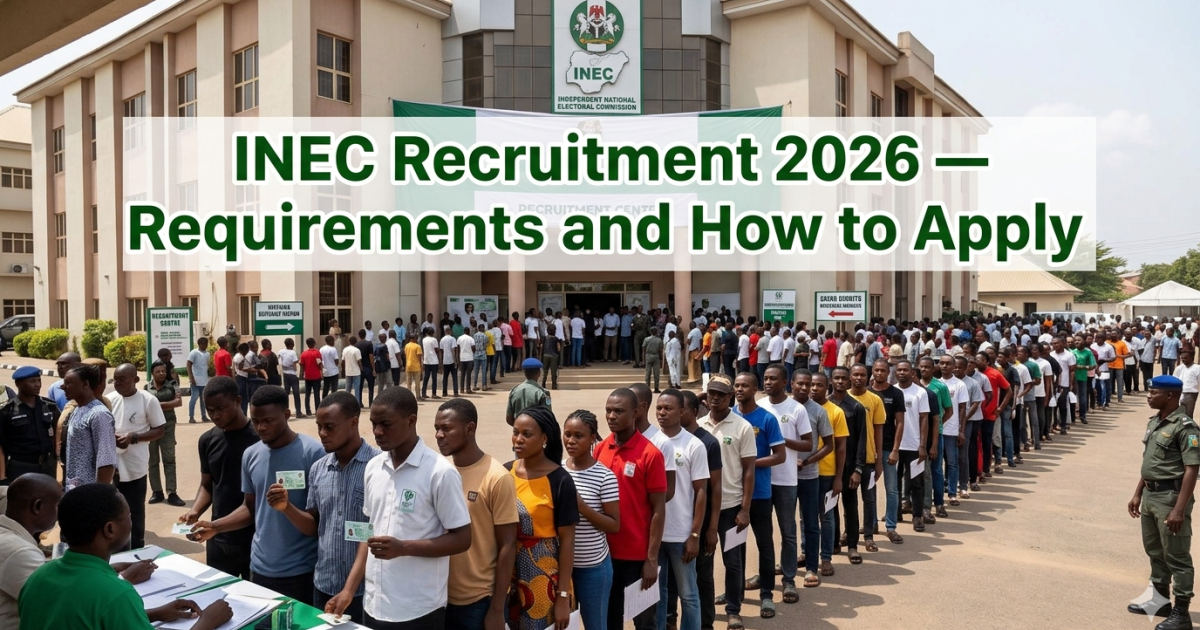
The Independent National Electoral Commission (INEC) is Nigeria’s constitutionally established body responsible for organising and conducting elections at the federal, state, and local government levels. Beyond its permanent civil service staff, INEC recruits a massive temporary ad-hoc workforce for every election cycle — Presiding Officers, Assistant Presiding Officers, Supervisory Presiding Officers, and various support roles needed to staff polling units, collation centres, and electoral logistics across Nigeria’s 176,000+ polling units. With major elections — including off-cycle governorship elections, by-elections, and preparation for the 2027 general elections — generating recruitment activity in 2026, this guide covers everything: who INEC recruits as ad-hoc staff, the requirements for each role, how to apply, what the pay is, and how to avoid recruitment scams.
Types of INEC Ad-Hoc Staff Roles
| Role | Responsibility | Typical Source |
|---|---|---|
| Presiding Officer (PO) | Oversees voting at a single polling unit; manages the entire voting process | NYSC corps members primarily; INEC ad-hoc staff secondarily |
| Assistant Presiding Officer (APO) | Assists the PO; manages voter accreditation, ballot distribution | NYSC corps members; INEC ad-hoc staff; sometimes graduate volunteers |
| Supervisory Presiding Officer (SPO) | Oversees multiple polling units within a ward; coordinates POs | Experienced ad-hoc staff or civil servants with prior election experience |
| Collation Officer | Collates results at ward, LGA, and state levels | Senior civil servants and INEC-vetted personnel |
| Returning Officer | Declares results at LGA or state level | University academics and senior professionals appointed by INEC |
| Security/Logistics Support | Material distribution, security coordination | Security agencies (Police, NSCDC) and logistics contractors |
NYSC Corps Members: INEC’s Primary Ad-Hoc Workforce
For decades, INEC’s primary source of ad-hoc Presiding Officers and Assistant Presiding Officers has been serving NYSC (National Youth Service Corps) members. This arrangement leverages the existing nationwide presence of corps members posted across all 36 states and the FCT, their relatively higher education level (university or polytechnic graduates), and the logistical efficiency of working through the established NYSC structure rather than recruiting and vetting an entirely separate ad-hoc workforce from scratch for each election.
If you are a serving NYSC corps member, your participation in INEC electoral duty is typically coordinated through your NYSC Local Government Inspector and your Community Development Service (CDS) group leadership — INEC liaises directly with NYSC state secretariats to mobilise corps members for election duty. You do not need to separately “apply” to INEC if you are already a serving corps member in an area where an election is scheduled — mobilisation happens through the NYSC structure. Watch for announcements from your NYSC Local Government Inspector or zonal coordinator about election duty mobilisation meetings, which typically occur 2–4 weeks before an election date.
Non-NYSC Ad-Hoc Staff Recruitment: For Graduates and Others
Beyond NYSC corps members, INEC also recruits ad-hoc staff directly from the general public — particularly in states or local government areas where there are insufficient corps members to fill all required polling unit positions, or for specific elections (governorship by-elections, local government elections) where NYSC mobilisation may be more limited. For these direct recruitment exercises, INEC typically opens applications through its State Resident Electoral Commissioner (REC) offices in the relevant state.
General Requirements for Direct INEC Ad-Hoc Recruitment
- Educational qualification: Minimum of OND, NCE, or equivalent for most positions; degree holders preferred for Supervisory Presiding Officer roles
- Age: Typically 18 years and above; no strict upper age limit for most ad-hoc roles, though physical fitness for the long election day is implicitly required
- Residency: Applicants are typically required to be residents of or have ties to the local government area where they will serve, to ensure local knowledge and reduce logistics costs
- Literacy and numeracy: Basic ability to read, write, and perform simple arithmetic — essential for accurate vote counting and result recording
- No political party affiliation: Applicants must not hold any political party position or be an active political party member, to maintain electoral neutrality
- Clean criminal record: No history of electoral malpractice or relevant criminal conviction
- Availability for training: Ad-hoc staff must attend mandatory training sessions before the election — usually held 1–2 weeks prior
How to Apply for INEC Ad-Hoc Recruitment 2026
- Monitor official INEC channels: Recruitment announcements are published on inecnigeria.org and through official INEC social media accounts (@inecnigeria on X/Twitter and Facebook). Announcements typically specify the election, the states/LGAs requiring staff, and the application window
- Visit your State INEC office: For non-NYSC applicants, applications are often submitted in person or through a state-specific online form at your State Resident Electoral Commissioner’s office
- Complete the application form: Provide personal details, educational qualifications, NIN, contact information, and your preferred local government area of service
- Submit required documents: Educational certificates, valid means of identification, NIN slip, and passport photographs
- Attend any required screening or interview: Some INEC state offices conduct brief interviews or screening sessions for shortlisted applicants
- Attend mandatory training: If selected, you must attend INEC’s pre-election training covering voting procedures, accreditation processes (BVAS — Bimodal Voter Accreditation System usage), result recording (using INEC’s official forms), and conflict de-escalation
- Receive your posting: Successful trainees are posted to specific polling units with clear instructions on reporting time and location for election day
INEC Ad-Hoc Staff Pay 2026
| Role | Approximate Pay Per Election | Notes |
|---|---|---|
| Presiding Officer (PO) | ₦25,000 – ₦40,000 | Plus transport allowance; figures vary by election type and are periodically reviewed |
| Assistant Presiding Officer (APO) | ₦20,000 – ₦30,000 | Plus transport allowance |
| Supervisory Presiding Officer (SPO) | ₦35,000 – ₦55,000 | Higher responsibility role overseeing multiple units |
| Collation/Returning Officers | Variable — typically higher | Senior roles with significant responsibility |
Note: INEC ad-hoc staff pay is reviewed for each election cycle and varies based on the type of election (general election vs by-election vs local government election) and budget allocation. Always confirm current rates through official INEC communication for the specific election you are being recruited for — historical figures may not reflect current rates.
What Happens on Election Day: A Presiding Officer’s Duties
For those selected as Presiding Officers or Assistant Presiding Officers, understanding the full scope of election day responsibilities helps you prepare effectively. Election day duties typically include: arriving at the polling unit very early (often before 7:30am) to set up voting materials, BVAS devices, ballot boxes, and voting booths; conducting voter accreditation using the Bimodal Voter Accreditation System (BVAS) which verifies voter fingerprints and facial recognition against the INEC voter register; managing the orderly queue and voting process throughout the day; ensuring ballot secrecy and preventing any electoral malpractice at the polling unit; closing the poll at the official closing time (typically 2:30pm, with all voters in the queue by that time still permitted to vote); counting votes transparently in the presence of party agents and observers; completing the official result sheet (Form EC8A) accurately; and transmitting results electronically via the BVAS device to INEC’s central server, then physically transporting the result sheet and materials to the designated collation centre.
This is a demanding full-day (often 12+ hour) responsibility requiring composure under pressure, basic technology proficiency for BVAS operation, and strict adherence to electoral procedures. INEC’s mandatory pre-election training covers all these procedures in detail — attend every training session offered, as gaps in your understanding of BVAS operation or result documentation can lead to errors that affect election integrity and your own standing as an ad-hoc staff member for future elections.
INEC Recruitment Scams: Protect Yourself
Every election cycle in Nigeria brings a wave of INEC recruitment fraud targeting job-seekers and NYSC corps members. Common scam patterns include: individuals or WhatsApp groups claiming to offer “INEC ad-hoc staff registration” for a fee, when legitimate INEC recruitment never requires payment from applicants; fake INEC recruitment portals that mimic the official website to collect personal information and payment; and individuals claiming to be INEC officials who can guarantee selection for a fee. Protect yourself: monitor only official INEC channels (inecnigeria.org and verified social media accounts); never pay any individual or platform for INEC ad-hoc recruitment; verify any recruitment announcement through your State INEC office directly before responding; and report suspected fraud to INEC’s official complaints channels or the EFCC at efcc.gov.ng.
INEC’s Permanent Staff Recruitment: A Different Pathway
Separate from ad-hoc election-day recruitment, INEC also periodically recruits permanent civil service staff across various departments — administration, ICT, legal, electoral operations, finance, and other functions. This permanent staff recruitment follows the standard Federal Civil Service Commission process and is announced through the official Federal Government job portal and INEC’s own careers page on inecnigeria.org. Permanent INEC positions require the standard civil service application process: CV submission, qualifying examinations where applicable, interviews, and reference checks. These roles offer the stability of permanent federal civil service employment with structured career progression, unlike the temporary, per-election nature of ad-hoc staff roles. If you are interested in a long-term career with INEC rather than periodic ad-hoc election duty, monitor the INEC careers page and the Federal Civil Service Commission’s recruitment announcements for permanent position openings.
Why INEC Ad-Hoc Work Matters: Beyond the Pay
While the pay for INEC ad-hoc duty is modest relative to the demanding nature of the role, many Nigerians who serve as Presiding Officers, Assistant Presiding Officers, or other ad-hoc staff describe the experience as civically meaningful beyond its financial compensation. Serving as election-day staff places you at the heart of Nigeria’s democratic process — you are directly responsible for ensuring that your fellow citizens’ votes are counted accurately and that the electoral process at your polling unit is conducted with integrity. For NYSC corps members, election duty also counts as part of fulfilling national service obligations and provides direct civic engagement experience that many describe as among the most meaningful aspects of their service year. For non-NYSC applicants, serving as ad-hoc INEC staff is also a credible addition to a CV, demonstrating civic responsibility, ability to work under pressure, and direct experience with one of Nigeria’s most important institutional processes.
Frequently Asked Questions — INEC Recruitment 2026
How do I apply for INEC ad-hoc staff recruitment 2026?
NYSC corps members are mobilised through their NYSC Local Government Inspector and CDS structure — no separate application is needed. Non-corps applicants should monitor inecnigeria.org and official INEC social media for recruitment announcements, then apply through their State INEC office (State Resident Electoral Commissioner’s office) when applications open for a specific election.
How much does INEC pay ad-hoc staff?
Presiding Officers earn approximately ₦25,000–₦40,000 per election, Assistant Presiding Officers approximately ₦20,000–₦30,000, plus transport allowances. Rates vary by election type and are reviewed for each electoral cycle — confirm current rates through official INEC communication for your specific assignment.
Does INEC recruitment require payment?
No — legitimate INEC ad-hoc recruitment is completely free. Any individual or platform requesting payment for INEC registration, “fast-tracking,” or guaranteed selection is committing fraud. Apply only through official INEC channels.
🗳️ INEC Recruitment 2026 — Quick Reference
- NYSC corps members: Mobilised through NYSC Local Government Inspector — no separate application
- Non-corps applicants: Apply through State INEC (REC) office when announced
- Official source: inecnigeria.org + verified @inecnigeria social media
- Key roles: Presiding Officer, Assistant Presiding Officer, Supervisory Presiding Officer
- Pay (PO): ₦25,000–₦40,000 per election + transport
- Pay (APO): ₦20,000–₦30,000 per election + transport
- Requirements: OND/NCE minimum; no political party affiliation; clean record
- Training: Mandatory pre-election training on BVAS and result procedures
- Cost: FREE — never pay anyone for INEC recruitment
- Permanent staff: Separate civil service process via Federal Civil Service Commission
Also read: NYSC Allowance 2026 | Nigerian Police Recruitment 2026 | How to Make Money Online Nigeria 2026
The BVAS System: What Every INEC Ad-Hoc Staff Must Master
The Bimodal Voter Accreditation System (BVAS) is the cornerstone technology of Nigeria’s modern electoral process, introduced to address the persistent challenges of voter impersonation and multiple voting that plagued earlier election cycles. As an INEC ad-hoc staff member — particularly a Presiding Officer or Assistant Presiding Officer — your competence with the BVAS device directly determines how smoothly your polling unit’s voting process runs. The BVAS device performs two simultaneous verification functions: it scans a voter’s fingerprint and compares it against the biometric data captured during voter registration, and it uses facial recognition technology to match the voter’s face against their registration photograph. Only when both verification methods confirm a match is a voter permitted to proceed to collect their ballot paper.
During INEC’s mandatory pre-election training, ad-hoc staff receive hands-on practice with the BVAS device, including: powering on and configuring the device for the specific polling unit; troubleshooting common issues such as poor fingerprint reads (often resolved by having voters clean their fingers or trying alternate fingers); managing situations where facial recognition fails due to lighting conditions (requiring repositioning or manual override procedures with documented justification); and the critical end-of-day procedure for transmitting results electronically to INEC’s central server. Mastering these procedures during training — rather than learning on election day under pressure — is essential. Ad-hoc staff who struggle with BVAS operation create delays that frustrate voters and can undermine confidence in the process at their polling unit. Take the training seriously, ask questions, and if possible, request additional practice time with the device before election day.
Handling Difficult Situations at the Polling Unit
Election day in Nigeria can present challenging situations that ad-hoc staff must be prepared to manage calmly and within INEC’s established procedures. Common scenarios include: voters who arrive without their voter’s card or with damaged identification — direct them to the appropriate INEC procedure for verification rather than making unilateral decisions; disputes between party agents over procedural matters — refer to your training on the role of party agents and escalate to your Supervisory Presiding Officer if a dispute cannot be resolved through standard procedure; security concerns or crowd management issues — coordinate immediately with the security personnel assigned to your polling unit rather than attempting to manage security situations yourself; and technical failures with voting materials — follow the documented contingency procedures covered in training, which typically involve immediate escalation to your ward collation officer or INEC’s local technical support team.
The overarching principle for all ad-hoc staff is to remain strictly neutral, follow documented procedures precisely, document any irregularities thoroughly using the official incident reporting forms provided during training, and escalate situations beyond your authority promptly rather than attempting independent resolution. Your role is to facilitate a free, fair, and transparent voting process — not to make judgment calls that could be perceived as favouring any party or candidate.
Building a Long-Term Relationship with INEC as Ad-Hoc Staff
Nigerians who perform well as INEC ad-hoc staff during one election cycle often find themselves recruited again for subsequent elections, as INEC maintains informal records of staff performance and reliability across electoral cycles. Demonstrating punctuality, procedural compliance, accurate documentation, and professional conduct during your first assignment significantly increases your likelihood of being recruited for future elections — including potentially being elevated to more senior roles such as Supervisory Presiding Officer after demonstrating competence as a Presiding Officer. For Nigerians interested in building recurring supplementary income through periodic INEC ad-hoc work — particularly relevant given Nigeria’s frequent election calendar including general elections, off-cycle governorship elections, local government elections, and by-elections — establishing yourself as a reliable, competent ad-hoc staff member during your first opportunity creates a foundation for repeated engagement over subsequent years.
Nigeria’s Election Calendar 2026–2027: Upcoming Recruitment Opportunities
Understanding Nigeria’s electoral calendar helps prospective ad-hoc staff anticipate when INEC recruitment activity is likely to occur. Nigeria conducts general elections every four years for the Presidency, National Assembly, and Governorship/State Assembly positions in most states. Beyond the main general election cycle, several states hold off-cycle governorship elections due to historical court judgments that shifted their election timing away from the main national cycle — these states include Ondo, Edo, Anambra, Bayelsa, Kogi, and Imo, each holding governorship elections at different points within the four-year cycle rather than alongside the general election. Local government elections, conducted by State Independent Electoral Commissions (SIECs) rather than INEC directly, occur on each state’s own schedule, typically every 3 years, and represent another source of electoral ad-hoc work though through a different commissioning body.
By-elections occur whenever a National Assembly or State Assembly seat becomes vacant due to death, resignation, court-ordered removal, or other circumstances — these can happen at any point and generate localised but genuine ad-hoc recruitment opportunities in the specific constituency affected. As Nigeria approaches the 2027 general elections, INEC’s preparatory activities — including voter registration exercises, continuous voter registration updates, and electoral logistics planning — will generate recruitment activity well before the actual election dates, particularly for roles supporting voter registration centres and INEC’s continuous registration exercise. Monitoring INEC’s official communications throughout 2026 and into 2027 will reveal these various recruitment windows as they open.
INEC’s Continuous Voter Registration (CVR) Staff
Beyond election-day ad-hoc roles, INEC also periodically recruits temporary staff to support its Continuous Voter Registration (CVR) exercise — the ongoing process through which eligible Nigerians who turn 18, change their residential address, or were previously unregistered can register to vote. CVR staff roles typically include data capture officers who operate INEC’s biometric voter registration machines, verification officers who confirm applicant eligibility and document authenticity, and registration centre supervisors who manage the overall registration process at designated centres. These roles often run for extended periods — weeks or months — rather than the single-day commitment of election duty, making CVR staff positions an attractive option for those seeking more sustained temporary income from INEC engagement. Requirements for CVR staff roles are broadly similar to ad-hoc election staff: minimum educational qualifications, NIN, no political party affiliation, and successful completion of INEC’s training on the registration system and biometric data capture devices. Announcements for CVR recruitment are made through the same official INEC channels — inecnigeria.org and verified social media — typically timed around scheduled CVR exercise windows announced by the Commission.
Election Observers and Party Agents: A Related but Distinct Role
It is worth distinguishing INEC ad-hoc staff roles from two related but entirely separate categories of people present at polling units on election day: election observers and party agents. Election observers are accredited by INEC to monitor the electoral process for transparency and credibility purposes — they include representatives from civil society organisations, domestic election observation groups (such as the Yiaga Africa Watching the Vote project), and international observer missions. Observers do not work for or get paid by INEC; they are independent monitors accredited through a separate application process specifically for civil society organisations and recognised observer bodies, not individual job seekers. Party agents, similarly, are not INEC staff — they are representatives nominated and paid by individual political parties or candidates to monitor the voting and counting process on behalf of their party’s interests at each polling unit. If you are interested in election-related civic participation but are not selected as INEC ad-hoc staff, becoming a party agent for a political party you support, or volunteering with an accredited civil society observation organisation, are alternative pathways to election-day civic engagement — though these come through entirely different application and accreditation channels than INEC’s own ad-hoc staff recruitment covered in this guide.
Preparing Mentally and Physically for Election Duty
Election day in Nigeria is physically and mentally demanding for ad-hoc staff. Presiding Officers and their assistants typically arrive at their polling unit before dawn and remain on duty well into the evening or even overnight in cases of delayed collation — a commitment that can extend to 14–18 hours of continuous, high-pressure work. Practical preparation matters significantly: get adequate rest the night before rather than staying up late finalising preparations; eat a substantial meal before departing for your polling unit, as breaks during election day are limited and unpredictable; bring sufficient water, light snacks, and any personal medication you may need; wear comfortable clothing and footwear appropriate for standing and moving throughout a long day; and bring a portable phone charger or power bank, as your phone may be essential for communication with your Supervisory Presiding Officer and for documenting any incidents that require reporting. Mentally, approach the day with the understanding that delays, technical hiccups, and unexpected situations are common in Nigerian elections — patience, composure, and strict adherence to your training will serve you far better than frustration or improvised decision-making when challenges arise.
Documenting Your INEC Service for Future Opportunities
After completing your INEC ad-hoc assignment, take practical steps to document and preserve evidence of your service for future reference. Request any official acknowledgment letter or certificate that INEC or the NYSC structure may provide confirming your participation and role — these documents are useful for CV building and for any future applications where INEC service is relevant. Keep records of your assignment details: the election date, your role, your polling unit or assignment location, and your Supervisory Presiding Officer’s contact information if available, in case any future verification of your service history is required. For NYSC corps members, ensure your CDS coordinator or Local Government Inspector has properly recorded your election duty participation as part of your overall service documentation, as this can be relevant to your final NYSC clearance and certification process. Building a documented track record of reliable election service — whether through one assignment or several across multiple election cycles — strengthens your profile for future INEC recruitment consideration and provides a credible, verifiable addition to your professional history demonstrating civic responsibility and the ability to perform demanding, detail-oriented work under significant time pressure and public scrutiny.
INEC’s Broader Mandate: Understanding the Institution You Would Be Serving
Understanding INEC’s broader constitutional mandate provides useful context for anyone considering ad-hoc service with the Commission. INEC was established under Nigeria’s 1999 Constitution as an independent body responsible for organising elections to the offices of the President and Vice-President, the Senate and House of Representatives, State Governors and Deputy Governors, and State Houses of Assembly. The Commission is also responsible for voter registration, the registration of political parties, the conduct of party primaries oversight, and electoral boundary delimitation. Headed by the Chairman of INEC (appointed by the President subject to Senate confirmation) and supported by National Commissioners and Resident Electoral Commissioners (RECs) in each state, INEC operates as one of Nigeria’s most scrutinised public institutions given its central role in the country’s democratic governance. Ad-hoc staff, while temporary and operating only at the most localised level of the electoral process, are nonetheless part of this constitutionally significant institutional structure — every Presiding Officer’s accurate result sheet contributes directly to the legitimacy of Nigeria’s electoral outcomes, from the smallest local government election to the Presidential contest itself. This institutional weight underscores why INEC’s training emphasises procedural precision, neutrality, and meticulous documentation — qualities that protect not just the integrity of any single election but the broader credibility of Nigeria’s democratic process as a whole.
In conclusion, INEC ad-hoc recruitment represents both a meaningful civic service opportunity and a legitimate source of supplementary income for eligible Nigerians, particularly NYSC corps members and graduates seeking direct involvement in the country’s electoral process. Monitor official channels closely, prepare thoroughly for any training offered, perform reliably on election day, and you position yourself for repeated engagement across Nigeria’s frequent and ongoing election calendar through 2027 and beyond.
Whatever role you ultimately play in supporting Nigeria’s elections — whether as a Presiding Officer at a single polling unit or as part of the broader continuous voter registration effort — your contribution forms a small but essential part of the machinery that sustains Nigerian democracy. Approach the opportunity with seriousness, and the experience will reward you both financially and in the satisfaction of meaningful national service.
Nigeria’s electoral infrastructure continues to modernise with each cycle, and the ad-hoc workforce that INEC mobilises remains the human backbone connecting sophisticated election technology with the everyday voters whose participation gives the entire system its legitimacy. Stay alert, stay prepared, and consider this guide your reference point whenever the next INEC recruitment window opens near you.
Good luck with your application.
Whether your motivation is the income, the civic experience, or both, approach the opportunity professionally and you will serve Nigeria well while building a credential that matters.




0 Comments
No comments yet. Be the first to share your thoughts!