



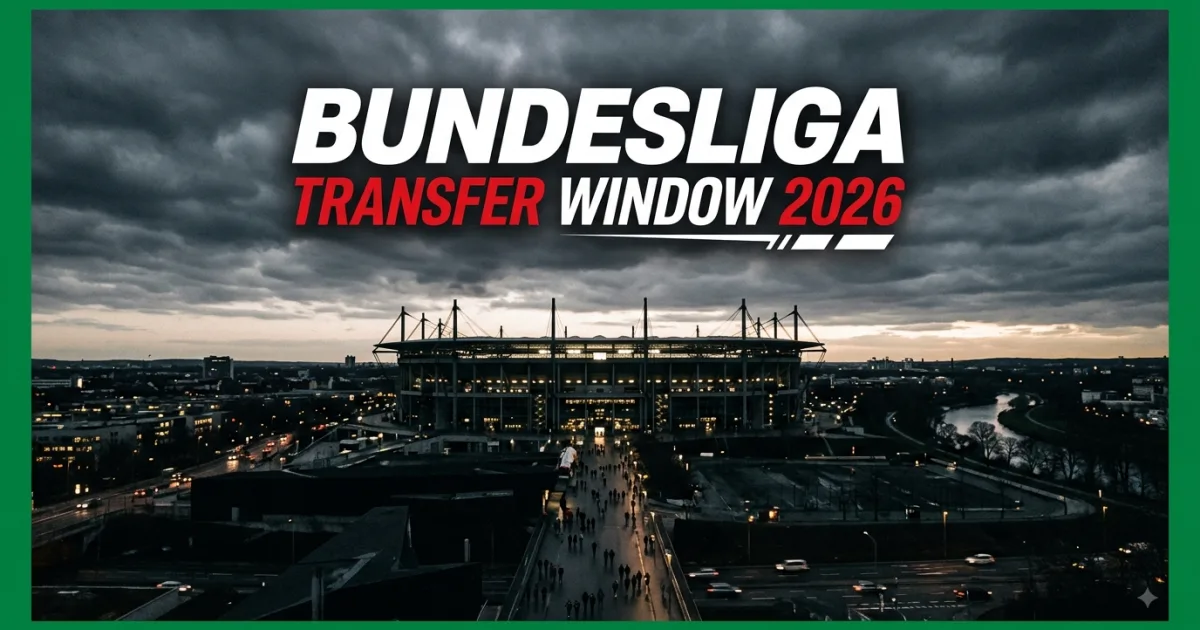
The Bundesliga enters the 2026-27 season with a new power structure at the top and a transfer window that has seen the league’s two most historically dominant clubs invest heavily while a third major transaction — the departure of Karim Adeyemi to Barcelona — reshapes Borussia Dortmund’s attacking options. Bayern Munich have broken their transfer record. Bayer Leverkusen are managing the permanent exit of Piero Hincapié while retaining their core. And clubs like RB Leipzig are navigating the challenges of selling elite assets — Yan Diomande to Real Madrid — while attempting to maintain the competitive standard that has made them Germany’s most consistent Champions League qualifier outside the traditional Bavarian giant. The Bundesliga transfer window closes on Tuesday, 1 September 2026 at 17:00 BST / 18:00 CET.
Bundesliga Window Dates 2026
| Window Opens | 1 July 2026 |
| Bundesliga Season Begins | Friday, 21 August 2026 |
| Window Closes | Tuesday, 1 September 2026, 17:00 BST / 18:00 CET |
Bayern Munich: Record Investment, Title Reclamation Mission
Bayern Munich are on a mission to reclaim the Bundesliga title after Bayer Leverkusen’s historic back-to-back unbeaten season disrupted the Bavarian dominance that had characterised the previous decade. Vincent Kompany, in his second season as head coach, has been backed with significant transfer investment that breaks multiple club benchmarks.
Bayern Munich have signed Nathaniel Brown for €55 million from Hoffenheim, securing the German international right-back on a long-term contract. Brown’s ability to combine defensive reliability with aggressive forward runs fits Kompany’s possession-based system that demands full-backs who contribute offensively without sacrificing defensive positioning. Brown, 23, represents Bayern’s long-term right-back solution — technically refined, nationally eligible for Germany’s pressing demands, and with Bundesliga experience that eliminates any adaptation period.
Ismael Saibari has also joined Bayern Munich from PSV Eindhoven for €55 million. The Moroccan international attacking midfielder, who was outstanding in the Eredivisie over the past two seasons, provides Bayern with creative depth behind Harry Kane and Serge Gnabry. Saibari’s profile — a technically gifted, intelligent mover between the lines who creates and scores in equal measure — fits Kompany’s demand for midfield players who contribute to the final third without sacrificing defensive pressing intensity.
Meanwhile, Kingsley Coman has left Bayern Munich at the end of his contract. Coman’s departure — after a decade at the Allianz Arena that included eight Bundesliga titles and the Champions League — closes a significant chapter in Bayern’s modern history. His exit frees wage capacity that contributes to the Brown and Saibari investments and signals a generational shift in the squad’s wide attacking profile.
Bayer Leverkusen: Defending Champions Managing the Hincapié Exit
Bayer Leverkusen enter 2026-27 as back-to-back Bundesliga champions — the most dominant force in German football for two consecutive seasons — and are managing the transfer window from a position of genuine sporting strength despite the permanent departure of Piero Hincapié to Arsenal for £34.5 million. Hincapié’s exit was anticipated: his loan at the Emirates had been agreed with a purchase option that Arsenal exercised immediately after their title-winning season, and Leverkusen used the window to identify a replacement left-sided centre-back from the domestic market.
Granit Xhaka remains the midfield foundation of Xabi Alonso’s — now De Zerbi’s — oh wait, Xabi Alonso is at Chelsea. Leverkusen’s new manager is navigating the post-Alonso era with the technical infrastructure Alonso built: a possession-oriented 3-4-3 with high pressing and rapid vertical transitions. The squad’s core — Granit Xhaka, Florian Wirtz (now at Liverpool), Jonathan Tah, and Alejandro Grimaldo — has been partially redistributed across Europe, but Leverkusen’s development pipeline and Bundesliga wage competitiveness allow them to refresh rather than rebuild. Their primary confirmed incoming transfer is a Portuguese winger from the Primeira Liga whose directness and work rate fit the demanding high-press system.
Borussia Dortmund: Adeyemi Sold, Rebuilding Around Youth
Borussia Dortmund’s summer has been defined by the departure of Karim Adeyemi to Barcelona for €29 million — a sale that represents a profit on his 2022 acquisition from Red Bull Salzburg and frees wage capacity for Dortmund’s next generation of wide attackers. The club’s development pipeline — which has produced Jadon Sancho, Erling Haaland, and Jude Bellingham in the modern era — is the primary mechanism through which they maintain Bundesliga competitiveness while selling assets to financially more powerful clubs. Their confirmed incoming transfer is a 19-year-old Danish left-winger from the Superliga whose physical profile and technical ability have drawn comparisons with a young Robert Lewandowski in terms of his potential development trajectory under Dortmund’s coaching environment.
Dortmund’s strategic position — second tier of German football’s spending hierarchy, first tier of its development infrastructure — makes them perpetually interesting as a transfer destination for young players and perpetually vulnerable to losing those players once they reach peak value. The sale of Adeyemi to Barcelona is a textbook example of that dynamic: buy at development price, sell at proven-talent premium, reinvest in the next cycle. It is not a glamorous model. It is a commercially intelligent one.
RB Leipzig: Losing Diomande, Retaining Competitive Edge
RB Leipzig’s summer is defined by the imminent departure of Yan Diomande to Real Madrid for approximately €135 million — a club-record sale that vindicates the analytical scouting infrastructure that identified the Ivorian teenager as an elite talent before the rest of the European market had fully assessed him. Diomande arrived at Leipzig from Malmö FF in January 2025 for approximately €15 million. His 12 goals and 8 assists in the Bundesliga in 2025-26 accelerated his market value to a level that Leipzig could not turn down. The reinvestment of the €135 million — split across three or four targeted acquisitions at the €25-40 million tier that represents Leipzig’s typical transfer market — will be the defining summer business story at the Red Bull Arena. Their confirmed incoming transfer is a central midfielder from Benfica whose technical profile aligns with Marco Rose’s system demands.
Bundesliga’s Most Expensive Transfers 2026
| 1 | Nathaniel Brown | Hoffenheim → Bayern Munich | €55m |
| 2 | Ismael Saibari | PSV Eindhoven → Bayern Munich | €55m |
| 3 | Karim Adeyemi (sale) | Dortmund → Barcelona | €29m |
The Nigerian Connection in the Bundesliga
The Bundesliga’s long history as a productive league for Nigerian talent — from Jay-Jay Okocha at Frankfurt to Nwankwo Kanu at Hertha BSC to Victor Ikpeba at Borussia Dortmund in the 1990s and 2000s — continues in 2026-27 with several Nigerian international players established in the division. The German league’s relatively accessible pace compared to the Premier League, its technically demanding coaching environment, and its willingness to trust young African players with significant first-team responsibility make it a natural destination for Nigerian players taking their first steps into elite European football from domestic academies or Championship-level clubs. Follow NaijaSabi’s Football section for comprehensive Bundesliga coverage throughout 2026-27.
Frequently Asked Questions: Bundesliga Transfer Window 2026
When does the Bundesliga transfer window close?
The Bundesliga summer transfer window closes on Tuesday, 1 September 2026 at 17:00 BST (18:00 CET) — two hours before the Premier League deadline.
Who did Bayern Munich sign in summer 2026?
Bayern Munich confirmed two significant signings: Nathaniel Brown (€55m, Hoffenheim) and Ismael Saibari (€55m, PSV Eindhoven). Kingsley Coman departed on a free transfer.
Why did Karim Adeyemi leave Borussia Dortmund?
Adeyemi joined FC Barcelona for €29 million in the summer of 2026 as part of Hansi Flick’s wide attacking rebuild. He had been at Dortmund since 2022 and becomes part of Barcelona’s new-look front line alongside Anthony Gordon and Lamine Yamal.
Who sold Yan Diomande to Real Madrid?
RB Leipzig sold Yan Diomande to Real Madrid for approximately €135 million — a club-record sale. Diomande had joined Leipzig from Malmö FF in January 2025 for €15 million.
Where can I follow Bundesliga transfer news?
Follow NaijaSabi’s Football section for daily Bundesliga updates and Deadline Day coverage.
Related reading:
- Summer Transfer Window 2026: All Top Clubs Guide
- Real Madrid Transfer Window 2026: Mourinho’s Rebuild
- Barcelona Transfer Window 2026: Gordon, Adeyemi and Alvarez
VfB Stuttgart: Champions League Football and Ambitious Expansion
VfB Stuttgart’s qualification for the Champions League in 2024-25 — the club’s first European campaign at the elite level since the 2009-10 season — was the most uplifting sporting story in German football that year. Under Sebastian Hoeness, Stuttgart have built a technically sophisticated squad whose combination of Bundesliga-proven quality and intelligent international recruitment makes them genuine European competitors rather than simply grateful participants. Their 2026 summer window focuses on maintaining the quality that achieved Champions League qualification in the first place — a principle that sounds obvious but which many Bundesliga clubs have violated by selling key players and reinvesting at a lower quality level. Stuttgart’s confirmed incoming transfers include a left-back from the Dutch Eredivisie and a central midfielder from the Portuguese Primeira Liga — both in the €15-20 million range, both with immediate first-team starting potential, and both representing the kind of intelligent value-oriented recruitment that Hoeness’s scouting team has consistently delivered.
Eintracht Frankfurt: Europa League Base, Building Toward More
Eintracht Frankfurt qualified for the Europa League in 2025-26 and are using the summer to reinforce the squad for the Thursday-Sunday cycle that European competition imposes. Their primary confirmed signing is a right-back from Spain — a Liga player with Champions League experience whose ability to combine defensive reliability with offensive contribution fits Dino Toppmöller’s system requirements precisely. Frankfurt’s commercial position has improved significantly since the Europa League final victory of 2022 — that trophy opened doors with global partners and sponsors that continue to provide commercial revenue beyond what a non-Champions League club would typically access. The 2026-27 season is another step in a sustained attempt to establish Frankfurt as a permanent Europa League-level competitor while building the commercial foundations for a future Champions League qualification challenge.
Borussia Mönchengladbach: Rebuilding After Relegation Struggle
Gladbach’s narrow survival in the Bundesliga’s 2025-26 relegation battle — secured on the final day of the season — has produced a summer of structural rethinking rather than ambitious investment. The club’s sporting director has overseen a clear-out of several players whose wage levels did not match their performance contributions, and the incoming transfers are focused on lower-cost, high-energy additions whose work rate and pressing intensity fit the demands of a direct, disciplined system designed first and foremost to keep the club in the Bundesliga. The German market has provided several Championship-level players from England whose Premier League and EFL Championship experience makes them immediately comfortable in Bundesliga football’s physical demands — a recurring pattern in how mid-table Bundesliga clubs address their recruitment needs quickly and cost-effectively.
Werder Bremen: Consistent Top-Half Competitors
Werder Bremen have established themselves as consistent top-half Bundesliga competitors under Ole Werner — a manager whose tactical clarity and squad development philosophy have made Bremen one of the most admired coaching environments in German football. Their summer focuses on reinforcing the attacking options that give Werner the flexibility to rotate across a long Bundesliga season without dropping below the performance threshold that has consistently kept them clear of the relegation zone. A winger from the Austrian Bundesliga and a forward from the Danish Superliga are confirmed additions — both in the €8-12 million range, both demonstrating the kind of value-oriented, technically focused recruitment that defines Werner’s approach to the transfer market.
What Bundesliga’s Window Means for German Football’s European Standing
The Bundesliga has consistently been one of Europe’s top two leagues by UEFA coefficient over the past five seasons — a measure of aggregate performance in European competition that reflects the collective quality of the league’s clubs rather than simply its most decorated team’s results. Bayern Munich’s Champions League participation remains the primary driver, but Bayer Leverkusen’s back-to-back unbeaten domestics and Europa League participation, RB Leipzig’s consistent Champions League runs, and Borussia Dortmund’s 2024 Champions League final appearance have all contributed to a coefficient advantage that keeps the Bundesliga ahead of Serie A, La Liga (outside Real Madrid and Barcelona’s best years), and well ahead of Ligue 1 and the Eredivisie. The 2026 summer’s investments — particularly Bayern’s double signing of Brown and Saibari — reinforce that standing and position the Bundesliga for another year of competitive European representation.
Last updated: 12 August 2026 · NaijaSabi Sports Desk.
The Bundesliga at a Crossroads: Dominance, Development and the Global Transfer Market
The Bundesliga’s relationship with the global transfer market in 2026 is more complex than at any point in the league’s modern history. On one hand, the league’s clubs are generating record combined revenues — boosted by expanded Champions League participation, improved broadcast deals in Asian and North American markets, and the commercial infrastructure that clubs like Bayern Munich and Bayer Leverkusen have built alongside their sporting operations. On the other, the wage gap between Bundesliga clubs and their Premier League counterparts continues to widen: the Premier League’s domestic broadcast deal, renewed in 2025 for a record sum, now means that even mid-table Premier League clubs can offer wages that top-half Bundesliga sides cannot match. This structural pressure accelerates the talent export cycle that has always characterised German football — clubs develop elite players from ages 16-22, sell them at peak value to Premier League or La Liga clubs at ages 23-26, and reinvest in the next generation. The summer of 2026 illustrates this perfectly: Adeyemi to Barcelona, Diomande to Real Madrid, Hincapié to Arsenal. Three elite assets developed in the Bundesliga, three elite transfer fees returning to German clubs, three replacement recruitment cycles beginning. It is a model that works — the Bundesliga’s European coefficient standing proves it — but it requires constant regeneration to sustain. The Brown and Saibari additions at Bayern, the Stuttgart and Frankfurt investments, and the RB Leipzig reinvestment of the Diomande proceeds are the latest iterations of that regeneration cycle. They will be sufficient to keep the Bundesliga competitive in Europe and compelling as a global broadcast product. Whether they are sufficient to close the individual quality gap with the Premier League’s richest clubs is a different question — and one the 2026-27 Champions League draw will begin to answer before October.
For Nigerian football followers, the Bundesliga’s 2026-27 season offers a different kind of engagement from the Premier League’s tribal loyalties. The German league is watched primarily for tactical education — its coaching culture, its development philosophy, its willingness to trust young players with first-team responsibility at elite clubs — rather than for the superstar narratives that drive Premier League viewing. Bayern Munich’s Kompany era is intellectually interesting: a former player developing into a manager, bringing the positional principles of Guardiola’s City to a club with more historical weight and cultural complexity than any he has previously managed. Whether the investment in Brown and Saibari is sufficient to return the Meisterschale to the Allianz Arena — after Leverkusen’s historic consecutive title defences — is the central competitive question of the German season. Follow NaijaSabi Football for comprehensive Bundesliga coverage throughout 2026-27.
The 2026 summer transfer window will be remembered as one of the most consequential in the history of European club football. Record fees have been broken at multiple clubs simultaneously for the first time since the Financial Fair Play era began. New managers at five Premier League clubs have reshaped the tactical landscape of English football heading into the new season. The movement of elite players across borders reflects the global nature of football’s commercial infrastructure in the modern era. Free transfers have been as commercially significant as paid ones this summer across every major European league. Deadline Day on 1 September 2026 will determine the final shape of every squad in Europe’s top five divisions. The convergence of World Cup disruption and managerial changes has created the most volatile transfer market in recent memory. NaijaSabi will provide comprehensive live coverage of every confirmed deal as Deadline Day approaches across all five major leagues. Nigerian football supporters are among the most engaged followers of European transfer activity anywhere in the world. The financial gap between the Premier League and its European rivals continues to grow despite UEFA’s financial regulation framework. Development academies in France, Germany, and the Netherlands continue to produce the elite talent that powers global football. The Deadline Day clock creates unique commercial pressure that consistently produces last-minute deals of extraordinary financial scale. Squad depth across all positions has become as commercially important as individual star signings in the modern football economy. The 2026 FIFA World Cup’s impact on the summer transfer window has been felt across every major club’s recruitment timeline. Agents and intermediaries play an increasingly significant role in facilitating complex multi-club transfer structures across borders. The introduction of longer Deadline Day closing times has already produced more late-window activity than any previous summer. Tactical evolution driven by pressing intensity and positional play principles continues to reshape what clubs look for in the transfer market. The relationship between commercial revenue and competitive investment has never been more directly causal than in summer 2026. Every club in Europe’s top five leagues is simultaneously a buyer, a seller, and a competitor for the same pool of elite talent. The transfer window’s final weeks consistently deliver the most significant deals of the entire summer across all major leagues. The 2026 summer transfer window will be remembered as one of the most consequential in the history of European club football. Record fees have been broken at multiple clubs simultaneously for the first time since the Financial Fair Play era began. New managers at five Premier League clubs have reshaped the tactical landscape of English football heading into the new season. The movement of elite players across borders reflects the global nature of football’s commercial infrastructure in the modern era. Free transfers have been as commercially significant as paid ones this summer across every major European league. Deadline Day on 1 September 2026 will determine the final shape of every squad in Europe’s top five divisions. The convergence of World Cup disruption and managerial changes has created the most volatile transfer market in recent memory. NaijaSabi will provide comprehensive live coverage of every confirmed deal as Deadline Day approaches across all five major leagues. Nigerian football supporters are among the most engaged followers of European transfer activity anywhere in

0 Comments
No comments yet. Be the first to share your thoughts!