


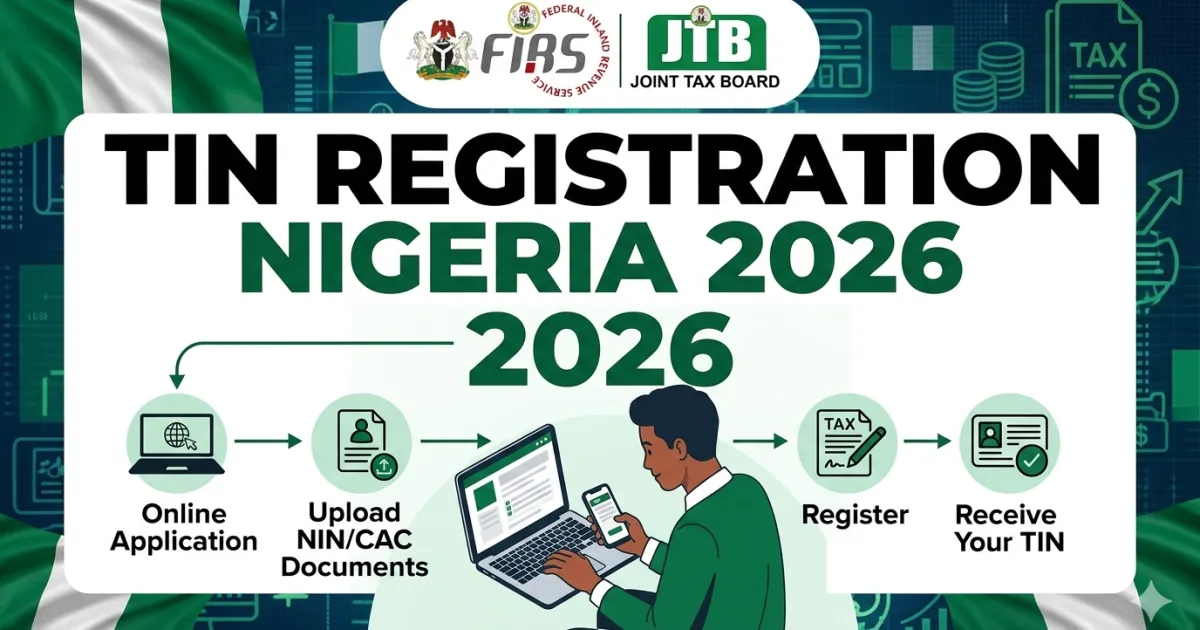
A Tax Identification Number (TIN) is a unique number issued by Nigeria’s Federal Inland Revenue Service (FIRS) that identifies you or your business for tax purposes in Nigeria. In 2026, TIN has expanded far beyond tax filing — it is now required for government contracts, corporate bank accounts, customs clearance, professional registration, and an expanding range of federal services. The good news: getting a TIN is completely free, takes under 30 minutes, and is done entirely online at tin.jtb.gov.ng using your BVN and NIN. This guide covers everything — who needs a TIN, how to register step by step, how to find an existing TIN, what TIN is needed for, how it differs from a Tax Clearance Certificate, how to file returns, and how to avoid TIN fraud.
What Is TIN and Who Needs One in Nigeria 2026?
Your TIN is your permanent identifier in Nigeria’s tax system. Unlike your BVN (banking system) or NIN (national identity), your TIN exists specifically for tax purposes. Every taxpayer — individual or corporate — has one. Taxaide Technologies’ 2026 TIN guide confirms: “The TIN is a unique number assigned to every taxpayer in Nigeria. It is used in the identification of taxpayers and documentation of tax payments.” In 2026, the following categories of Nigerians are legally required to have a TIN: all registered businesses (companies, partnerships, business names, sole proprietorships); formally employed workers (auto-assigned through employer PAYE filings, though you still need to know your number); self-employed professionals, consultants, and freelancers; traders bidding for any government contract at any level; importers clearing goods through Nigeria Customs Service; and landlords earning rental income above the personal income tax threshold. If you earn any form of income in Nigeria, you need a TIN.
How to Get Your TIN Free Online — Step by Step 2026
The Joint Tax Board (JTB) — which coordinates all federal and state tax administration in Nigeria — operates the official TIN registration portal at tin.jtb.gov.ng. Registration is free and the TIN is generated instantly. Here is the confirmed process based on Taxaide Technologies’ 2026 guide and the official JTB portal instructions.
What you need before you begin: Your 11-digit BVN; your 11-digit NIN; an active email address you can access immediately; the phone number registered with your BVN; and your current residential address including street, LGA, and state.
- Open your browser and visit https://tin.jtb.gov.ng
- On the homepage, click Register for TIN then select Individual
- Enter your 11-digit BVN in the provided field. The system automatically retrieves your full name, date of birth, and gender from the NIBSS database and pre-populates the form
- Carefully verify that your name and date of birth displayed are correct. If they are wrong, stop — resolve the BVN data issue at your bank before continuing
- Enter your 11-digit NIN
- Enter your email address (this receives your TIN certificate)
- Enter your phone number (same number registered to your BVN)
- Enter your residential address — street address, LGA, and state
- Select your state of tax jurisdiction — this must be the state where you actually work and reside, which determines which State Internal Revenue Service handles your personal income tax. Do not select your state of origin if you live and work elsewhere
- Click Submit
- Your TIN appears on screen immediately — write it down and take a screenshot
- A TIN certificate PDF is sent to your registered email within minutes — download it and save multiple copies
For companies: select Non-Individual Registration on the portal, enter your CAC RC number, and the system pulls company details directly from the CAC database. Add director details, company address, and tax jurisdiction, then submit. Company TINs are also generated instantly. Important: a company TIN is entirely separate from the personal TINs of its directors — both are needed for different regulatory and banking purposes.
Check If You Already Have a TIN Before Registering
FIRS has been auto-assigning TINs to Nigerians of working age using BVN data — meaning you may already have a TIN registered to you without ever having applied for one. Creating a new TIN when one already exists generates a duplicate record that causes complications in tax filing, TCC applications, and government contract verification. Always verify first. Visit https://tinverify.jtb.gov.ng and enter your BVN — if a TIN is registered to you, it displays immediately along with the associated name and registration date. Other ways to find your existing TIN: check any FIRS assessment notice, tax payment receipt, or tax clearance certificate you have received previously (all bear your TIN); ask your employer’s HR or payroll department who files PAYE returns under your TIN; or visit any FIRS Customer Connect centre with your BVN and a valid government-issued ID.
TIN Use Cases — Where You Need It in Nigeria 2026
| Purpose | Required? | Notes |
|---|---|---|
| Federal government contracts | Yes — compulsory | Automatic disqualification of any bid without valid TIN in documentation |
| Corporate / business bank account | Yes — compulsory | CBN requires TIN for all business account openings at regulated banks |
| Nigeria Customs import clearance | Yes | Required in all import documentation packages |
| Annual income tax returns | Yes | TIN is your filing identifier with FIRS and State IRS |
| Tax Clearance Certificate (TCC) | Yes | TCC is issued against your TIN after returns filed and taxes paid |
| Individual bank account (high turnover) | Increasingly required | CBN tightening KYC requirements for accounts with significant transaction volumes |
| Real property transactions in FCT | Required above threshold | FCT Land Registry requires TIN for property conveyances |
| FIRS TaxPro-Max e-filing | Yes | TIN is the login credential for taxpromax.firs.gov.ng |
| SMEDAN and government business grants | Yes | Most federal grant programmes require TIN in application documentation |
TIN vs Tax Clearance Certificate: The Difference Every Nigerian Must Know
These two documents are the most commonly confused in Nigerian tax compliance, and confusing them leads to providing the wrong document for official requirements. Here is the clear distinction:
TIN (Tax Identification Number): Issued once; permanent; never expires; does not prove tax payment of any kind. It is purely an identification number — like your BVN or NIN but for the tax system. Anyone can have a TIN regardless of whether they have ever paid any tax. Getting a TIN does not make you liable for any immediate tax payment.
Tax Clearance Certificate (TCC): Issued annually; expires after one year; proves that you have filed tax returns for the past three years and that all assessed taxes have been paid in full. You cannot get a TCC without first having a TIN, filing at least three years of returns, and clearing all outstanding tax liabilities. The TCC is the document that most professional bodies, government agencies, contract requirements, and international organisations need when they want proof that you are tax-compliant — not just registered. To obtain a TCC: log into taxpromax.firs.gov.ng with your TIN, file returns for the past three years (even nil returns in years of zero or below-threshold income), pay any outstanding assessments, then apply for TCC through the same portal. Processing takes five to ten working days and the certificate downloads as a PDF.
How to File Your Annual Tax Return Using Your TIN
TIN registration is the first step — annual tax filing is the ongoing obligation. Here is how to meet that obligation through the official platforms:
Federal Taxes (Companies and VAT) — FIRS TaxPro-Max
Visit taxpromax.firs.gov.ng, register once using your TIN to create a TaxPro-Max account, then log in with your TIN for all subsequent filings. Select the tax type (Company Income Tax for companies; VAT for VAT-registered businesses), select the period, complete the return form declaring income and allowable deductions, submit electronically, and pay any assessed tax through the platform via Remita, bank transfer, or debit card. Keep your filing acknowledgment receipt for your records.
Personal Income Tax — State Internal Revenue Service
Personal income tax for employed individuals is handled by your employer through PAYE remittances to your State IRS — you do not need to file separately if your only income is your salary and your employer is correctly deducting and remitting tax. However, if you have additional income sources (rental income, freelance income, business income, investment returns), you must file a direct assessment return with your State IRS to declare the total income. Self-employed individuals with no employer must file direct assessment returns annually. Each state’s IRS has its own filing platform — check your state’s IRS website. Lagos State IRS: lirs.gov.ng. Rivers State IRS: rsirs.gov.ng. Abuja (FCT IRS): fctirsapp.gov.ng. Other states have similar portals or accept physical returns at their offices.
FIRS vs State IRS: Who Collects Which Tax in Nigeria?
| Tax Type | Administered By | Who Pays |
|---|---|---|
| Company Income Tax (CIT) | FIRS | All incorporated companies (Ltd, Plc) |
| Value Added Tax (VAT) | FIRS | Businesses with annual turnover above 25 million naira |
| Personal Income Tax / PAYE | State IRS (employer remits) | Employed individuals — employer deducts and remits monthly |
| Direct Assessment | State IRS | Self-employed, freelancers, traders, professionals |
| Withholding Tax | FIRS or State IRS depending on transaction | Deducted at source on qualifying payments to vendors and contractors |
| Capital Gains Tax | FIRS | On disposal of chargeable assets above the annual threshold |
| Tertiary Education Tax (EDT) | FIRS | Companies — 2.5% of assessable profit |
Your TIN is your identifier across all these tax types. Both FIRS and all State IRS offices reference the same JTB-administered TIN database — your single TIN number works across the entire Nigerian tax system at both federal and state levels.
TIN for Freelancers and Online Income Earners 2026
Nigeria’s digital economy has grown dramatically — freelancers earning dollars on Upwork, Fiverr, and international platforms; YouTube creators receiving AdSense payments; remote workers employed by international companies; digital product sellers on Selar and Gumroad; and social media influencers receiving brand deals. All of these income streams are taxable in Nigeria. Taxaide Technologies is explicit: online income earners in Nigeria are legally required to register for TIN and file annual tax returns on their earnings regardless of whether they are paid in naira or foreign currency.
At the current dollar-to-naira rate of approximately 1,400 naira per dollar, a freelancer earning 1,000 dollars per month receives 1,400,000 naira — well above Nigeria’s annual personal income tax-free threshold. Formal tax compliance is increasingly important for this category. FIRS is investing in digital economy tracking through BVN-linked transaction monitoring, and enforcement coverage of online income earners is growing. Register your TIN now, maintain annual filing records through your State IRS, and if your online earnings are significant, engage a CITN-registered tax practitioner (find one at citn.org) to ensure your compliance structure is optimal and your effective tax rate is minimised within the law.
TIN Registration Errors and How to Avoid Them
- BVN and NIN name mismatch: If your name appears differently on your BVN versus your NIN, the JTB portal flags a conflict and may prevent registration completion. Resolve through NIN modification at NIMC or BVN name update at your bank before attempting TIN registration
- Creating a duplicate TIN: Always check tinverify.jtb.gov.ng before registering. If a TIN already exists for your BVN through auto-assignment, use that TIN. Duplicate TIN records cause complications in FIRS systems for future filing and clearance applications
- Wrong state of tax jurisdiction: Select the state where you actually live and work — not your state of origin. Your personal income tax returns go to that State IRS. Selecting the wrong state means your returns and payments go to the wrong authority, which can invalidate your TCC application
- Paying for TIN registration: Legitimate TIN registration at tin.jtb.gov.ng is completely free at every step. Any individual, WhatsApp group, or website charging for TIN registration is committing fraud. Fake TIN certificates fail verification at tinverify.jtb.gov.ng and are legally worthless for any official purpose
- Registering with a wrong email: Your TIN certificate is sent to the email you provide. Use an active email you control and check regularly. If you lose access to the email later, retrieving your certificate requires contacting JTB directly — avoidable by using a reliable email from the start
What Happens If You Operate Without a TIN?
For formally employed Nigerians whose only income is their salary, the immediate practical consequences of not personally knowing your TIN are limited — your employer files PAYE remittances under your auto-assigned TIN regardless. However, for self-employed individuals, business owners, and online income earners, the consequences of operating without a TIN are growing and will continue to intensify as Nigeria’s tax infrastructure matures.
Current consequences include: automatic disqualification from all government contract bids at any value; inability to open corporate or business bank accounts at CBN-regulated banks; customs clearance difficulties for importers; inability to obtain a Tax Clearance Certificate (which many professional bodies, universities, and employers require); and technical non-compliance with Nigerian tax law that creates legal exposure as FIRS enforcement broadens. The trend is clearly toward a more fully documented tax population — the FIRS 2023-2027 strategic plan explicitly targets expanding the registered taxpayer base from approximately 45 million to over 100 million through BVN-NIN-TIN linkage. Register proactively at tin.jtb.gov.ng — it takes 30 minutes, costs nothing, and protects you from growing compliance consequences.
Frequently Asked Questions — TIN Registration Nigeria 2026
How do I register for TIN in Nigeria 2026?
Visit tin.jtb.gov.ng, click Individual Registration, enter your BVN (auto-fills your details), add your NIN, email, phone, and address, select your state of tax jurisdiction, and submit. Your TIN is generated instantly on screen and a certificate PDF is sent to your email. The process is completely free and takes under 30 minutes.
How do I find my existing TIN number?
Visit tinverify.jtb.gov.ng and enter your BVN — if a TIN is registered to you (including auto-assigned TINs from FIRS), it displays immediately. Also check old FIRS letters, ask your employer’s HR department, or visit any FIRS office with your BVN and valid ID.
Is TIN registration free in Nigeria?
Yes — completely free at tin.jtb.gov.ng. Never pay any individual, agent, or platform for TIN registration. Legitimate TIN registration involves zero naira in payment at any stage.
What is the difference between TIN and BVN?
BVN (Bank Verification Number) identifies you in Nigeria’s banking system — issued by NIBSS under CBN supervision. TIN (Tax Identification Number) identifies you in Nigeria’s tax system — issued by FIRS and JTB. Both are permanent. They are linked through FIRS-CBN data sharing but serve different regulatory purposes in different institutional systems.
What is the difference between TIN and TCC?
TIN is permanent and does not prove tax payment. Tax Clearance Certificate (TCC) is issued annually, expires yearly, and proves that you have filed three years of returns and paid all assessed taxes. To get a TCC: have a TIN, file returns at taxpromax.firs.gov.ng or your State IRS portal, pay all assessed taxes, then apply for TCC. Processing takes five to ten working days.
TIN Registration Nigeria 2026 — Complete Quick Reference
- Register at: tin.jtb.gov.ng — completely free
- Verify existing TIN: tinverify.jtb.gov.ng — enter your BVN
- What you need: BVN + NIN + email + phone + address
- Processing time: Instant — TIN displayed on screen immediately
- Certificate: PDF emailed within minutes of registration
- Tax filing: taxpromax.firs.gov.ng (federal); State IRS portal (personal income)
- TIN is permanent: never expires, never changes
- TIN vs TCC: TIN = identity number; TCC = annual proof of tax compliance
- Required for: Government contracts, corporate bank accounts, customs clearance
- Check first: Many Nigerians already have TIN via auto-assignment — verify before registering
- Wrong state jurisdiction: Always select your state of residence — not state of origin
- Never pay anyone: Any payment request for TIN is a scam
Also read: How to Check BVN on Phone Nigeria 2026 | NIN Modification Nigeria 2026 | How to Make Money Online Nigeria 2026
TIN for Small Business Owners and Market Traders
Small business owners and market traders often assume that the informal nature of their operations exempts them from TIN requirements. This assumption is increasingly incorrect. Several practical situations make TIN essential even for small and micro businesses in 2026. Opening a business bank account: CBN regulations now require TIN for all business name and sole proprietorship account openings at regulated banks. Without a TIN, accessing formal business banking is increasingly difficult. Obtaining official market trade permits: some state governments, particularly Lagos, Abuja, and Kano, require TIN as part of the market trader registration and permit renewal process for formally registered market associations. Bidding for government supply contracts: even small government contracts — supplying stationery to a local government office, painting a public building, catering for a government event — require TIN in vendor documentation. A market trader without a TIN is locked out of all government procurement regardless of how competitive their pricing is. Applying for government business support programmes: most federal and state government grant and loan programmes for small businesses — including CBN’s SME credit facilities and SMEDAN support programmes — require TIN as part of the application documentation. The trend across all these areas is the same: TIN is becoming the universal gateway to formal economic participation in Nigeria. Register at tin.jtb.gov.ng today. It is free, instant, and the single most important administrative step an unregistered Nigerian business owner can take in 2026.
FIRS Free Resources and Support for Nigerian Taxpayers
FIRS has invested significantly in taxpayer education and support infrastructure. Free resources available in 2026 include the official FIRS website at firs.gov.ng with comprehensive guides on all major tax types and step-by-step filing instructions; the FIRS YouTube channel with tutorial videos demonstrating how to navigate TaxPro-Max for different tax types; FIRS Customer Connect centres in Lagos, Abuja, Port Harcourt, Kano, Enugu, Benin, Ilorin, Kaduna, and Onitsha where qualified FIRS officers provide free guidance on registration, filing, and payment disputes; and FIRS social media accounts at @FIRSNigeria on X (formerly Twitter), Facebook, and Instagram where queries receive responses and regular tax education content is published. For complex tax situations involving international income, transfer pricing, VAT on digital services, or multiple-entity corporate structures, engaging a practitioner registered with the Chartered Institute of Taxation of Nigeria is strongly advisable. CITN members are bound by professional ethics standards and are Nigeria’s authoritative source of tax advisory services. Find a CITN-registered practitioner near you at citn.org. The combination of FIRS free resources for standard compliance and CITN practitioner advice for complex situations gives any Nigerian taxpayer the support needed to maintain full tax compliance in 2026 and beyond.
Nigeria’s Tax Reform Agenda 2026: What It Means for TIN Holders
The Nigeria Tax Act 2025 — a landmark piece of tax legislation signed into law in late 2025 — introduced several significant changes to Nigeria’s tax framework that affect all TIN holders. Key changes relevant to individuals and small businesses include: the consolidation of multiple taxes into a simplified structure reducing compliance complexity; revised personal income tax rates and expanded exemptions for lower income earners; new provisions for taxation of digital economy income including social media monetisation, e-commerce, and remote work income from international sources; updated VAT registration thresholds and simplified compliance for small businesses; and enhanced penalties for non-registration and non-filing. TechCabal’s December 2025 analysis confirmed that from January 2026, electronic transfer stamp duty rules affecting fintech platforms were also updated under this legislation. For TIN holders, the practical implication is that the Nigerian tax landscape is more comprehensively structured in 2026 than at any previous point — and the expected trajectory is toward broader enforcement and reduced tolerance for non-compliance. Maintaining active TIN registration, filing annual returns (even nil returns in low-income years), and staying current with FIRS communications through firs.gov.ng positions you correctly within this evolving framework.
Protecting Yourself From TIN Fraud in Nigeria
Every government registration process in Nigeria attracts fraudsters, and TIN registration is no exception. Common TIN fraud patterns in 2026 include websites that mimic the JTB portal at tin.jtb.gov.ng and collect personal information and payment without generating any valid TIN; WhatsApp and Telegram groups advertising fast TIN registration services for fees of three thousand to ten thousand naira when the genuine process is free and instant; agents at FIRS offices and government buildings who claim TIN registration requires their paid assistance; and fake TIN certificates that look genuine but are not registered in the JTB database and fail any verification check at tinverify.jtb.gov.ng. The core protection rule is simple: legitimate TIN registration at tin.jtb.gov.ng is free at every stage. No payment of any amount is required. No agent, facilitator, or middleman is needed. Any person or platform requesting payment for TIN registration is committing fraud. Protect yourself further by: only accessing the TIN portal through tin.jtb.gov.ng typed directly into your browser — never through links sent via WhatsApp, SMS, or email; verifying any TIN presented to you by a vendor or contractor at tinverify.jtb.gov.ng before accepting it as valid; and reporting any TIN fraud attempts to FIRS at info@firs.gov.ng or to the Economic and Financial Crimes Commission at efcc.gov.ng. If you have already paid someone for TIN registration and suspect fraud, report the incident to the EFCC with all evidence including payment receipts, phone numbers, and any written communication from the fraudster. The EFCC actively prosecutes online fraud and financial scams, and your report contributes to protecting other Nigerians from the same scheme. Finally, remember that TIN registration done correctly at tin.jtb.gov.ng takes under thirty minutes and costs nothing — there is no legitimate reason to engage any paid assistance for this process.
TIN and the BVN-NIN Linkage in Nigeria 2026
One of the most significant developments in Nigerian identity and tax infrastructure is the progressive linkage of TIN with BVN and NIN. The FIRS strategic plan 2023-2027 explicitly targets auto-generating TINs for all Nigerians who have a BVN, using the BVN data ecosystem to create tax identities for the entire adult population. This means millions of Nigerians may already have a TIN assigned without having applied for one. This auto-TIN assignment draws your name, date of birth, gender, and address from your BVN record and assigns your tax identity to the State Internal Revenue Service of your state of residence. If your BVN shows a date of birth that places you above eighteen years of age, you likely already have a TIN in the JTB database. Always verify at tinverify.jtb.gov.ng by entering your BVN before going through the registration process. Attempting to register for a new TIN when one already exists creates a duplicate that must be resolved through JTB administration — an avoidable complication. The BVN-NIN-TIN linkage also means that your financial transactions are increasingly visible to tax authorities through data sharing between CBN and FIRS. Large or frequent bank transfers, regular international remittance receipts, and significant e-commerce payment platform withdrawals are all data points that FIRS can use to identify potential taxpayers who are not yet compliant. This digital audit trail is precisely why proactive TIN registration and annual filing is the rational approach for all economically active Nigerians in 2026 — it is far better to manage your tax obligations proactively than to receive an unexpected assessment based on transaction data flagged by the FIRS monitoring system.
In summary, obtaining your TIN in 2026 is one of the most straightforward and consequential administrative tasks any Nigerian adult can complete. The entire process takes under thirty minutes online at tin.jtb.gov.ng, requires only your BVN and NIN, and costs nothing whatsoever. Your TIN unlocks access to government contracting, formal business banking, tax clearance certificates, and full participation in Nigeria’s growing formal economy. Check tinverify.jtb.gov.ng first to confirm whether a TIN is already assigned to your BVN. If not, register at tin.jtb.gov.ng today. Then file your annual returns through taxpromax.firs.gov.ng or your State IRS portal to maintain clean compliance and qualify for Tax Clearance Certificates when needed. These three steps — verify, register, and file — constitute the complete foundation of Nigerian tax compliance in 2026, and all three can be completed entirely online without visiting any office or paying any fees to any person or platform.
The Nigerian tax system is evolving rapidly and TIN sits at its centre. Every Nigerian who registers their TIN, files their annual returns, and maintains clean compliance is contributing to the broader goal of building a self-sufficient Nigerian economy that is less dependent on oil revenue and more supported by a broad, fair, and efficiently administered tax base. Your compliance matters — both for your own access to economic opportunities and for the collective national interest of a Nigeria that can fund its own infrastructure, education, and healthcare from domestic tax revenue rather than borrowed funds and commodity windfalls.




0 Comments
No comments yet. Be the first to share your thoughts!