


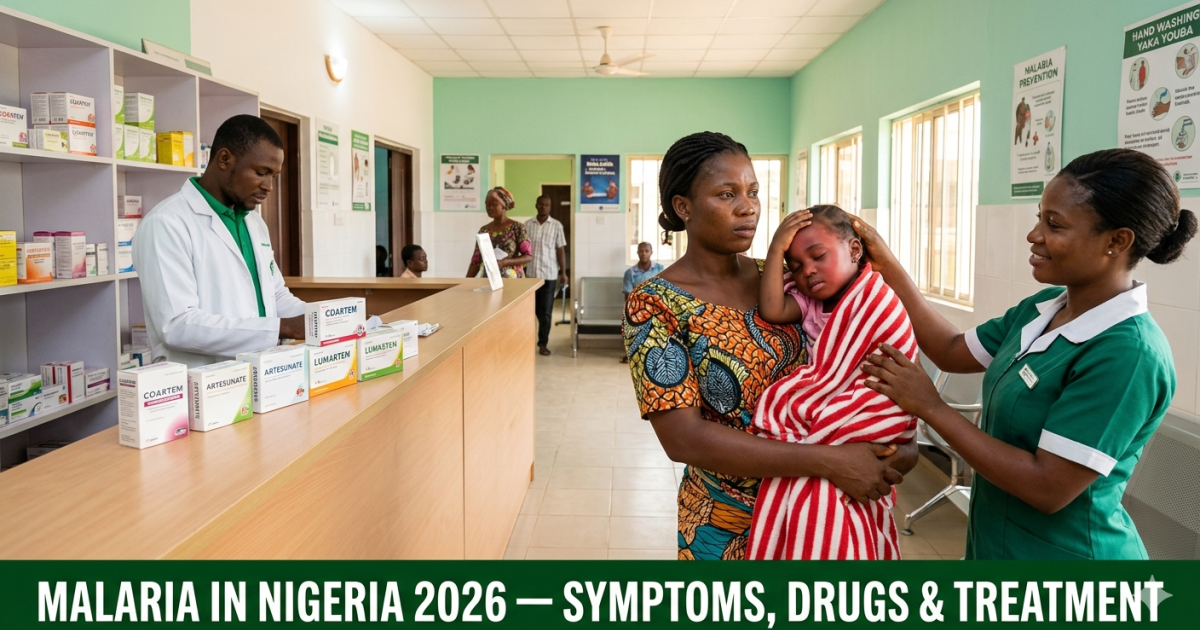
⚕️ Medical Disclaimer: This article is for educational purposes only and does not constitute medical advice. If you or a family member has symptoms of malaria — especially high fever in a child — seek medical attention immediately. Only a qualified healthcare provider can diagnose and prescribe treatment for malaria. Do not self-medicate without a confirmed diagnosis.
Malaria kills more Nigerians than almost any other single disease. According to the World Health Organization’s 2025 malaria report, Nigeria alone accounted for 31.9% of all malaria deaths in Africa — the highest share of any country on the continent. With 610,000 malaria deaths recorded globally in 2024, Nigeria was responsible for approximately one in every three of them. And the victims were disproportionately children under five.
Yet malaria is both preventable and treatable. The tragedy is not that the drugs do not work — Artemisinin-based Combination Therapies (ACTs) achieve cure rates above 90%. The tragedy is delayed treatment, incorrect drugs, self-medication without diagnosis, and preventable exposure. This guide covers everything a Nigerian adult needs to know about malaria in 2026: how to recognise it, what to do, which drugs actually work, and how to protect your family.
Nigeria and Malaria: The Scale of the Problem
| Nigeria’s share of African malaria deaths (2024) | 31.9% — the highest of any country (WHO) |
| Global malaria deaths (2024) | 610,000 (up from 598,000 in 2023) |
| Africa’s share of global deaths | 95% — the continent carries almost the entire burden |
| Most vulnerable group | Children under 5 years (75% of all malaria deaths in Africa) |
| Most dangerous species in Nigeria | Plasmodium falciparum — responsible for most malaria deaths |
| Transmission season | Year-round in Nigeria; peak during and after rainy season (April–October) |
| Vector | Female Anopheles mosquito (bites primarily between dusk and dawn) |
| First-line treatment (national guideline) | Artemisinin-based Combination Therapy (ACT) — specifically Artemether-Lumefantrine (AL) |
The Nigeria Centre for Disease Control and Prevention (NCDC) classifies malaria as one of the country’s most significant public health challenges, noting that it is the most common cause of outpatient visits and a leading cause of death at all age groups but especially in children under five and pregnant women.
Malaria Symptoms in Nigerians: What to Watch For
Malaria symptoms typically appear 7 to 14 days after an infected mosquito bite (sometimes up to 30 days for some species). The classic pattern involves cycles of symptoms — often recurring every 48 or 72 hours — though in Nigeria the most dangerous malaria (Plasmodium falciparum) often presents more continuously and more severely.
⚠️ Common Symptoms of Uncomplicated Malaria
- High fever (often above 38.5°C / 101.3°F) — may come and go in cycles
- Severe chills and shivering (the “cold stage”)
- Headache — often intense, at the front or back of the head
- Sweating (the “sweating stage” follows the fever peak)
- Muscle and joint pain (“body pain”)
- Fatigue and weakness
- Nausea and vomiting
- Loss of appetite
- Abdominal pain or discomfort
- Diarrhoea (especially in children)
🚨 Severe Malaria — Go to Hospital IMMEDIATELY
Severe malaria is a life-threatening emergency. Seek emergency care immediately if you or your child has:
- Altered consciousness, confusion, or difficulty waking up
- Seizures / convulsions (especially in children)
- Rapid breathing or difficulty breathing
- Jaundice (yellow skin or eyes)
- Very dark or black urine (“blackwater fever”)
- Severe anaemia (pale skin, extreme weakness)
- Inability to stand or walk
- Prolonged high fever in a child under 5
- No improvement after 24–48 hours of treatment
A critical point about fever in Nigerian children: Not every fever is malaria — but in Nigeria, where malaria transmission is year-round, any child under five with a fever that does not respond to paracetamol within 24 hours should be tested for malaria at the nearest health facility. Do not assume and self-medicate. A rapid diagnostic test (RDT) at a pharmacy or clinic can confirm or rule out malaria within 15–20 minutes at low cost.
How Malaria Is Diagnosed in Nigeria
The NCDC and Nigeria’s National Malaria Elimination Programme (NMEP) recommend that malaria should be confirmed by a parasitological test before treatment — not presumptively based on fever alone. Two testing methods are available:
| Test Type | Where Available | Cost (approx.) | Result Time | Accuracy |
|---|---|---|---|---|
| Rapid Diagnostic Test (RDT) | Most pharmacies, primary health centres, clinics | ₦500 – ₦2,000 | 15–20 minutes | High for P. falciparum; good for all types |
| Blood Film Microscopy | Government hospitals, diagnostic labs (SYNLAB, Lancet) | ₦1,500 – ₦5,000 | 1–4 hours | Very high — gold standard for diagnosis |
The RDT is the most practical option for most Nigerian families — it is fast, affordable, widely available, and accurate enough for the most dangerous malaria parasite (P. falciparum) which is responsible for the vast majority of Nigeria’s malaria cases. If the RDT is positive, proceed immediately to treatment. If it is negative but symptoms are severe or persisting, seek further medical evaluation — a negative RDT does not completely rule out malaria in all circumstances.
Best Malaria Treatment in Nigeria 2026: The Drugs That Work
Nigeria’s National Malaria Treatment Guidelines, issued by the Federal Ministry of Health, specify Artemisinin-based Combination Therapy (ACT) as the only recommended treatment for uncomplicated malaria caused by Plasmodium falciparum — the species responsible for most Nigerian malaria deaths. The national policy is clear on this: ACTs are effective; chloroquine monotherapy (the old standby for decades) is no longer recommended due to widespread resistance. According to research published in PMC (National Center for Biotechnology Information), “ACT availability within the country stands at 97%” — the drugs are in the healthcare system, but uptake of correct treatment protocols remains a challenge.
First-Line Treatment: Artemether-Lumefantrine (AL)
Brand names in Nigeria: Coartem (Novartis), Larimal, Lumartem, AL generics
Format: Oral tablets (3-day, 6-dose regimen)
Recommended for: Uncomplicated malaria in adults and children (weight ≥5kg)
Efficacy: 93–100% cure rates in clinical trials; WHO-recommended since 2006
Artemether-Lumefantrine is the gold standard for treating uncomplicated falciparum malaria in Nigeria. The Medicines for Malaria Venture (MMV) explains how it works: Artemether rapidly clears the malaria parasites from the blood in the first 24–48 hours (fast action that prevents the disease from worsening), while Lumefantrine has a longer half-life (3–6 days) that eliminates any remaining parasites and prevents recurrence. The combination is specifically effective against chloroquine-resistant parasites — which are now the predominant strains in Nigeria.
Coartem (the branded artemether-lumefantrine by Novartis) achieved positive Phase 3 results for a new formulation in partnership with Novartis in clinical trials. It is available at most Nigerian pharmacies, government health centres, and hospitals. Generic AL equivalents (Larimal, Lumartem, and others) are also widely available and equally effective — the WHO has prequalified several generic versions, meaning their manufacturing quality meets international standards.
Dosing Chart: Artemether-Lumefantrine (6-dose, 3-day regimen)
Important: Always follow the dosage instructions on the package or as directed by your doctor. The dosage is weight-based, especially for children. The standard adult regimen is 4 tablets per dose, taken twice daily for 3 days (6 doses total):
| Weight | Tablets per dose | Schedule | Total doses |
|---|---|---|---|
| 5–14 kg (infants and young children) | 1 tablet per dose | Twice daily for 3 days | 6 doses |
| 15–24 kg (children) | 2 tablets per dose | Twice daily for 3 days | 6 doses |
| 25–34 kg (older children) | 3 tablets per dose | Twice daily for 3 days | 6 doses |
| 35 kg and above (adults) | 4 tablets per dose | Twice daily for 3 days | 6 doses |
Critical instruction: Artemether-Lumefantrine must be taken with food — preferably a fatty meal or drink. Lumefantrine’s absorption is significantly reduced on an empty stomach, which is one reason for treatment failure. If the patient cannot eat solid food due to vomiting, try giving with milk, Milo drink, groundnut, or palm oil soup. If vomiting occurs within 30 minutes of a dose, the dose must be repeated. Complete the full 6-dose course even if you feel better after the first day. Stopping early is a major cause of treatment failure and contributes to drug resistance.
Alternative ACTs Also Used in Nigeria
| Drug Combination | Abbreviation | Notes |
|---|---|---|
| Artesunate-Amodiaquine | ASAQ | Second acceptable ACT per Nigerian guidelines; SPAQ used in seasonal malaria prevention |
| Dihydroartemisinin-Piperaquine | DHAPQ | Alternative ACT; longer post-treatment protection |
| Artesunate-Mefloquine | ASMQ | Alternative ACT; less commonly used in Nigeria |
Treatment for Severe Malaria
Severe malaria requires injectable treatment — oral medications are not sufficient when a patient has altered consciousness, convulsions, or cannot swallow. The recommended treatment for severe malaria in Nigerian hospitals is Intravenous (IV) Artesunate as the first-line drug, followed by a complete oral ACT course once the patient can swallow. If IV Artesunate is not available, IM (intramuscular) Artemether injection is the alternative. This must be administered at a hospital or clinic with qualified medical staff — not at home. Any patient with signs of severe malaria should be taken to the nearest hospital immediately, not to a pharmacy.
Drugs That Are No Longer Effective for Malaria in Nigeria
⚠️ Do NOT use these as primary malaria treatment:
- Chloroquine (Malaraquin, Chloro): Plasmodium falciparum — which causes most malaria in Nigeria — is now widely resistant to chloroquine. Chloroquine monotherapy for falciparum malaria is ineffective for most Nigerian infections and is no longer recommended by the Nigerian Federal Ministry of Health or WHO for treatment of confirmed P. falciparum malaria.
- Sulphadoxine-Pyrimethamine (Fansidar) as sole treatment: Resistance is widespread. SP is still used for prevention in pregnant women (IPTp) but not for treatment of active infection.
- Herbal/traditional remedies alone: There is no herbal remedy proven to cure malaria to WHO or NAFDAC standards. Some herbal preparations may provide temporary symptom relief while the parasites continue multiplying. Delay in starting ACT treatment is dangerous, particularly in children and pregnant women.
New Development: Ganaplacide-Lumefantrine (GanLum) — 2026 Update
A major development in malaria treatment was announced in November 2025: a novel malaria treatment called Ganaplacide-Lumefantrine (GanLum), developed by Novartis in collaboration with the Medicines for Malaria Venture (MMV), achieved positive Phase 3 clinical trial results. As the first non-artemisinin-based antimalarial drug in 25 years, GanLum is particularly significant because it can kill drug-resistant parasites — which is increasingly important as artemisinin resistance begins to be reported in parts of Africa. GanLum is expected to be submitted to regulatory authorities (including Nigeria’s NAFDAC) in 2026 for approval. It is not yet available in Nigerian pharmacies as of April 2026, but its approval and rollout could significantly change the malaria treatment landscape over the next few years — particularly for cases where ACT resistance becomes a concern.
Malaria in Pregnancy: Special Risks and Treatment
Malaria during pregnancy is particularly dangerous — it significantly increases the risk of miscarriage, premature delivery, low birth weight, anaemia in the mother, and maternal death. Pregnant Nigerian women are at high risk because the malaria parasite can accumulate in the placenta even without severe symptoms. The NCDC recommends Intermittent Preventive Treatment in Pregnancy (IPTp) using Sulphadoxine-Pyrimethamine (SP) — given at each antenatal visit from the second trimester (at least 3 doses total). This does not treat malaria but prevents it from taking hold in the placenta.
For treatment of active malaria during pregnancy: Artemether-Lumefantrine is safe and recommended in the second and third trimester. In the first trimester, the safety profile is less established — a doctor should be consulted. Quinine with Clindamycin is often used in the first trimester when other options are unavailable. Never self-medicate for malaria during pregnancy — the consequences of wrong treatment are severe for both mother and baby. Go directly to a hospital or antenatal clinic.
How to Prevent Malaria in Nigeria: Proven Methods
The NCDC outlines four evidence-based prevention strategies for Nigeria. Here is how to implement each one practically:
1. Insecticide-Treated Mosquito Nets (ITNs / LLINs)
The most important prevention tool — responsible for approximately 68% of malaria case reductions achieved in Africa since 2000, according to research in PMC. Long-Lasting Insecticidal Nets (LLINs) are treated with pyrethroid insecticide that kills mosquitoes on contact. Use them correctly: hang over the sleeping area, tuck the edges under the mattress before sleeping, and sleep inside the net every night — not occasionally. The Anopheles mosquito bites primarily between 10pm and 4am; consistent net use during these hours is your most effective single defence. LLINs are available free at government health facilities during distribution campaigns and for purchase at pharmacies and markets across Nigeria.
2. Indoor Residual Spraying (IRS)
IRS involves spraying the interior walls of homes with insecticide that kills mosquitoes when they rest on surfaces after feeding. This is typically done by government public health teams in high-transmission areas. Individual households can supplement this by using mosquito coils, electric vaporisers, or insecticide sprays (those containing permethrin or DEET) in bedrooms before sleeping.
3. Environmental Control
Anopheles mosquitoes breed in standing water. Eliminating standing water around your home reduces the local mosquito population significantly:
- Empty and clean water storage containers (drums, buckets, overhead tanks) regularly
- Drain or fill stagnant water pools, puddles, and waterlogged areas near your home
- Clear blocked gutters and drains
- Keep bins covered and dispose of tyres, tins, or containers that collect rainwater
- Use window and door screens where available to reduce indoor mosquito entry
4. Personal Protection Measures
- Wear long-sleeved clothing in the evenings and nights when outdoors, particularly from dusk onwards
- Apply mosquito repellent containing DEET (minimum 20% concentration) to exposed skin when outdoors at night. Apply to children’s skin — not hands or faces
- Avoid being outdoors between 10pm and 4am when possible, especially in high-risk areas
- Use mosquito coils or vaporisers in bedrooms at night
5. Malaria Prevention for Pregnant Women (IPTp)
Pregnant women must attend antenatal care and receive SP doses at each visit from the second trimester onwards (at least 3 doses throughout the pregnancy). Nigeria has adopted the WHO model of a minimum of eight antenatal contacts during pregnancy. Receiving IPTp at these visits is a free, government-supported prevention measure that significantly reduces malaria risk during the most dangerous period for both mother and baby.
What About the Malaria Vaccine?
As of 2026, there is a licensed malaria vaccine — the RTS,S vaccine (brand name Mosquirix), developed by GlaxoSmithKline and PATH. It is the world’s first malaria vaccine and is now being rolled out in several African countries through WHO and UNICEF-supported programmes. However, the NCDC’s factsheet notes that vaccine availability and coverage remain limited and uneven. The RTS,S vaccine provides partial protection (approximately 30–50% reduction in severe malaria cases in children) and is intended to complement, not replace, the other prevention measures described above. For Nigerian families, checking whether the vaccine is available at your local government health centre is worth the effort — particularly for young children in high-transmission areas. The Nigerian Federal Ministry of Health is working with international partners to scale up access, but distribution is ongoing rather than universal as of 2026.
When to Go to the Hospital vs When to Use Pharmacy Treatment
| Situation | Action |
|---|---|
| Adult with fever, body pain, headache — positive RDT — no severe symptoms | Pharmacy ACT treatment (Artemether-Lumefantrine) is appropriate. Complete the full course. Return to clinic if no improvement after 48 hours. |
| Child under 5 with fever | Test first (RDT at clinic/pharmacy). If positive, seek treatment at a health facility — children require weight-adjusted dosing and closer monitoring than adults. |
| Pregnant woman with fever | Go to hospital immediately — do not self-medicate during pregnancy. |
| Any patient with confusion, convulsions, difficulty breathing, yellowing of eyes, very dark urine | Emergency — go to hospital immediately. This is severe malaria requiring IV treatment. |
| No improvement after 48 hours of ACT treatment | Return to clinic — possible treatment failure or wrong diagnosis. Requires medical evaluation. |
| Vomiting every dose within 30 minutes | Hospital or clinic — patient cannot absorb oral medication; may need injectable treatment. |
Frequently Asked Questions
What is the best malaria drug in Nigeria in 2026?
The best and officially recommended first-line treatment for uncomplicated malaria in Nigeria is Artemether-Lumefantrine (AL) — available as Coartem (branded) or generic AL equivalents (Larimal, Lumartem, and others). This is prescribed in a 3-day, 6-dose regimen and achieves cure rates of 93–100% when taken correctly with food. The Nigerian Federal Ministry of Health’s national malaria guidelines and the WHO both designate AL as the first-line treatment. Always confirm with a positive malaria test before taking any antimalarial drug.
Can I take Coartem without a test?
The NCDC recommends testing before treatment — not presumptive treatment based on fever alone. A rapid diagnostic test (RDT) takes 15–20 minutes and costs ₦500–₦2,000 at most pharmacies and health centres. Testing before treating prevents unnecessary antimalarial use, reduces the risk of drug resistance building up, and ensures you are not missing a different diagnosis (not all fever is malaria). In areas where testing is genuinely unavailable, presumptive treatment of a febrile child may be warranted — but confirm diagnosis as soon as a test is accessible.
Is chloroquine still effective for malaria in Nigeria?
No — not for Plasmodium falciparum malaria, which causes the vast majority of malaria in Nigeria. Chloroquine resistance in P. falciparum is now widespread in Nigeria, which is precisely why the national treatment guidelines replaced chloroquine with ACTs as the recommended treatment. Chloroquine may still have some role in treating the rarer P. vivax and P. malariae malaria species, but for the dominant Nigerian malaria parasite (P. falciparum), chloroquine should not be used as the primary treatment. Using ineffective drugs delays proper treatment and allows the infection to worsen.
What Nigerian foods help with malaria recovery?
While no food cures malaria (only ACTs do), the right nutrition supports recovery and helps the immune system fight the infection. During and after malaria treatment, focus on: iron-rich foods to address anaemia (liver, red meat in moderation, ugwu, spinach, beans); vitamin C-rich foods that improve iron absorption (oranges, tomatoes, fresh pepper); easily digestible foods for patients with nausea (ogi/pap, toast, light rice, banana); and adequate hydration (water, coconut water, diluted fruit juice, oral rehydration salts if diarrhoea is present). Avoid heavy, fatty foods that may worsen nausea — except the small fatty meal needed to help absorb Artemether-Lumefantrine.
Can malaria come back after treatment?
Yes — in two different ways. A recrudescence means the same infection was not fully cleared (usually because treatment was not completed or the drug was not absorbed properly). A reinfection means a new mosquito bite transmitted a new malaria parasite. In Nigeria’s high-transmission environment, reinfection is common. Completing your full ACT course prevents recrudescence. Using prevention measures consistently (nets, repellent, environmental control) reduces reinfection risk. There is no immunity from malaria — even Nigerians who grew up in high-transmission areas and developed some partial immune tolerance can still develop symptomatic malaria.
🦟 Malaria in Nigeria 2026 — Key Facts Summary
- Nigeria accounts for 31.9% of all malaria deaths in Africa — the highest of any country (WHO 2025 report)
- Most dangerous parasite in Nigeria: Plasmodium falciparum
- Peak transmission: April–October (rainy season) but transmission occurs year-round
- First symptom typically appears 7–14 days after mosquito bite
- Most vulnerable: children under 5 and pregnant women
- Best treatment: Artemether-Lumefantrine (AL / Coartem) — 6 doses over 3 days, taken with food
- Do not use chloroquine alone — resistance to P. falciparum is widespread in Nigeria
- Test before you treat: RDT available at most pharmacies for ₦500–₦2,000
- Best prevention: Insecticide-treated nets (LLINs) every night + mosquito repellent + eliminate standing water
- Severe malaria (convulsions, confusion, dark urine) = emergency — go to hospital immediately
- New drug GanLum (Novartis/MMV) achieved positive Phase 3 results in November 2025 — regulatory submission expected in 2026
This article is for educational purposes only. Always consult a qualified medical doctor for diagnosis and treatment of malaria. If you have concerns about malaria prevention or treatment for your family, speak with your doctor or visit your nearest government health centre. For more health guides, read our articles on Signs of High Blood Pressure in Nigeria and the Best Private Hospitals in Lagos 2026.



0 Comments
No comments yet. Be the first to share your thoughts!