




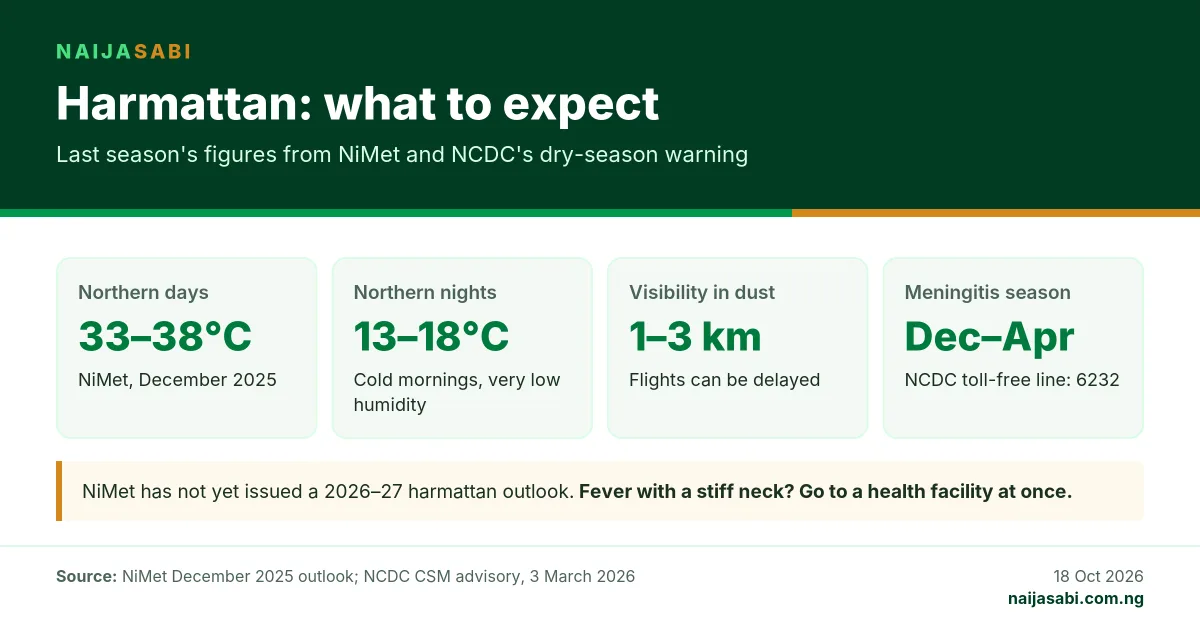
📌 Quick answer: Harmattan is the dry, dusty north-easterly wind that blows from the Sahara across Nigeria during the dry season. The rains are now retreating: NiMet’s October 2026 outlook describes rainfall gradually declining. By December last year, NiMet said the dry season was “fully established nationwide with Harmattan dominance”, with northern days of 33–38°C, nights of 13–18°C and visibility down to 1–3 km in dust. NCDC warns that cerebrospinal meningitis is most common from December to April. NiMet has not yet issued a specific harmattan outlook for 2026–27.
Every year the change comes the same way: the last storms of the rainy season give way to hazy skies, cold early mornings, cracked lips and a fine layer of dust on every surface. For some Nigerians harmattan is the most pleasant time of year. For others it brings asthma attacks, eye irritation, flight delays and a higher risk of fire. This guide explains what to expect, using what NiMet, NCDC and the aviation regulator have said, and how to prepare.
What Is Harmattan?
Harmattan is a dry north-easterly trade wind that carries dust from the Sahara south across West Africa. NiMet’s climate and health bulletin for the last quarter of 2024 describes “cold, dry, and dusty northeasterly (Harmattan) winds” prevailing in the north during October, November and December. The Nigeria Civil Aviation Authority describes the resulting dust haze as “a dry and dusty wind that blows south from the Sahara across Nigeria.”
The wind brings four things: dust in the air, very low humidity, cold nights and early mornings, and hot afternoons. The effects are strongest in the north and weaken towards the coast, but the haze can reach southern cities too.
When Does Harmattan Start in 2026?
Harmattan follows the end of the rains, which happens first in the far north and last along the coast. NiMet’s monthly outlook for October 2026 describes rainfall gradually declining as the rainy season retreats. Its 2026 Seasonal Climate Prediction, released on 10 February 2026, forecast that the rains would end:
- Earlier than normal in parts of Ogun, Osun, Ondo, Imo, Rivers, Akwa Ibom, Kogi and Niger States;
- Later than normal in Lagos, Ogun, Anambra, Enugu, Cross River, Benue, Nasarawa and Kaduna States.
Ogun appears on both lists because the early-end forecast applies only to parts of the state. NiMet also predicted a longer-than-normal rainy season for states including Lagos, Benue, Enugu, Ebonyi, Ogun, Oyo, Nasarawa, Anambra, Kwara, Kebbi, Kaduna, Gombe and Taraba, which means a later start to the dry season there.
For a sense of timing, look at last season. NiMet’s outlook for December 2025 said the dry season was fully established nationwide with harmattan dominant, and the aviation regulator’s past advisories have expected dust haze to last until March. NiMet has not published a dedicated harmattan forecast for 2026–27 yet; its monthly outlooks for November and December are the ones to watch.
What Harmattan Weather Looks Like
| Condition | What NiMet reported for the north, December 2025 |
|---|---|
| Daytime temperature | 33–38°C |
| Night-time temperature | 13–18°C |
| Humidity | Very low |
| Visibility in dust haze | 1–3 km, and below 3 km in affected areas |
That swing of 20°C or more between night and afternoon is what catches people out: a jacket at 6am, sunburn at 2pm.
Harmattan and Your Health
Meningitis: the most serious risk
The Nigeria Centre for Disease Control and Prevention (NCDC) says cerebrospinal meningitis (CSM) “occurs more frequently between December and April, when dry, dusty conditions, overcrowding, and poor ventilation increase the risk of transmission.” It spreads through respiratory droplets during close contact. NCDC lists the main symptoms as sudden high fever, severe headache and neck stiffness, and in babies a bulging soft spot, irritability, refusal to feed and excessive sleepiness.
NCDC’s advice: get vaccinated when eligible and take part in state vaccination campaigns, avoid overcrowding where possible, keep homes and gathering places well ventilated, and go to a health facility promptly if symptoms appear. It warns specifically: do not self-medicate and do not rely on herbal remedies, because immediate antibiotic treatment at a health facility is essential. NCDC’s toll-free line is 6232.
Breathing, eyes and skin
- Dust and breathing: if you have asthma or another lung condition, keep your inhaler and medicines with you and speak to your doctor about the season. A face mask helps on very dusty days.
- Eyes: dust and dry air irritate the eyes. Sunglasses help outdoors; do not rub irritated eyes, and see a pharmacist or doctor if irritation persists.
- Skin and lips: moisturise after bathing while skin is still damp, use lip balm, and drink more water than you think you need. Low humidity dries you out even when you do not feel hot.
- Children and older people: they feel the cold mornings most. Dress them in layers they can remove as the day warms up.
Flights, Roads and Fire
Flights
In a past harmattan advisory, the Nigeria Civil Aviation Authority warned that dust haze can reduce air-to-ground visibility, push aerodrome visibility below operating minimums and, in severe conditions, “blot out runways, markers and airfield lightings.” It said flights “are bound to be delayed, diverted or cancelled” when visibility falls below the minimum, and directed operators to cushion the effect on passengers. If you are flying in December or January, book morning-to-midday flights where you can, allow slack for connections and check your flight status before leaving home. See our guide to domestic flights in Nigeria.
Roads
- Switch on dipped headlights in haze so others can see you, and avoid full beam, which reflects off the dust.
- Slow down and increase your following distance; visibility can drop suddenly.
- Replace worn wiper blades and keep your windscreen washer filled; dust smears quickly.
- Check your car’s air filter and cabin filter more often than usual.
Fire
Dry grass, dry air and wind make fires start more easily and spread faster. Do not burn refuse or bush near homes, markets or farms, switch off appliances and gas cylinders when not in use, avoid overloading sockets, and keep a working fire extinguisher where you can reach it.
Harmattan Preparation Checklist
| Area | What to do now |
|---|---|
| Health | Check meningitis vaccination status for your family; restock asthma medicines; know the symptoms NCDC lists |
| Skin and comfort | Body cream, lip balm, a refillable water bottle, a warm layer for mornings |
| Home | Keep rooms ventilated, cover stored water and food, check electrical wiring and sockets |
| Car | Wiper blades, washer fluid, air and cabin filters, working headlights |
| Travel | Build in extra time for flights in December and January; check status before leaving |
Frequently Asked Questions
When does harmattan start in Nigeria?
It follows the end of the rains, starting in the north. In NiMet’s December 2025 outlook, harmattan was dominant nationwide. NiMet has not issued a dedicated 2026–27 harmattan forecast yet, so watch its November and December outlooks.
How long does harmattan last?
Typically through the dry season. The aviation regulator’s past advisories have expected dust haze to persist until March.
Why is meningitis more common during harmattan?
NCDC says dry, dusty conditions, overcrowding and poor ventilation increase transmission, which is why cases rise between December and April.
Does harmattan cause flight delays?
It can. When dust haze reduces visibility below the minimum required at an airport, flights may be delayed, diverted or cancelled.
What is NCDC’s emergency number?
NCDC’s toll-free number is 6232.
Sources
- Nigerian Meteorological Agency (NiMet) – 2026 Seasonal Climate Prediction, unveiled 10 February 2026 – nimet.gov.ng
- NiMet – October 2026 and December 2025 weather outlooks (official social media); Climate and Health Bulletin, 4th quarter 2024
- Nigeria Centre for Disease Control and Prevention – Public Health Advisory on Cerebrospinal Meningitis, 3 March 2026 – ncdc.gov.ng
- Nigeria Civil Aviation Authority – “NCAA cautions pilots, operators on harmattan haze” (Advisory Circular NCAA-AEROMET-28) – ncaa.gov.ng
Last updated: 24 October 2026 · NaijaSabi Lifestyle Desk. This is general information, not medical advice. If you or your child has fever with a stiff neck or confusion, go to a health facility immediately.




0 Comments
No comments yet. Be the first to share your thoughts!