




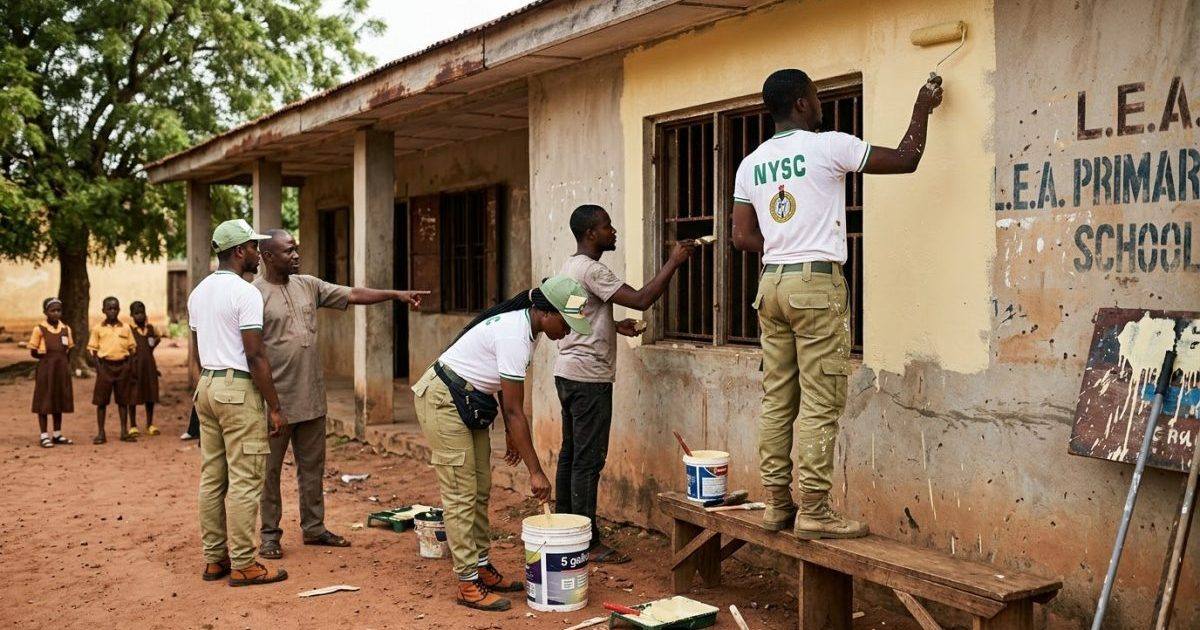
📌 Quick Summary: Community Development Service (CDS) is one of the four cardinal programmes of the NYSC. Corps members use one day a week for group CDS and are not expected at their place of primary assignment on that day. There are three kinds: group CDS, personal CDS projects and collaborative CDS with partner agencies. NYSC’s handbook says you cannot belong to more than one group and that your Local Government Inspector assigns you, unless you joined a specialised group in camp. A personal project needs an approved written proposal, and NYSC says it must never be funded from your allowance. This guide follows NYSC’s own “ABC of Community Development Service” handbook.
Most corps members first hear about CDS in camp and spend the next few weeks guessing how it works. NYSC publishes an official handbook that answers most of the questions: what the groups are, who picks yours, how a project gets approved and how it is funded. This guide sets that out in plain language. One thing to know up front: the handbook is dated October 2014, so check the details with your Local Government Inspector (LGI) in your state.
What Is CDS?
NYSC’s handbook describes CDS as one of the four cardinal programmes of the Scheme, in which corps members contribute to the development of their host communities throughout the national service year. Among its stated objectives are improving rural community life, developing the spirit of entrepreneurship in corps members, exposing them to the traditions and customs of host communities, giving them on-the-job training, and instilling the tradition of dignity of labour and productivity. NYSC’s current CDS page adds that group CDS activities follow the Scheme’s 16 approved groups.
How Often Is CDS and Does It Replace My Job Day?
Under the handbook, corps members are expected to use one day a week for group CDS activities and are not expected to attend duties at their place of primary assignment on CDS days. NYSC says those days are dedicated to projects and programmes that improve living conditions in the host community. The handbook does not name a weekday, so the day depends on your state or local government. Ask your LGI or group leader.
The Three Types of CDS
- Group CDS: the weekly activity with your assigned group.
- Personal (individual) CDS: a project you carry out yourself in the host community, based on a need the community has expressed. The handbook’s examples include building toilets, incinerators, bridges, classrooms and school games facilities, or setting up an ICT laboratory, school libraries, extra-mural classes, campaigns, charity work and vocational training for unemployed youths.
- Collaborative CDS: programmes NYSC runs with national and non-governmental organisations under an MOU that sets out each partner’s role. Corps members take part as volunteers.
The CDS Groups
These are the groups, purposes and example activities named in NYSC’s handbook. NYSC’s current page says there are 16 approved groups. The text of the handbook we could read shows 15 of them clearly, so ask your LGI for the full current list in your state.
| Group | Purpose | Example activities |
| Corps Legal Aid Group (CLAG) | Free legal services for the less privileged and indigent prison inmates; public awareness on human rights | Prison visits, legal service to inmates and indigent persons, public lectures |
| Sports Group | Recreation and healthy rivalry; promoting healthy lifestyles; identifying talent | Sports competitions, training community members |
| Cultural and Tourism Group (Band, Dance, Drama and Tourism) | Promoting arts and culture; passing on socio-economic and political messages | Identifying talent, entertainment, setting up theatre groups |
| Education Development Group (Mass Literacy, Adult Education, Extra-Murals, ICT) | Raising education standards in the host community; career guidance for students | Campaigns against illiteracy, extra-mural classes for adults, in-school programmes |
| Environmental Protection and Sanitation Group (Ecovanguard, NESREA) | Promoting a healthy environment and sustainable environmental management | Tree planting, sanitation, drainage and erosion control, reforestation, landscaping |
| Editorial/Publicity Group | Supporting NYSC’s Public Relations Unit in passing information to the community | Presentations on mass media on socio-cultural education |
| Road Safety Group | Contributing to public safety on the roads | Traffic sensitisation and control, first aid for accident victims, school road safety clubs |
| Reproductive Health and HIV/AIDS Group | Training and mentoring students; community responses to HIV/AIDS prevention | Sensitisation and campaigns |
| Anti-Corruption Group (EFCC and ICPC) | Fighting corruption through campaigns | Sensitisation, awareness in schools and organisations, anti-corruption clubs in schools |
| Service Delivery Group (Attitudinal Change, Re-Branding), MDGs | Sensitisation on service delivery and good work ethics; awareness on the MDGs | Training, sensitisation, group discussions on value re-orientation, mentoring |
| Medical and Health Services Group (Red Cross, Breast Without Spot, Polio Plus, etc.) | Promoting and providing medical services | Health outreach, first aid, community clinics, a clinic for the NYSC secretariat |
| Drug Free and Quality Control Group (NDLEA, NAFDAC, SON) | Fighting fake and adulterated food and drugs; awareness on drug abuse | Campaigns, drug-free clubs in schools |
| Agro-Allied Group | Supporting agro-allied activities; better food production and security | Demonstration farms, farmers’ cooperatives, teaching new farming techniques, young farmers’ clubs |
| Charity Services and Gender Group | Improving the living standard of the down-trodden | Charity outreaches, visits to orphanages and prisons, donations |
| Disaster Management Group (NEMA) | Awareness on disaster management through Corps Emergency Vanguards | Public enlightenment, liaison with NEMA during emergencies, emergency vanguard clubs in schools |
The handbook marks the Road Safety, Reproductive Health and HIV/AIDS, Anti-Corruption, Service Delivery, Medical and Health Services, and Drug Free and Quality Control groups as collaborative CDS groups.
Who Chooses Your CDS Group?
NYSC’s handbook answers this directly in its FAQ:
- Can I belong to more than one CDS group? No. NYSC wants every corps member fully committed to one group.
- Can I choose my group? No. The Local Government Inspector assigns corps members, except where you joined a specialised group in camp and received training for your role.
- Should a personal project interfere with my primary assignment? No. Personal CDS is for spare time and must not affect your duties at your place of primary assignment or your group CDS activities.
How to Do a Personal CDS Project
The handbook sets out these steps for a project:
- Meet community stakeholders and identify what the community actually needs.
- Identify sources of funds and relevant linkages.
- Write a proposal with the guidance of your Local Government and Zonal Inspectors. It should state the name of the project, estimated cost, source of funding, expected completion time and proposed commissioning date, with a work plan attached.
- Get the project approved by the NYSC secretariat after consultation with the inspectors.
- Mobilise resources together with community members, the local government council, government and non-government organisations and philanthropists.
- Contact the linkages relevant to your project.
- Carry out the project jointly with the community.
- Submit progress reports with documents and photographs. The handbook’s steps say bimonthly, and its FAQ says at least three progress reports plus a completion report.
- Submit a completion report to the NYSC State Secretariat.
- Commission the project and hand it over to the community.
- Give feedback to the people who donated.
What Gets a Project Approved
The handbook lists these criteria: a written proposal addressed to the State Coordinator through the Local and Zonal Inspectors; a statement of why the project matters to the community; how the community will benefit after you leave; a location that is not in a disputed area and is accessible; funding sourced within your state of service; and completion within the service year. NYSC also tells corps members to test their idea against the SMART test (Specific, Measurable, Achievable, Rewarding, Time-bound) and the community’s felt need.
Who Pays? The Rule on Funding
NYSC is explicit: on no account should a corps member fund a CDS project with his or her allowance or with money from parents or relatives. Funds should come from the community, corporate organisations, NGOs, philanthropists, government agencies, public-spirited individuals and political office holders. Keep an income and expenditure record with receipts attached. And you must not write letters to government bodies, parastatals or private organisations except through the State Coordinator.
The CDS Year at a Glance
The handbook gives a generic timeline for a service year:
| When | Activity |
| Month 1 | Orientation camp |
| Month 2 | Placement of corps members on CDS groups and settling down |
| Months 3–4 | Development and submission of proposals |
| Month 5 | Approval of proposals and project commencement |
| Month 6 | Supervision and monitoring of projects by relevant officers |
| Month 7 | Collation and submission of quarterly reports; late proposals and approvals |
| Months 8–9 | Project execution and supervision continue; late proposals and approvals (month 8) |
| Month 10 | Final reports and inauguration of projects |
| Month 11 | Passing out |
CDS Awards
NYSC says carrying out a project does not automatically earn an award. Awards are made through a procedure of selection, evaluation and verification of CDS projects, performance at the place of primary assignment, orientation course and winding-up activities. The awards listed are:
| Award |
| State Coordinator’s Letter of Commendation |
| Local Government Honours Award |
| State Government Honours Award |
| Presidential Honours Award |
What the Handbook Does Not Say
- No penalties are listed. The handbook calls CDS a programme undertaken by all corps members throughout the service year, but it does not set out penalties for missing CDS. Ask your LGI how attendance is recorded in your state.
- No fixed weekday. It says one day a week without naming the day.
- It is from 2014. Group names and procedures may have changed since. NYSC’s current CDS page still refers to the 16 approved groups.
Frequently Asked Questions
What does CDS mean in NYSC?
Community Development Service, one of the four cardinal programmes of NYSC, in which corps members contribute to the development of their host communities during the service year.
How many CDS groups are there?
NYSC’s current CDS page refers to 16 approved groups. NYSC’s 2014 handbook lists them with their purposes and activities.
Can I choose my CDS group?
According to NYSC’s handbook, no. The Local Government Inspector assigns you, except where you joined a specialised group in camp and were trained for it.
Can I be in two CDS groups?
No. The handbook says a corps member cannot belong to more than one group.
Do I need approval for a personal CDS project?
Yes. NYSC says a written proposal must be approved before you start, and progress and completion reports must follow.
Can I use my allowance for my CDS project?
No. NYSC says corps members must not fund CDS projects with their allowance or with money from parents or relatives.
Also read: NYSC 2026 registration and camp guide and NYSC allowance 2026.
Sources
- National Youth Service Corps — “ABC” of Community Development Service (handbook, October 2014) — nysc.gov.ng/downloads/CDS_ABC.pdf
- National Youth Service Corps — Community Development Service and Special Projects Department — nysc.gov.ng/cds.html
Based on NYSC’s official CDS handbook and CDS page, checked on 8 October 2026. The handbook is dated 2014; confirm current practice with your Local Government Inspector or State Secretariat. Last updated: 8 October 2026 · NaijaSabi Education Desk.





0 Comments
No comments yet. Be the first to share your thoughts!