




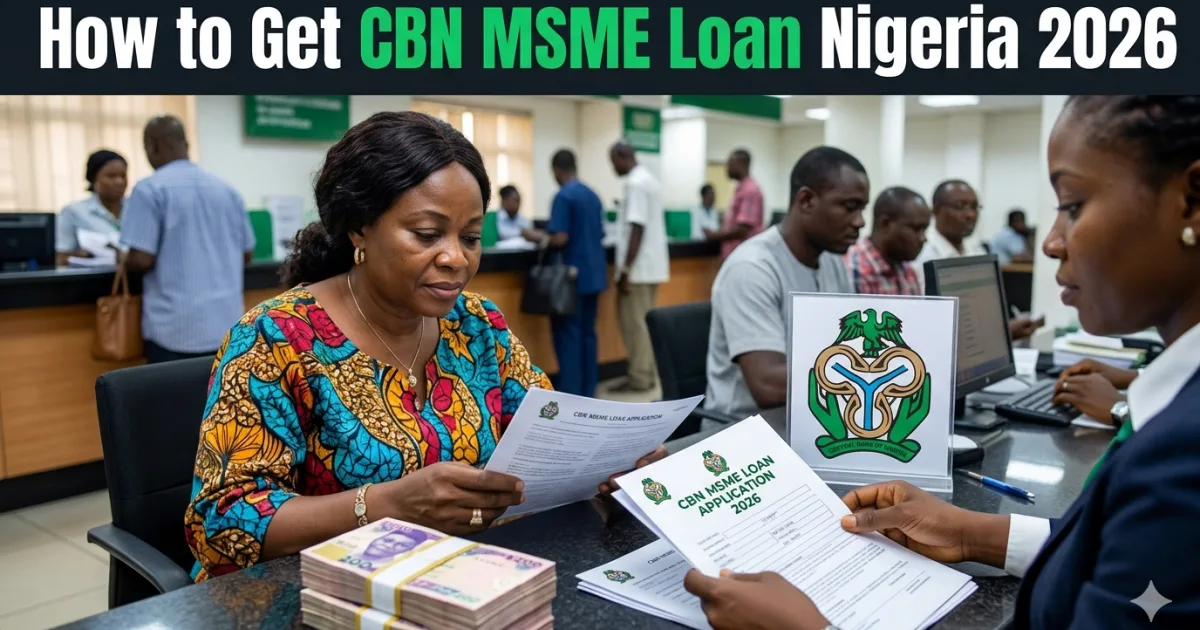
Access to affordable business financing is one of the most persistent challenges facing Nigerian small and medium enterprises. Commercial bank loans carry interest rates of 25–35% per annum — unviable for most small businesses operating on thin margins. The Central Bank of Nigeria (CBN), recognising this barrier, has established several intervention schemes offering loans at subsidised interest rates of 5–9% per annum to Micro, Small, and Medium Enterprises (MSMEs). In 2026, multiple CBN-backed lending schemes are operational — though some have been restructured, merged, or had their eligibility criteria updated under the current CBN Governor Olayemi Cardoso’s monetary policy framework. This comprehensive guide tells you exactly which schemes are available, how much you can borrow, what the interest rates are, who qualifies, what documents you need, and how to apply.
Overview of CBN MSME Loan Schemes Available in 2026
| Scheme | Maximum Loan | Interest Rate | Target | Apply Through |
|---|---|---|---|---|
| AGSMEIS (Agric, Small/Medium Enterprise Investment Scheme) | ₦10,000,000 (₦10 million) | 5% per annum | Agric, MSMEs, startups | NIRSAL Microfinance Bank |
| Targeted Credit Facility (TCF) | ₦25,000,000 for SMEs; ₦3,000,000 for households | 5% per annum | COVID-impacted businesses; households | NIRSAL Microfinance Bank |
| National Youth Investment Fund (NYIF) | ₦3,000,000 | 5% per annum | Nigerian youth entrepreneurs (18–35) | Federal Ministry of Youth Development via NIRSAL MFB |
| Creative Industry Financing Initiative (CIFI/CreativesHub) | Varies by category | 9% per annum | Nollywood, music, fashion, IT, others | Designated commercial banks |
| Anchor Borrowers Programme (ABP) | Per crop/season basis | 9% per annum | Smallholder farmers linked to anchor companies | Participating banks and anchor companies |
AGSMEIS Loan: The Most Accessible CBN MSME Scheme
The Agribusiness/Small and Medium Enterprise Investment Scheme (AGSMEIS) is funded by a 0.5% contribution from commercial banks’ profits, pooled under the CBN and disbursed through NIRSAL Microfinance Bank (NIRSAL MFB). It offers loans at just 5% per annum — compared to 25–35% at commercial banks — making it the most affordable formal credit available to Nigerian MSMEs.
AGSMEIS Key Terms
- Maximum loan amount: ₦10,000,000 (₦10 million)
- Interest rate: 5% per annum (flat)
- Tenor (repayment period): Up to 7 years
- Moratorium: Up to 12 months (you don’t start repaying for the first 12 months)
- Collateral: Moveable assets, equipment, or guarantors may be required depending on loan size
- Who qualifies: MSMEs, startups, agricultural businesses, youth-owned enterprises
Who Is Eligible for AGSMEIS?
AGSMEIS is open to: formally registered businesses (with CAC registration); sole proprietors and cooperatives; agricultural enterprises (farming, processing, storage, distribution); and micro, small, and medium enterprises in manufacturing, trade, and services. Applicants must have completed an NIRSAL-approved entrepreneurship training programme — this is a mandatory pre-qualification requirement that many applicants overlook. The training is typically 3–5 days and is offered through accredited training institutions across Nigeria. Without this training certificate, your AGSMEIS application cannot proceed regardless of how strong your business plan is.
How to Apply for AGSMEIS Loan — Step by Step
- Complete NIRSAL-approved entrepreneurship training: Find an accredited training provider through the NIRSAL MFB website at nirsal-mfb.com. Training takes 3–5 days and focuses on business planning, financial management, and loan management
- Register on the NIRSAL MFB portal: Visit nirsal-mfb.com and create an applicant account
- Complete your business plan: Your business plan must include: executive summary, business description, market analysis, products/services, operational plan, financial projections (3-year income statement, cash flow, and balance sheet), and the loan amount requested with clear justification of how the funds will be used
- Submit application online: Upload your business plan, training certificate, CAC documents, financial statements, and all required supporting documents through the portal
- Application review: NIRSAL MFB reviews your application — this takes 2–8 weeks depending on application volume
- Physical verification: If your application passes initial review, NIRSAL MFB sends an officer to verify your business premises and operations
- Loan committee decision: Your application is reviewed by NIRSAL MFB’s credit committee
- Disbursement: Approved loans are disbursed directly to your designated business account
Documents Required for CBN MSME Loan Application
| Document | Notes |
|---|---|
| CAC registration certificate | Certificate of Incorporation or Business Name registration — must be valid and current |
| Valid means of identification | NIN card, international passport, voter’s card, or driver’s licence |
| BVN | Bank Verification Number — compulsory for all applications |
| TIN | Tax Identification Number from tin.jtb.gov.ng |
| Business plan | Comprehensive, professionally prepared; must include financial projections |
| Financial statements | Audited accounts for established businesses; management accounts for newer businesses |
| Bank statements | 6–12 months of business bank account statements |
| Training certificate | NIRSAL-approved entrepreneurship training — mandatory for AGSMEIS |
| Passport photograph | Recent, white background |
| Evidence of business address | Utility bill, tenancy agreement, or local government business premises certificate |
National Youth Investment Fund (NYIF): For Young Entrepreneurs
The National Youth Investment Fund was established by the Federal Ministry of Youth Development in partnership with NIRSAL MFB to provide affordable loan financing specifically to Nigerian young entrepreneurs aged 18–35. The scheme offers loans at 5% per annum — the same highly subsidised rate as AGSMEIS — for youth-owned businesses across all sectors.
NYIF Key Terms and Eligibility
- Age requirement: 18–35 years old at time of application
- Maximum loan: ₦3,000,000 per applicant
- Interest rate: 5% per annum
- Repayment period: Up to 36 months
- Sectors covered: All sectors — agriculture, manufacturing, trade, services, technology, creative industries
- Business registration: Must have CAC-registered business or cooperative
- Training: Mandatory entrepreneurship training from accredited provider
- Apply at: nyif.nmfb.com.ng or through NIRSAL MFB portal
Targeted Credit Facility (TCF): For COVID-Impacted Businesses
The Targeted Credit Facility was introduced in 2020 to support businesses and households affected by the COVID-19 pandemic. While its original mandate was COVID relief, the scheme has continued operating in 2025–2026 to support businesses still recovering from the economic disruptions of the pandemic period combined with the subsequent fuel subsidy removal shock. As of 2026, TCF applications are accepted through NIRSAL MFB at nmfb.com.ng with the following terms: household applicants can borrow up to ₦3,000,000 at 5% per annum; SME applicants can borrow up to ₦25,000,000 at 5% per annum; repayment periods of up to 12 months for working capital loans and 36 months for term loans.
Creative Industry Financing Initiative (CIFI): For the Creative Sector
The Creative Industry Financing Initiative (now branded CreativesHub in some CBN communications) targets Nigeria’s rapidly growing creative economy — Nollywood, music, fashion and design, information technology, and other creative industries. Unlike AGSMEIS and TCF which are channelled exclusively through NIRSAL MFB, CIFI is available through designated commercial banks. Interest rate is 9% per annum — higher than AGSMEIS but still dramatically below commercial bank rates. Key sectors covered include: film production and distribution (Nollywood); music production, recording, and distribution; fashion design and manufacturing; software development and IT services; and animation, gaming, and content creation. Applications are made through CBN-designated participating banks — check the CBN website at cbn.gov.ng for the current list of CIFI-participating banks. CIFI loans can be used for: production equipment, working capital, studio facilities, distribution infrastructure, and capacity building in the creative sector.
Why Most MSME Loan Applications Are Rejected — And How to Avoid It
CBN intervention loans are oversubscribed — applications vastly exceed available funds. Understanding the most common rejection reasons gives you the best chance of approval on your first application.
1. Weak or Missing Business Plan
The business plan is the centrepiece of any MSME loan application — yet it is the most commonly inadequate element. A weak business plan that lacks realistic financial projections, market analysis, and a clear explanation of how the loan will generate revenue to enable repayment is the primary rejection cause. Invest in a professionally prepared business plan — either from a business development consultant (₦20,000–₦80,000 for quality preparation) or through rigorous self-preparation using CBN’s published MSME business plan guidelines. Your financial projections must be realistic — grossly optimistic revenue projections that don’t match your industry norms are easily spotted by experienced credit officers and undermine your entire application.
2. Missing Training Certificate
For AGSMEIS and NYIF, the entrepreneurship training certificate from an NIRSAL-accredited provider is mandatory. Many applicants submit otherwise strong applications that are automatically disqualified because they skipped the training step. Do the training first — it also genuinely improves your business planning skills and loan management knowledge.
3. Incomplete or Inconsistent Documents
Name inconsistencies across documents (different spelling on CAC registration, NIN, and bank statements), missing bank statements, financial statements that don’t match your bank account inflows, or expired CAC registration all trigger rejection. Audit every document for consistency before submission and ensure your CAC registration is current with the relevant Annual Return filed.
4. No Established Business Operations
While AGSMEIS includes startups, loan officers are more comfortable approving businesses with demonstrable operating history. A business with 12+ months of documented operations, revenue flowing through its business account, and evidence of existing customers has significantly higher approval chances than a pure startup with no track record. If you are a startup, ensure your business plan is exceptionally strong to compensate for the absence of operating history.
5. Previous Loan Default
If you or your business has previously defaulted on any CBN intervention loan — AGSMEIS, TCF, NYIF, or others — your application will be rejected. The CBN Credit Risk Management System (CRMS) tracks all intervention loan histories. There are no workarounds for previous defaults in the CBN loan system — full repayment of any outstanding intervention loan debt is required before reapplying.
NIRSAL MFB: The Primary CBN MSME Loan Window
The NIRSAL Microfinance Bank (NIRSAL MFB, also known as the Nigeria Incentive-Based Risk Sharing System for Agricultural Lending Microfinance Bank) is the primary channel through which most CBN MSME intervention loans flow. NIRSAL MFB was specifically established by the CBN to de-risk agricultural and MSME lending — providing guarantees and partial risk coverage to encourage more banks to lend to small businesses. Its portal at nirsal-mfb.com (and nmfb.com.ng for some schemes) is the starting point for AGSMEIS, TCF, NYIF, and related applications. NIRSAL MFB branches are located in all 36 states and the FCT, and its online portal allows applications to be submitted without branch visits for the initial stages. Customer support: 07080222000 or support@nirsal-mfb.com.
Alternative Business Financing Options in Nigeria 2026
CBN intervention loans are highly attractive but limited in availability and require significant documentation and preparation. Here are practical alternatives for businesses that cannot access CBN schemes:
- Commercial bank SME loans: Most major Nigerian banks have dedicated SME loan products — Access Bank’s SME loan, GTBank’s Quick Credit for businesses, Zenith Bank’s SME products. Rates are typically 22–28% per annum — much higher than CBN intervention rates but more consistently available
- Cooperative societies: Joining or forming a cooperative society and accessing cooperative loans at 8–15% per annum is available to members in good standing. Cooperative loans typically require smaller documentation than bank loans
- Fintech SME lending: Platforms including Carbon, Fairmoney, Renmoney, and Branch offer business loans at 15–36% per annum with fast digital approval — useful for working capital needs that can be repaid within 6–12 months
- Government state programs: Several state governments operate their own MSME support funds — Lagos State’s LSEDA, Ogun State’s OGFZA, and similar — with subsidised lending separate from CBN schemes
- Angel investors and venture capital: For tech startups and scalable businesses, angel investment platforms (Lagos Angel Network, Rising Tide Africa, Ventures Platform) provide equity funding rather than debt — no repayment required in exchange for an ownership stake
Frequently Asked Questions — CBN MSME Loan 2026
How do I apply for CBN MSME loan in Nigeria 2026?
For AGSMEIS and TCF: register at nirsal-mfb.com or nmfb.com.ng. Complete an NIRSAL-approved entrepreneurship training, prepare a comprehensive business plan, gather all required documents (CAC cert, NIN, BVN, TIN, bank statements, financial statements), submit online. For NYIF: apply at nyif.nmfb.com.ng. For CIFI: apply through CBN-designated participating commercial banks.
What is the interest rate on CBN MSME loan?
AGSMEIS, TCF, and NYIF: 5% per annum — dramatically below commercial bank rates of 25–35%. CIFI (Creative Industry): 9% per annum. Anchor Borrowers Programme: 9% per annum.
How much can I borrow from CBN MSME loan?
AGSMEIS: up to ₦10,000,000. NYIF: up to ₦3,000,000. TCF (SMEs): up to ₦25,000,000. TCF (households): up to ₦3,000,000. The actual approved amount depends on your business plan, financial projections, and credit assessment.
💼 CBN MSME Loan Nigeria 2026 — Quick Reference
- AGSMEIS: Up to ₦10M at 5%/yr — apply at nirsal-mfb.com
- NYIF (youth): Up to ₦3M at 5%/yr — age 18–35 — nyif.nmfb.com.ng
- TCF: Up to ₦25M (SME) / ₦3M (household) at 5%/yr — nmfb.com.ng
- CIFI (creative sector): 9%/yr — via designated commercial banks
- Training required: NIRSAL-approved entrepreneurship training mandatory for AGSMEIS/NYIF
- Documents needed: CAC cert + NIN + BVN + TIN + business plan + bank statements
- Key rejection cause: Weak business plan — invest in professional preparation
- NIRSAL MFB contact: nirsal-mfb.com | 07080222000
- No shortcuts: Any agent charging to “guarantee” loan approval is a scammer
Also read: TIN Registration Nigeria 2026 | How to Make Money Online Nigeria 2026 | How to Open Kuda Account 2026
Writing a Winning Business Plan for Your CBN Loan Application
The business plan is the single most important document in any CBN MSME loan application — and the most commonly under-prepared. A business plan that wins loan approval is not a vague statement of your business idea but a detailed, evidence-based document that demonstrates to the credit officer that you understand your market, have a viable business model, have realistic financial projections, and have a credible plan for generating enough revenue to repay the loan comfortably within the agreed term. Here is what a winning CBN MSME loan business plan must include:
Executive Summary (1–2 pages)
A concise summary of your business, the loan amount requested, the purpose of the funds, and the projected impact on your business revenue. Write this last — after completing all other sections — so it accurately summarises what follows. The executive summary is the first thing the credit officer reads and must be compelling enough to motivate them to read the full plan.
Business Description (2–3 pages)
Describe your business in detail: what products or services you sell, how long you have been operating, your legal structure (sole proprietorship, partnership, limited company), your CAC registration details, your physical location and business premises, your management team and their relevant experience, and your current customer base. For established businesses, include your current monthly revenue and the trend over the past 12 months.
Market Analysis (2–4 pages)
Demonstrate that you understand your market. Who are your customers? What are their needs and buying habits? How large is the total addressable market in your area? Who are your competitors and what distinguishes your business from them? What market trends support your business growth projections? Credit officers want to see that you are operating in a real, viable market — not simply expressing optimism about a business idea.
Financial Projections (3–5 pages)
This is the most critical section for credit assessment. You must provide: a projected income statement for 3 years showing monthly revenue, cost of goods sold, gross profit, operating expenses, and net profit; a cash flow projection for 3 years showing actual cash inflows and outflows month by month; a projected balance sheet; and a loan repayment schedule showing how the principal and 5% interest will be repaid over the agreed term. Your projections must be internally consistent — revenue growth rates must align with market analysis assumptions, cost assumptions must reflect actual input costs in your industry, and cash flow timing must realistically reflect your business’s collection and payment cycles. Projections that show implausibly rapid growth without credible justification are red flags that undermine your entire application.
Loan Utilisation Plan
Specify exactly how every naira of the requested loan will be used. A ₦5,000,000 loan request should be broken down: ₦2,000,000 for equipment purchase (specify the equipment and provide supplier quotes); ₦1,500,000 for raw material stock; ₦1,000,000 for working capital; ₦500,000 for marketing and business development. The more specific and evidence-based your utilisation plan, the more confidence you give the credit officer that funds will be deployed purposefully rather than diffusely.
CBN MSME Loan Scams: Protect Yourself
The desperation of Nigerian small businesses for affordable financing has created a fertile environment for loan-related fraud. Common CBN loan scams in 2026 include: individuals claiming they can “process” your CBN loan application and guarantee approval for an upfront fee (₦20,000–₦200,000); fake CBN or NIRSAL MFB websites that collect application fees and personal information without delivering any loan; WhatsApp messages claiming “CBN loan disbursement” is available for immediate application with a link to a fraudulent portal; and individuals at NIRSAL MFB offices posing as staff who can fast-track applications for cash. Protect yourself: apply only through nirsal-mfb.com, nmfb.com.ng, or nyif.nmfb.com.ng — official portals. No legitimate CBN or NIRSAL MFB process requires any upfront cash payment to an individual. Report fraud to the EFCC at efcc.gov.ng or call the CBN consumer protection line at 0700-225-5226.
Repaying Your CBN MSME Loan: Obligations and Consequences
Taking a CBN intervention loan at 5% interest is a significant privilege relative to market rates. With this privilege comes a clear repayment obligation. Key points on repayment: your repayment schedule is agreed at disbursement — typically monthly instalments of principal plus interest. Set up a standing instruction from your business account to ensure repayments are made on time every month without requiring manual action. Missing repayments triggers penalty charges and, if persistent, results in your account being classified as non-performing in the CBN Credit Risk Management System (CRMS). A CRMS default classification follows you permanently in the Nigerian financial system — future applications for any bank loan, intervention scheme, or credit facility will be rejected until the default is fully resolved. Do not treat CBN intervention loans as “government money” that doesn’t need to be repaid — they are loans from a formal financial institution with legal recourse for non-payment, and the NIRSAL MFB actively pursues defaulters through debt collection and legal action.
State Government Loan Schemes: Complementary to CBN Loans
Beyond federal CBN intervention schemes, several Nigerian state governments operate their own MSME financing programmes that complement rather than compete with CBN loans. Lagos State Employment Trust Fund (LSETF) provides loans to Lagos-based MSMEs at single-digit interest rates, with amounts ranging from ₦250,000 to ₦5,000,000 depending on business category. Lagos State Employment and Development Agency (LSEDA) similarly supports MSME development through training and complementary financing. Ogun State Free Zones Authority (OGFZA) provides incentives and financing support for businesses operating within Ogun’s industrial free zones. Kano State, Rivers State, and several other states have launched their own MSME support funds in recent years, typically administered through state ministries of commerce and industry or dedicated state investment agencies. Applying for both a CBN intervention loan and a relevant state programme simultaneously is permitted in most cases — they are separate funding sources with separate eligibility criteria, and a business with both federal and state-level financing diversifies its capital sources and reduces dependence on any single scheme’s availability and processing timeline. Check your specific state’s ministry of commerce, industry, or investment website for the current programmes available to businesses registered in that state.
CBN MSME Loan Disbursement Timeline: What to Expect
Understanding the realistic timeline from application to disbursement helps you plan your business cash flow appropriately rather than assuming funds will arrive immediately. The complete process from initial application to actual disbursement typically takes 8–16 weeks for AGSMEIS and similar NIRSAL MFB-administered schemes, broken down approximately as follows: entrepreneurship training completion (if not already done) takes 3–5 days plus scheduling time; business plan preparation, if done thoroughly, takes 1–3 weeks; online application submission and document upload is completed in a single session once all documents are ready; initial document review by NIRSAL MFB takes 2–4 weeks; physical verification visit to your business premises is scheduled and conducted within 1–3 weeks of passing initial review; credit committee decision typically follows within 1–2 weeks of the verification visit; and disbursement to your account occurs within 1–2 weeks of final approval. Total realistic timeline: 8–16 weeks from a complete, well-prepared application to funds in your account. Plan your business cash flow needs with this timeline in mind — do not apply for a CBN loan as an emergency funding source for an immediate cash crisis, as the processing time makes it unsuitable for urgent needs. Instead, apply proactively for planned expansion, equipment purchase, or working capital needs where the multi-month timeline is acceptable.
State-Level Complementary Loan Schemes
Beyond CBN’s federal intervention schemes, several Nigerian state governments operate their own MSME support funds that complement rather than compete with CBN loans. Understanding these state-level options gives applicants additional avenues to explore, particularly when CBN funding windows are temporarily oversubscribed or closed for new applications.
Lagos State Employment Trust Fund (LSETF)
LSETF provides loans to Lagos-based MSMEs and individual entrepreneurs at single-digit interest rates, typically ranging from ₦300,000 to ₦5,000,000 depending on the applicant category. LSETF has historically run structured cohorts with specific application windows announced on its website and social media. Eligibility requires Lagos State residency or business location, and the application process includes business plan submission, an interview stage, and in some cohorts, a short business training requirement similar to NIRSAL’s approach.
Ogun State Investment Promotion Agencies
Ogun State, given its concentration of manufacturing and free trade zone activity, operates investment promotion support through agencies that provide both grants and low-interest loans to qualifying SMEs operating within the state, with particular focus on manufacturing and agro-processing businesses that align with the state’s industrial development strategy.
Other State MSME Funds
Kano, Rivers, Kaduna, Enugu, and several other states maintain MSME development agencies that periodically open funding windows. These are typically smaller in scale than CBN’s federal schemes but can be more accessible for very small or micro-businesses that may not meet the documentation thresholds for AGSMEIS or NYIF. Check your state’s Ministry of Commerce and Industry or dedicated MSME agency website for current programmes — availability and terms change frequently as state budgets are reallocated each fiscal year.
Loan Disbursement Timeline: What to Expect
One of the most frequent applicant complaints about CBN MSME loans is the length of time between application submission and actual fund disbursement. Understanding the realistic timeline helps you plan your business cash flow rather than relying on the loan as an immediate solution to urgent funding needs.
| Stage | Typical Duration |
|---|---|
| Entrepreneurship training completion | 3–5 days (one-time prerequisite) |
| Online application submission | 1 day (assuming documents are ready) |
| Initial document review | 1–3 weeks |
| Physical business verification visit | 1–4 weeks after document approval |
| Credit committee decision | 1–3 weeks after verification |
| Disbursement after approval | 1–2 weeks |
| Total realistic timeline | 8–16 weeks from application to disbursement |
Plan your business financing needs with this realistic 2–4 month timeline in mind. If you have an urgent, time-sensitive funding need (a specific opportunity with a tight deadline), a CBN intervention loan is unlikely to arrive in time — consider faster but more expensive alternatives like fintech lending platforms for the immediate need, then use CBN financing for your longer-term capital requirements where the extended timeline is acceptable.
Success Stories: How Nigerian MSMEs Have Used CBN Loans
While individual loan beneficiary details are confidential, NIRSAL MFB and the CBN have publicised aggregate impact data from these schemes over the years. Typical success patterns reported include: agricultural businesses using AGSMEIS funds to purchase processing equipment that allows them to move from raw commodity sales to value-added processed products, capturing significantly higher margins; small manufacturers using funds to purchase production machinery that increases output capacity and allows fulfillment of larger orders previously beyond their capability; and youth entrepreneurs under NYIF using funds to formalise informal trading operations into registered businesses with proper inventory systems, enabling access to larger wholesale supply relationships. The common thread across successful loan utilisation is specificity — businesses that used funds for clearly identified, revenue-generating purposes (equipment, inventory expansion, capacity building) consistently outperformed those that used funds for vague “business expansion” without a specific operational plan. This reinforces the importance of the detailed loan utilisation plan covered earlier in this guide — both for securing approval and for actually achieving the business growth that justifies taking on debt in the first place.
Comparing All CBN MSME Schemes Side by Side
| Feature | AGSMEIS | NYIF | TCF (SME) | CIFI |
|---|---|---|---|---|
| Maximum amount | ₦10,000,000 | ₦3,000,000 | ₦25,000,000 | Varies |
| Interest rate | 5%/year | 5%/year | 5%/year | 9%/year |
| Age restriction | None | 18-35 years | None | None |
| Training required | Yes — mandatory | Yes — mandatory | Recommended | Varies by bank |
| Apply through | NIRSAL MFB | NIRSAL MFB | NIRSAL MFB | Designated commercial banks |
| Best for | General MSMEs, agribusiness | Young entrepreneurs | Pandemic-affected SMEs, recovery | Film, music, fashion, tech |
If you qualify for multiple schemes — for instance, a 28-year-old Nigerian running a registered creative business — compare the terms carefully. NYIF’s lower ₦3,000,000 ceiling at 5% may suit a smaller working capital need, while AGSMEIS’s higher ₦10,000,000 ceiling at the same 5% rate suits larger equipment or expansion needs. You generally cannot hold multiple active CBN intervention loans simultaneously across different schemes — choose the scheme that best matches your specific funding need and apply for that one rather than submitting parallel applications to multiple schemes, which can create complications in the CRMS system.
Success Stories: How Nigerian MSMEs Have Used CBN Loans
Understanding how successful applicants have deployed CBN MSME funding illustrates the practical impact these schemes can have. Agribusiness operators have used AGSMEIS funding to purchase processing equipment that allows them to add value to raw agricultural produce — converting raw cassava into garri or flour, for example — capturing significantly higher margins than selling unprocessed crops. Small manufacturers have used the funding to purchase production machinery that increases output capacity, allowing them to fulfil larger orders and access new B2B customers previously beyond their production capability. Retail and trade businesses have used working capital loans to purchase inventory in bulk at better wholesale prices, improving their margins on each sale. Creative industry recipients of CIFI funding have used the capital to upgrade studio equipment, fund film and music production costs, and build distribution capacity that increases their revenue-generating capability. The common thread across successful loan deployments is specificity: businesses that used the funds for a clearly defined, revenue-generating purpose (rather than vague general business support) consistently report the strongest business growth outcomes and the smoothest loan repayment experience.




0 Comments
No comments yet. Be the first to share your thoughts!