


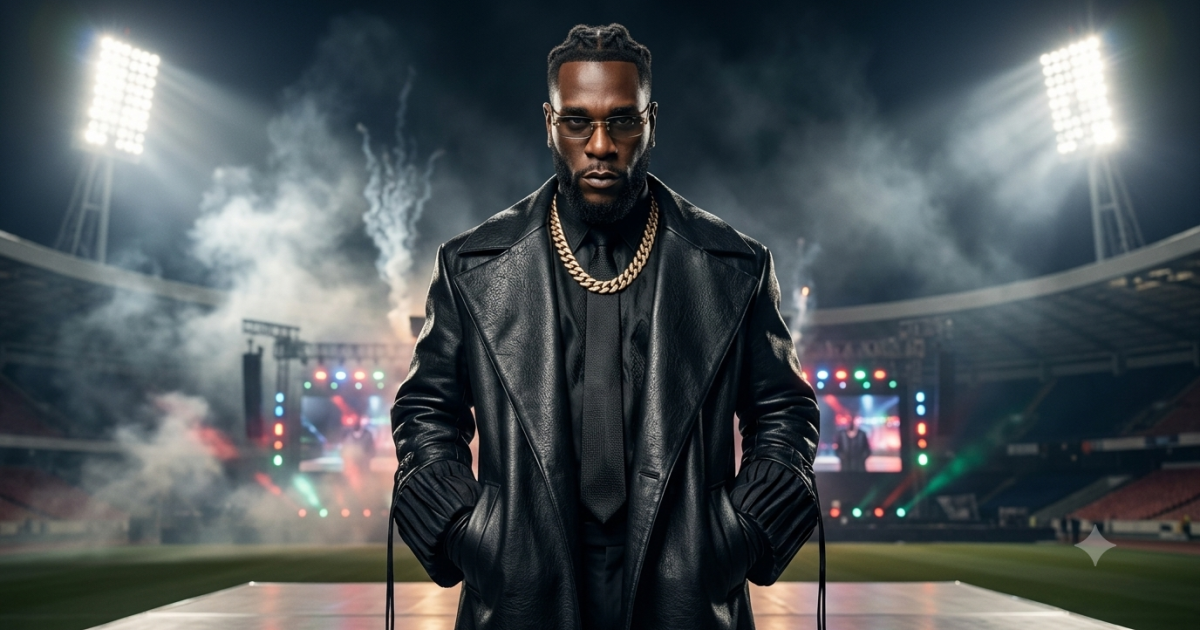
When Burna Boy stepped onto the stage at the opening ceremony of the 2026 FIFA World Cup in Mexico City alongside Colombian superstar Shakira, performing their official anthem “Dai Dai” before a global television audience of hundreds of millions, it was a moment that crystallised something many Nigerians had known for years and the rest of the world was finally being forced to acknowledge: this man from Port Harcourt, Rivers State, is not just a Nigerian music star or even an African music star. He is one of the most significant musical forces on the planet.
The journey from the streets of Port Harcourt to the world’s biggest sporting stage is a story of extraordinary talent, extraordinary stubbornness, and an almost supernatural refusal to allow the world’s expectations of what an African artist could become to place a ceiling on what he was building. It is the story of a boy who started making beats on a cracked copy of FruityLoops at age ten, dropped out of university in England, served time in jail, returned home with nothing, and rebuilt himself into a Grammy-winning, arena-filling, World Cup-opening global phenomenon. His name is Damini Ebunoluwa Ogulu. The world knows him as Burna Boy. And this is his full story.
Burna Boy Biography Facts at a Glance
| Full Name | Damini Ebunoluwa Ogulu |
| Stage Name | Burna Boy (also: The African Giant, ODG, Big 7) |
| Date of Birth | July 2, 1991 |
| Age | 35 years old (as of 2026) |
| Place of Birth | Port Harcourt, Rivers State, Nigeria |
| State of Origin | Rivers State, Nigeria |
| Ethnicity / Tribe | Igbo / Mixed heritage |
| Height | 6 ft 1 in (185 cm) |
| Education | Attended University of Sussex and Oxford Brookes University (did not graduate) |
| Occupation | Singer, Songwriter, Record Producer |
| Genres | Afrobeats, Afro-fusion, Reggae, Dancehall, Hip-Hop |
| Record Label | Spaceship Records / Atlantic Records / Bad Habit |
| Mother / Manager | Bose Ogulu (Mama Burna) |
| Father | Samuel Ogulu |
| Grandfather | Benson Idonije (former manager of Fela Kuti) |
| Grammy Awards | 1 win (Best Global Music Album, 2021); 13 nominations total |
| Studio Albums | 8 (L.I.F.E through No Sign of Weakness) |
| Net Worth (Estimated) | $25 million – $30 million USD |
| Nationality | Nigerian |
Early Life: Port Harcourt, Music in the Blood
Damini Ebunoluwa Ogulu was born on July 2, 1991, in Port Harcourt, the oil-rich capital of Rivers State in southern Nigeria. The city — Nigeria’s third largest, known for its industrial economy, its complex ethnic tapestry, and its fierce cultural pride — was the first environment that shaped him. But it was the family he was born into, more than any city, that determined the direction of his life.
His father, Samuel Ogulu, managed a welding and construction business. His mother, Bose Ogulu — whom the world would later come to know as Mama Burna — was a remarkable woman in her own right: a language translator for the West African Chambers of Commerce, a lecturer who taught French at the University of Education in Port Harcourt for a decade, and a woman fluent in English, French, German, and Italian. She would eventually become Burna Boy’s manager and the CEO of Spaceship Collective, the holding company for his record label and publishing operations — making her one of the most consequential music industry figures to emerge from Nigeria in the last decade.
But the family member whose legacy cast the longest shadow over Damini’s life and music was his maternal grandfather: Benson Idonije. A broadcaster, jazz enthusiast, and music critic of considerable standing, Idonije had managed one of the most important figures in the history of African music — Fela Kuti, the Afrobeat pioneer, activist, and cultural icon whose influence on how Africa sounds to the world is almost impossible to overstate. Growing up in a family that had that connection to Fela’s world meant that Burna Boy did not merely discover Afrobeats as an adult listening to playlists — he absorbed it as a living inheritance, something in the air of his childhood home.
He grew up alongside two sisters: Jehovah-Nissi (Nissi Ogulu), his younger sister who is herself a singer, graphic artist, entrepreneur, and mechanical engineer, and Ronami, his older sister who is a scientist and designer. Talent runs deep in this family.
Burna Boy had his primary education at Montessori International School and later attended Corona Secondary School in Agbara, Ogun State — both institutions associated with a middle-class upbringing that gave him structure and exposure without insulating him from the raw cultural energy of Nigerian street life that would later define his art.
He started making music at an almost comically young age. At ten years old, a classmate gave him a copy of FruityLoops (now FL Studio) production software. Working on an old family computer, he began constructing his own beats — an activity that consumed him with the kind of obsessive focus that usually signals genuine vocation rather than passing interest.
London, Dropout, Jail and the Return: The Formative Detour
After secondary school, Burna Boy relocated to the United Kingdom to pursue university education. He enrolled at the University of Sussex to study Media Technology, then transferred to Oxford Brookes University for Media Communications and Culture. He was not a committed student. His passion for music was pulling him away from lecture halls, and after two years, he made the decision that would ultimately change his life: he dropped out and returned to Nigeria.
His time in England was not without difficulty. Reports from various sources indicate that he became involved in gang-related activity during his time there and served a period in jail — an experience he has rarely discussed in detail publicly but which clearly marked him. It is the kind of biographical detail that becomes easier to understand when you listen to the anger, the defiance, and the hunger for redemption and recognition that runs like a current through the best of his music.
When he returned to Nigeria in 2010, he was nineteen years old with no degree, no record deal, and no obvious plan. What he did have was the music he had been building since he was ten. He began frequenting the studio space of producer LeriQ in southern Nigeria — a partnership that would prove crucial — and joined the rap collective DEF Code, where he sharpened his freestyling ability under the early stage name Shotgun. He also completed a one-year internship at Rhythm 93.7 FM in Port Harcourt, gaining his first professional experience in the broadcasting world while simultaneously developing his music.
The Lagos street music scene, the dancehall and reggae records his father played at home, and the Fela Kuti recordings that were part of his family’s cultural inheritance — all of it began to fuse inside him into something that had no clean precedent. He was building a sound that would take the rest of the world several years to understand and several more years to fully appreciate.
The Breakthrough: “Like to Party” and L.I.F.E.
In 2012, Burna Boy released the single that changed everything: “Like to Party.” Produced with LeriQ, the track was immediately distinctive — it had the rhythmic energy of dancehall, the melodic warmth of Afrobeats, and a vocal delivery that was confident, relaxed, and entirely its own. Nigerian audiences responded instantly. The song became a hit that earned him a deal with Aristokrat Records and a move to Lagos to begin work on his debut album.
On August 12, 2013, he released his debut studio album: L.I.F.E (Leaving an Impact for Eternity). The album featured collaborations with Wizkid and Timaya and peaked at number seven on the Billboard Reggae Albums Chart — an early indication that his music was resonating beyond Nigerian borders. It was nominated for Best Album of the Year at the 2014 Nigeria Entertainment Awards. Burna Boy had arrived.
In 2014, he parted ways with Aristokrat Records and founded his own label: Spaceship Records — a move that, like Asake’s later founding of Giran Republic, signalled a determination to own his creative and commercial destiny that would pay massive dividends in the years ahead.
The Wilderness Years and the Resurgence: Outside and African Giant
His second album, On a Spaceship, was released in 2015 and built on his following without breaking through to the next level. In 2017, he signed to Bad Habit / Atlantic Records in the United States and Warner Music International globally — deals that gave his music international distribution infrastructure for the first time. That same year, he released Outside (2018), which included the massive hit “Ye” — a track that went viral across Africa and the diaspora and effectively announced to the world that Burna Boy had entered a new phase of his career.
The album African Giant arrived in 2019 and cemented his status as one of the most important artists on the continent. Produced with characteristic Afro-fusion ambition, it was the album that first announced to the global music press that they needed to pay serious attention to this man from Port Harcourt. The title track — a defiant, sweeping statement of continental pride and personal identity — became one of his signature songs and gave him a nickname that has stuck ever since.
African Giant received a Grammy nomination for Best Global Music Album at the 62nd Grammy Awards — the first of what would become a remarkable thirteen nominations across his career. He did not win. But the nomination confirmed that the Recording Academy had taken notice, and Burna Boy did not forget that he had come close.
Twice as Tall: The Grammy and the Turning Point
In 2020, Burna Boy released Twice as Tall — a deeply considered, internationally collaborative album executive produced by Diddy and featuring contributions from Stormzy, Chris Martin, Youssou N’Dour, and others. It was the most fully realised artistic statement he had made to that point: confident, ambitious, culturally rooted, and globally fluent.
On March 14, 2021, at the 63rd Grammy Awards ceremony in Los Angeles, Twice as Tall won the Grammy Award for Best Global Music Album — making Burna Boy the first-ever winner of that renamed category and the first Nigerian artist to win a Grammy as a solo act. Accepting the award virtually from Lagos, surrounded by his family and a crowd of fans, he delivered a speech that became instantly iconic in Nigeria and across the African diaspora:
“Yes oh! Yes oh! Yes oh! Africa is in the house man; Africa, we’re in the house, you get me? This is a big win for my generation of Africans all over the world, and this should be a lesson to every African out there: no matter where you are, no matter what you plan to do, you can achieve it, no matter where you’re from, because you are a king. Look at me now, Grammy Award-winning Burna Boy.”
The Grammy win transformed his career in every commercial dimension simultaneously. Performance fees tripled. Endorsement negotiations started from higher baselines. Festival booking moved him from mid-card to headliner status. International media coverage intensified. He had always been extraordinary — now the world’s most recognised music institution had confirmed it in writing, and the doors that opened as a result were doors that had previously existed only in theory.
Love, Damini, I Told Them… and Global Stadium Status
The post-Grammy albums demonstrated that Burna Boy had no intention of resting on the recognition he had earned. Love, Damini (2022) included the global smash “Last Last” — his biggest solo song to date, certified Diamond in France and his most-streamed track across all platforms. The album featured collaborations with Ed Sheeran, J Balvin, and 21 Savage and powered a world tour that filled arenas across three continents.
In 2023, I Told Them… became the first album by a Nigerian artist to top the official UK Albums Chart — a milestone that placed him in a conversation previously occupied only by the very biggest names in British music history. Collaborations with Dave, J. Cole, and others confirmed his ability to move between African music, British hip-hop, and American rap with equal fluency. He also became the first African artist to headline London Stadium — a 60,000-capacity venue — and Madison Square Garden in New York.
By this point, Burna Boy had become the first African artist to have two albums earn over one billion streams on Spotify. He had won four BET Awards for Best International Act — a record. He had 232 music certifications across 26 countries. He had nine Billboard Hot 100 entries — the most by any African artist — and was the first African artist to chart on the Hot 100 for six consecutive years (2021–2026).
No Sign of Weakness: His Most Personal Album
On July 11, 2025, Burna Boy released his eighth studio album: No Sign of Weakness, through Spaceship Records, Atlantic, and Bad Habit. Described by Burna himself as his most personal release to date, the album was musically vibrant and more eclectic than its predecessors — blending Afrobeats, reggae, dancehall, pop, and amapiano across a tracklist that critics noted for its introspective tone and emotional depth.
Key tracks included “Bundle by Bundle” (released December 2024 as the lead single), “Update” (which sampled Soul II Soul’s “Back to Life”), “TaTaTa” featuring Travis Scott, “Sweet Love” (a reggae-inflected highlight featuring soulful saxophone), and “Buy You Life” — one of the album’s most emotionally resonant moments, built on acoustic guitars and choir harmonics. The album also featured a guest appearance from Mick Jagger — a collaboration that divided fans but confirmed the extraordinary breadth of Burna Boy’s international musical network.
Critics received the album with measured enthusiasm — acknowledging its musical ambition and Burna’s vocal authority while noting that it did not quite scale the heights of Twice as Tall or I Told Them… as a complete artistic statement. Fans, however, embraced several of its singles warmly, and the album extended his run as one of the most commercially consistent artists in global music.
The 2026 FIFA World Cup: Africa’s Voice at the World’s Biggest Stage
In June 2026, Burna Boy co-performed the official 2026 FIFA World Cup anthem “Dai Dai” with Shakira at the tournament’s opening ceremony in Mexico City. The performance was watched by hundreds of millions globally and generated immediate, overwhelming reaction — trending across social media platforms in dozens of countries simultaneously, and positioning Burna Boy as Africa’s definitive cultural ambassador to the world’s biggest single sporting event.
“Dai Dai” became his biggest charting song ever — reaching number one on both Billboard’s global charts and in 28 countries worldwide. It was, by any measure, the highest-profile moment of his career to that point, and it came at a time when he had already accumulated achievements that most artists spend entire careers dreaming of.
The performance also marked a symbolic full circle: a boy born in Port Harcourt, grandson of Fela Kuti’s manager, who had absorbed the music of the continent as a birthright, standing on the world stage beside one of pop music’s all-time global icons as an equal — not a guest, not a novelty, but an equal — performing a song that would be the soundtrack to a billion people’s memories of that summer.
Burna Boy’s Net Worth in 2026
Burna Boy’s estimated net worth in 2026 is between $25 million and $30 million USD, with Celebrity Net Worth placing the figure at approximately $28 million. His wealth has been constructed across multiple streams over more than a decade of increasingly high-level commercial activity:
- Music streaming: Two albums with over one billion Spotify streams each; nine Billboard Hot 100 entries; 232 certifications across 26 countries
- Live performances: Stadium-level touring fees — post-Grammy, his per-show fee is reported to range from $150,000 to $300,000, with full tours generating multi-million dollar revenue
- Endorsements: Global partnerships with brands across telecommunications, beverages, luxury drinks, and sportswear, including a 2026 multi-year partnership with Swiss sportswear company On as the face of its Clubhouse Nights campaign
- Spaceship Records: As founder and owner of his label, he benefits from catalogue ownership and the careers of artists signed to the label including BNXN (Buju) and his sister Nissi
- Publishing rights: As a prolific songwriter and producer, his publishing catalogue generates ongoing royalty income
Full Discography
| Year | Album | Label | Key Achievement |
| 2013 | L.I.F.E | Aristokrat Records | Debut album; Billboard Reggae Albums Chart #7 |
| 2015 | On a Spaceship | Spaceship Records | Second album; independent release |
| 2018 | Outside | Spaceship / Atlantic | “Ye” goes viral across Africa and the diaspora |
| 2019 | African Giant | Spaceship / Atlantic | Grammy nomination (62nd); global breakthrough |
| 2020 | Twice as Tall | Spaceship / Atlantic | Grammy WIN — Best Global Music Album (2021) |
| 2022 | Love, Damini | Spaceship / Atlantic | “Last Last” — Diamond certified in France; biggest solo song |
| 2023 | I Told Them… | Spaceship / Atlantic | #1 UK Albums Chart — first Nigerian artist; London Stadium headline |
| 2025 | No Sign of Weakness | Spaceship / Atlantic / Bad Habit | 8th album; most personal release; ft. Travis Scott, Mick Jagger |
Career Timeline
| Year | Milestone |
| 1991 | Born July 2 in Port Harcourt, Rivers State |
| 2001 | Begins making beats on FruityLoops at age 10 |
| ~2008–2010 | Studies in UK (University of Sussex, Oxford Brookes); drops out after two years |
| 2010 | Returns to Nigeria; interns at Rhythm 93.7 FM Port Harcourt; joins DEF Code collective |
| 2012 | Releases “Like to Party” — breakthrough single; signs with Aristokrat Records |
| 2013 | Debut album L.I.F.E released; peaks at #7 Billboard Reggae Albums Chart |
| 2014 | Leaves Aristokrat Records; founds Spaceship Records |
| 2015 | On a Spaceship released independently |
| 2017 | Signs with Atlantic Records / Warner Music International |
| 2018 | Outside released; “Ye” becomes viral hit across Africa and diaspora |
| 2019 | African Giant released; first Grammy nomination (62nd Grammys) |
| 2020 | Twice as Tall released; executive produced by Diddy |
| March 2021 | Wins Grammy Award for Best Global Music Album — first Nigerian solo Grammy winner |
| 2022 | Love, Damini released; “Last Last” becomes biggest solo hit; Diamond-certified in France |
| 2023 | I Told Them… released; #1 UK Albums Chart; headlines London Stadium and Madison Square Garden |
| July 2025 | No Sign of Weakness released — 8th studio album; most personal to date |
| June 2026 | Performs “Dai Dai” with Shakira at FIFA World Cup 2026 opening ceremony in Mexico City |
| 2026 | “Dai Dai” reaches #1 globally and in 28 countries — his biggest charting song ever |
What Burna Boy Means for Nigeria and for Africa
It is worth pausing to consider what Burna Boy’s career represents in historical context, because the achievement is genuinely extraordinary. He did not have the benefit of riding a wave that already existed — he was part of building the wave. When he released L.I.F.E in 2013, Afrobeats was a genre with passionate followers in Nigeria and the diaspora but almost no mainstream global recognition. The pathway from Lagos or Port Harcourt to the Grammy stage, to Madison Square Garden, to the FIFA World Cup opening ceremony did not exist in the way it does today. Burna Boy helped create it.
His insistence on a Pan-African identity — on describing himself as an African artist first and a Nigerian artist second — has sometimes generated controversy but has also given his music a breadth and a moral seriousness that distinguishes it from more commercially accommodating approaches. His willingness to embed African history, anti-colonial sentiment, and Black pride into pop music that is simultaneously catchy enough to dominate global charts is a genuine artistic achievement. He did not water himself down to gain international acceptance. He made the world come to him on his own terms.
Thirteen Grammy nominations. One Grammy win. Eight studio albums. The first Nigerian solo Grammy winner. The first African artist to top the UK Albums Chart. The first African artist with two albums over one billion Spotify streams. Nine Billboard Hot 100 entries. A FIFA World Cup opening ceremony performance. And a career that, at 35, shows absolutely no sign of weakness.
Frequently Asked Questions About Burna Boy
What is Burna Boy’s real name?
Burna Boy’s real name is Damini Ebunoluwa Ogulu. He was born on July 2, 1991, in Port Harcourt, Rivers State, Nigeria. He is also known by the nicknames The African Giant, ODG, and Big 7. His stage name “Burna Boy” was adopted early in his career and has remained his primary professional identity.
How old is Burna Boy?
Burna Boy is 35 years old as of 2026. He was born on July 2, 1991, in Port Harcourt, Rivers State. He celebrates his birthday on July 2 annually.
What state is Burna Boy from?
Burna Boy is from Rivers State, Nigeria. He was born and raised in Port Harcourt, the state capital. He later relocated to Lagos for his music career and also spent time in the United Kingdom during his late teens. Despite his global profile, he has consistently identified Port Harcourt as his home and foundation.
Has Burna Boy won a Grammy?
Yes. Burna Boy won the Grammy Award for Best Global Music Album at the 63rd Grammy Awards in 2021 for his album Twice as Tall. He was the first-ever winner of that renamed category and the first Nigerian artist to win a Grammy as a solo act. Across his career, he has accumulated 13 Grammy nominations in total.
What is Burna Boy’s net worth in 2026?
Burna Boy’s estimated net worth in 2026 is between $25 million and $30 million USD, with Celebrity Net Worth placing the figure at approximately $28 million. His wealth is generated through music streaming royalties, sold-out world tours, brand endorsements, his Spaceship Records label, music publishing rights, and merchandise. His 2026 partnership with Swiss sportswear brand On added a significant new commercial dimension to his portfolio.
Did Burna Boy perform at the 2026 FIFA World Cup?
Yes. Burna Boy co-performed the official 2026 FIFA World Cup anthem “Dai Dai” alongside Colombian superstar Shakira at the tournament’s opening ceremony in Mexico City in June 2026. The performance was broadcast to hundreds of millions of viewers globally. “Dai Dai” became Burna Boy’s biggest-charting song ever, reaching number one on both Billboard global charts and in 28 countries worldwide.
Who is Burna Boy’s mother and manager?
Burna Boy’s mother and manager is Bose Ogulu, widely known as Mama Burna. She is a formidable figure in her own right — a former language lecturer, translator, and businesswoman fluent in five languages. She is the founder and CEO of Spaceship Collective, the holding company for Burna Boy’s record label and publishing operations. She has managed his career since its rise to prominence and is widely credited as one of the key architects of his international success.
What is Burna Boy’s connection to Fela Kuti?
Burna Boy’s maternal grandfather, Benson Idonije, was a broadcaster, jazz critic, and the manager of Fela Kuti — the legendary Nigerian Afrobeat pioneer and activist. This family connection means that Burna Boy grew up with direct access to Fela’s musical legacy as a personal inheritance rather than a historical abstraction. He has consistently cited Fela as his primary musical idol and philosophical influence, and the pan-African consciousness and anti-colonial themes that run through his music are a direct descendant of that lineage.
What is Burna Boy’s latest album?
Burna Boy’s most recent studio album is No Sign of Weakness, released on July 11, 2025, through Spaceship Records, Atlantic Records, and Bad Habit. It is his eighth studio album and has been described as his most personal and introspective release to date. Key tracks include “Bundle by Bundle,” “TaTaTa” featuring Travis Scott, “Sweet Love,” and “Update.” The album also features a guest appearance from Mick Jagger.


0 Comments
No comments yet. Be the first to share your thoughts!