


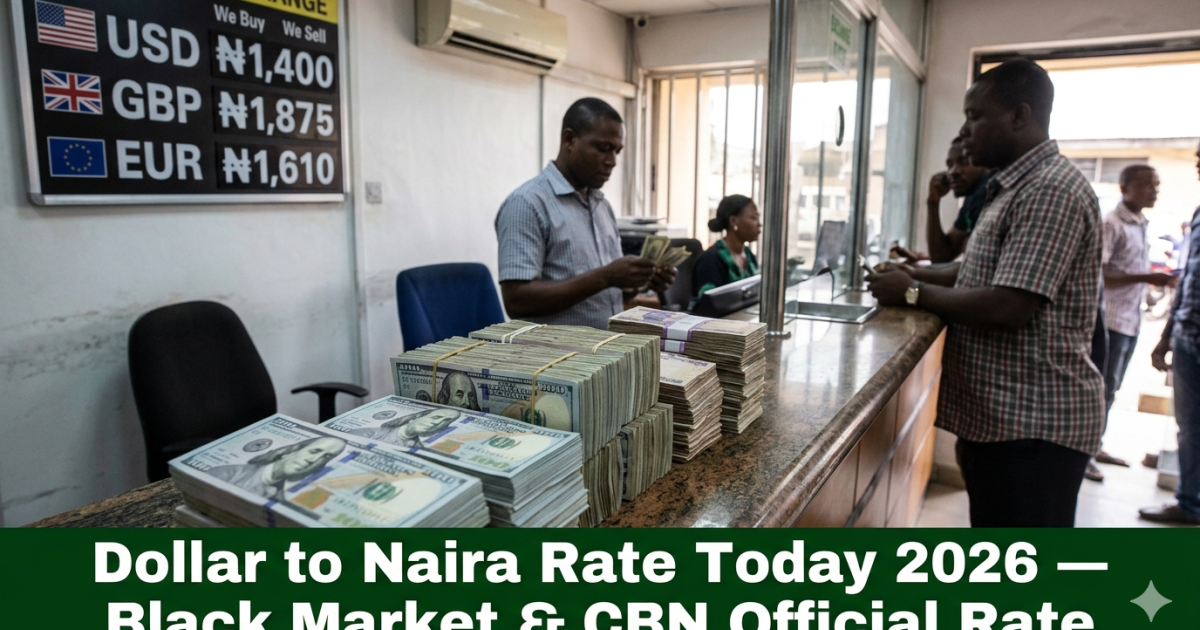
The dollar to naira exchange rate is without question the single most searched financial query in Nigeria every single day — and for very good reason. Whether you are a business owner who imports raw materials priced in dollars, a parent sending a child abroad to university, a freelancer receiving payment from an international client, a worker whose salary needs to cover imported goods, or simply a Nigerian trying to understand why the price of tomatoes, rice, and fuel keeps creeping upward, the dollar-to-naira rate is at the heart of your daily economic reality.
This article gives you the most current rates as of April 20, 2026, explains everything you need to know about both the official CBN rate and the parallel market (black market) rate, tells you exactly where to check the rate daily, walks you through the full history of how we got here, and answers the most common questions Nigerians have about the naira-to-dollar exchange.
Dollar to Naira Rate Today — April 20, 2026
Based on data from multiple sources including Glamtush (April 19, 2026), NgnRates.com (April 18, 2026), and NairaToday (April 15, 2026), here are the current exchange rates for the US dollar against the Nigerian naira across the two major markets:
| Market | Buy Rate (₦ per $1) | Sell Rate (₦ per $1) | Source |
|---|---|---|---|
| Black Market / Parallel Market | ₦1,390 – ₦1,395 | ₦1,400 – ₦1,405 | Glamtush (Apr 19); NgnRates (Apr 18); AbokiForex |
| CBN / NFEM Official Rate | ₦1,343 – ₦1,352 | ₦1,352 – ₦1,362 | Vanguard Nigeria (Apr 14–15); NairaToday (Apr 15) |
| Bureau De Change (BDC) | ₦1,390 – ₦1,395 | ₦1,395 – ₦1,405 | NgnRates.com BDC user reports |
Important note: The dollar-to-naira exchange rate changes every day — sometimes multiple times within a single trading session. The rates published here reflect the most current data available at the time of writing. For the absolute latest rate right now, scroll down to the section on where to check live rates.
All Major Currencies to Naira — Black Market Rates (April 2026)
It is not just the dollar that Nigerians need to track. Here is the full black market and CBN rate breakdown for all major currencies traded in Nigeria’s parallel market, as reported by NairaToday on April 15, 2026:
| Currency | Black Market Buy (₦) | Black Market Sell (₦) | CBN Official Rate (₦) |
|---|---|---|---|
| 🇺🇸 US Dollar (USD) | ₦1,380 – ₦1,395 | ₦1,395 – ₦1,405 | ~₦1,343 – ₦1,362 |
| 🇬🇧 British Pound (GBP) | ₦1,840 – ₦1,875 | ₦1,870 – ₦1,900 | ~₦1,824 |
| 🇪🇺 Euro (EUR) | ₦1,570 – ₦1,600 | ₦1,600 – ₦1,625 | ~₦1,585 |
| 🇨🇦 Canadian Dollar (CAD) | ₦1,000 – ₦1,010 | ₦1,010 – ₦1,018 | ~₦990 |
| 🇦🇪 UAE Dirham (AED) | ₦370 – ₦380 | ₦375 – ₦385 | ~₦365 |
| 🇸🇦 Saudi Riyal (SAR) | ₦355 – ₦365 | ₦360 – ₦370 | ~₦358 |
Sources: NairaToday.com (April 15, 2026); NgnRates.com (April 18, 2026). All black market rates are indicative averages from multiple BDC operators in Lagos and Abuja. Rates vary by location, volume, and dealer.
What Is the Black Market Rate? Why Is It Different from the CBN Rate?
Many Nigerians — especially those who haven’t previously dealt with foreign exchange — are confused by the existence of two different rates for the same currency. Here is a plain-English explanation of both, and why the gap between them exists.
The CBN Official Rate (NFEM Rate)
The Central Bank of Nigeria (CBN) manages an official foreign exchange window called the Nigerian Foreign Exchange Market (NFEM). In this system, commercial banks, licensed dealers, and institutional investors buy and sell dollars at rates that are closely guided by CBN policy. This is the rate you will see published on CBN’s official website, in bank branch exchange boards, and in reports from the CBN after each trading session. The CBN official rate is used for government transactions, official imports, international bank transfers, and remittances processed through formal banking channels.
The key limitation of the CBN official rate is access. Getting dollars at the official rate requires going through a commercial bank with all the necessary documentation — proof of the purpose of the transaction, bank verification, compliance checks, and often a waiting period. For many ordinary Nigerians who simply need dollars quickly for travel, school fees, medical treatment abroad, or small business imports, the bank process is too slow and too restrictive.
The Black Market / Parallel Market Rate (Aboki Rate)
The parallel market — commonly called the black market, the street rate, or the aboki rate — is the informal foreign exchange market where Nigerians buy and sell dollars, pounds, euros, and other currencies outside of the official banking system. Bureau De Change (BDC) operators, street traders, and informal dealers make up this market. As AbokiForex explains: “The black market exists because of limited dollar availability through official channels, making it the go-to option for individuals who need immediate dollar access without bank documentation, bureaucratic delays, or transaction limits.”
The parallel market rate is set purely by supply and demand — there is no government price control here. When more people want dollars than are available (which is almost always the case in Nigeria), the price in naira goes up. When more dollars are available (for example, after a large diaspora remittance inflow or a CBN dollar injection), the rate can ease slightly. AbokiDollar’s analysis confirms this market typically runs “10–20% higher than the CBN official rate, reflecting true market demand and supply dynamics.”
What Drives the Dollar to Naira Rate? Key Factors Explained
The naira’s exchange rate against the dollar is not random — it is driven by a combination of structural, policy, and market forces. Understanding these factors helps you make sense of why the rate moves the way it does, and what to watch when trying to anticipate changes.
1. Oil Revenue and Foreign Reserves
Nigeria is an oil-dependent economy — crude oil sales account for the majority of the country’s foreign exchange earnings. When global oil prices are high and Nigeria is pumping at full capacity, more dollars flow into the country’s foreign reserves, the CBN has more capacity to supply the market, and the naira tends to strengthen. When oil prices fall or production drops (due to pipeline vandalism, shut-ins, or OPEC quota cuts), dollar supply tightens and the naira comes under pressure.
2. CBN Monetary Policy and FX Intervention
The Central Bank periodically intervenes in the foreign exchange market by selling dollars from Nigeria’s external reserves to licensed dealers. These injections temporarily increase dollar supply and ease pressure on the naira. The CBN also controls interest rates through the Monetary Policy Rate (MPR) — higher interest rates attract foreign portfolio investors who bring dollars into Nigeria, supporting the naira. CBN policy decisions therefore directly move the exchange rate in both the official and parallel markets.
3. Import Demand for Dollars
Nigeria imports the vast majority of what it consumes — from refined petroleum products to food, electronics, machinery, pharmaceuticals, and consumer goods. Every import transaction requires dollars. When import volumes are high, demand for dollars increases and the naira weakens. This structural import dependency is a long-term driver of naira depreciation pressure and one of the core reasons the parallel market rate is persistently above the official rate.
4. Remittances from the Diaspora
Nigeria is one of the world’s top recipients of diaspora remittances — Nigerians in the UK, USA, Canada, Europe, and the Middle East send billions of dollars home every year. When remittances are strong (often boosted around festive seasons — December, Easter, summer), more dollars flow into the parallel market and can temporarily ease the rate. Remittance inflows are a significant source of dollar supply particularly in the black market, since many diaspora senders use informal channels to maximise the naira their recipients receive.
5. Global Dollar Strength (DXY Index)
When the US dollar strengthens globally against all other currencies (as measured by the DXY index), the naira — like most emerging market currencies — tends to weaken in tandem. Conversely, a weakening dollar on global markets can provide temporary relief to the naira. This global factor is largely outside Nigeria’s control.
6. Inflation and Purchasing Power
Nigeria’s persistently high inflation rate (above 25% year-on-year in recent periods) erodes the purchasing power of the naira over time. In theory, a currency with higher inflation should depreciate against currencies with lower inflation (a concept called purchasing power parity). Nigeria’s higher inflation relative to the US has been a structural driver of naira depreciation over the past decade.
7. Speculation and Market Sentiment
When economic conditions are uncertain — for example, approaching elections, after major policy announcements, or during periods of political instability — Nigerians and businesses tend to buy and hold dollars as a store of value and hedge against naira depreciation. This speculative demand adds pressure to the exchange rate beyond the fundamental supply-demand dynamics.
Dollar to Naira Rate: History and How We Got to ₦1,400
For many older Nigerians, today’s exchange rate feels surreal. Here is a brief history of how the naira has depreciated against the dollar over the past three decades, to help you understand how Nigeria arrived at the April 2026 rate of approximately ₦1,390–₦1,405 in the parallel market.
| Year | Approximate Rate (₦ per $1) | Key Event |
|---|---|---|
| 1985 | ~₦1 | Pre-SAP era — naira was stronger than the dollar |
| 1992 | ~₦20 | Post-SAP devaluation era |
| 2000 | ~₦110 | Obasanjo government; managed exchange rate |
| 2015 | ~₦198 | Pre-devaluation; CBN defending ₦197 peg |
| 2016 | ~₦305 (official) / ₦450 (black market) | CBN floated naira; crude oil price crash |
| 2020 | ~₦390 (official) / ₦475 (black market) | COVID-19 impact; oil revenue collapse |
| June 2023 | ~₦750 (official) / ₦800 (black market) | FG removed fuel subsidy; CBN unified exchange rate |
| Jan 2024 | ~₦1,500 (official) / ₦1,600 (black market) | CBN devaluation; naira floated fully |
| Mid-2025 | ~₦1,580 (official) / ₦1,650+ (black market) | Naira at record lows; CBN tightening |
| April 2026 | ~₦1,352 (official) / ₦1,400 (black market) | Naira recovered significantly; CBN reforms taking effect |
Notably, the naira has strengthened significantly from its 2024–2025 lows. A year ago in April 2025, the CBN official rate was approximately ₦1,604 per dollar — compared to approximately ₦1,344–₦1,362 today, representing a substantial appreciation of the naira. This reflects improved foreign reserve positions, CBN tightening measures, and improved diaspora remittance inflows. However, analysts caution this stability must be maintained through consistent policy and improved oil revenue.
Dollar to Naira Rate Impact on Everyday Nigerians
The exchange rate is not just an abstract number in a financial newspaper — it has direct, tangible effects on the daily life of every Nigerian. Here is how the dollar-to-naira rate affects different groups of people:
Importers and Business Owners
Every Nigerian business that imports goods — whether it is a pharmacist importing medicines, a supermarket importing consumer goods, a manufacturer importing raw materials, or a tech company importing computers and equipment — must source dollars to pay foreign suppliers. When the naira is weak against the dollar, the cost of importing rises, which forces businesses to either absorb the losses or pass costs on to consumers through higher prices. The current rate of ₦1,400 per dollar means that a product costing $10 abroad costs ₦14,000 just in foreign exchange — before shipping, customs duties, and other landing costs are added.
Students Studying Abroad
For Nigerian families supporting children studying in the UK, USA, Canada, or other countries, the exchange rate directly determines how much naira must be sent to cover tuition and living expenses. A student paying £2,000 monthly rent in London at today’s parallel market rate of ₦1,900 per pound needs ₦3,800,000 just for rent — a figure that would have been dramatically lower at older exchange rates. Many families have had to significantly cut back on money sent abroad as the naira weakened over the 2023–2025 period.
Freelancers and Remote Workers
This group is arguably the biggest beneficiary of naira depreciation. A Nigerian freelancer earning $1,000 per month from international clients received approximately ₦390,000 when the rate was ₦390/$1 in 2020. At today’s parallel market rate of ₦1,400, the same $1,000 converts to ₦1,400,000 — more than three times as much in naira terms. This dramatic change in earnings has made remote work and international freelancing one of the most attractive career paths for educated Nigerians, and has contributed to the massive growth of platforms like Fiverr, Upwork, and international remote job boards in Nigeria.
Petrol Prices and Transportation
Although the Dangote Refinery now produces a significant portion of Nigeria’s petrol domestically, refining costs and crude oil procurement are still largely dollar-denominated. A weaker naira means higher refinery production costs, which feed directly into higher pump prices. When the naira depreciates, petrol prices rise, transportation fares increase, and the cost of every good transported across Nigeria goes up — creating a broad inflationary effect that hits all Nigerians, but disproportionately hurts the poor.
Food Prices
Even domestically produced food is affected by the exchange rate. Nigerian farmers use imported fertilisers, pesticides, and equipment — all priced in dollars. When the naira weakens, input costs for agriculture rise, which pushes up the farm-gate price of food. Add higher transportation costs from more expensive petrol, and the full chain of naira depreciation ripples through to higher prices for rice, tomatoes, onions, palm oil, and every other food item at the market.
Where to Check the Dollar to Naira Rate Daily
Given how frequently the rate changes, it is important to use reliable, up-to-date sources before any currency transaction. Here are the most trusted platforms Nigerians use to check the dollar-to-naira rate in 2026:
| Platform | What It Shows | Update Frequency |
|---|---|---|
| AbokiForex.app | Black market rates for USD, GBP, EUR, CAD, AED, SAR and more — aggregated from BDC dealers across Lagos, Abuja, Kano, Port Harcourt | Hourly throughout the trading day |
| NairaToday.com | Daily black market and CBN official rates for all major currencies | Daily — published each morning |
| NgnRates.com | User-reported BDC rates from Lagos and Abuja operators — includes contact info for BDCs | Throughout the day as users report |
| CBNIntelligence / CBN.gov.ng | Official CBN NFEM closing rate after each banking day | Once per trading day (weekdays) |
| Vanguard Nigeria (vanguardngr.com) | Daily morning exchange rate reports citing both official and parallel market rates | Daily — morning publication |
| AbokiDollar.com | Black market rates with dollar-to-naira conversion calculator | Daily |
Pro tip: For the most accurate black market rate before a transaction, check at least two of these platforms and compare. Rates can vary by ₦5–₦15 depending on the source and timing. AbokiForex.app updates hourly and is widely considered the most reliable aggregator for parallel market data.
How to Exchange Currency Safely in Nigeria
Whether you are buying dollars to travel, selling dollars received from abroad, or converting naira to a foreign currency, there are several ways to exchange money in Nigeria — each with different advantages, risks, and rate quality.
Option 1: Commercial Bank (Official Rate)
Banks are the safest but often the least favourable channel for ordinary Nigerians. You get the CBN official rate — approximately ₦1,343–₦1,362 per dollar — which is significantly lower than the parallel market rate, meaning you receive fewer naira per dollar compared to black market channels. Banks require documentation: you must explain the purpose of the transaction (travel, school fees, medical, etc.), and limits apply. For large, documented transactions (especially business imports, tuition payments, and medical trips), banks remain the most secure and legally compliant option.
Option 2: Licensed Bureau De Change (BDC)
Licensed BDC operators are regulated by the CBN and are required to operate within officially approved rate bands. In practice, BDC rates track closely with the parallel market. BDCs are the recommended option for moderate amounts — they are faster than banks, require less documentation for smaller transactions, and are found in major commercial areas in Lagos (Victoria Island, Ikeja, Oshodi), Abuja (Wuse, Garki, Utako), and other cities. Always deal with operators at established, identifiable locations — not strangers on the street. The CBN’s NgnRates.com platform lists verified BDC operators with their contact details.
Option 3: Fintech Remittance Platforms
For Nigerians receiving money from abroad, platforms like Wise (TransferWise), WorldRemit, MoneyGram, and Western Union offer competitive rates for inbound transfers from the UK, USA, Canada, and Europe. These services deposit naira directly into your Nigerian bank account at rates close to or slightly above the CBN official rate — generally better than what your commercial bank would offer for a direct international transfer. For outbound transfers (sending naira abroad), these platforms are more restricted given Nigeria’s capital controls.
Option 4: P2P Platforms (Fintech)
Platforms like Binance P2P, ByBit P2P, and similar crypto-adjacent platforms have become popular channels for dollar-naira exchange in Nigeria, particularly after CBN’s 2024 restrictions were eased. Rates on P2P platforms often track the parallel market closely. Users are advised to trade only with verified, high-reputation counterparties and to always use the escrow feature built into P2P platforms — never release naira until the dollar (or stablecoin) has been confirmed in your wallet.
Option 5: Grey Market / Street Dealers (Highest Risk)
Exchanging currency with unknown individuals on the street — outside any established business location — carries significant fraud risk. Common scams include counting fake notes, distracting the victim during counting, and using counterfeit currency. AbokiDollar’s safety guide advises: “Count money carefully in the presence of the exchanger, verify note authenticity, and for large amounts, consider using bank transfers rather than carrying cash.” If you must use an informal dealer, insist on a known, established location and never accept a deal that seems too good to be true — it invariably isn’t.
How Much Is $100 in Naira Today? Quick Conversion Table
For quick reference, here is how much various dollar amounts are worth in naira at today’s approximate parallel market rate of ₦1,400 per dollar (selling rate):
| Dollar Amount | Naira Value (at ₦1,400/$1) | Naira Value at CBN Rate (₦1,352/$1) |
|---|---|---|
| $10 | ₦14,000 | ₦13,520 |
| $50 | ₦70,000 | ₦67,600 |
| $100 | ₦140,000 | ₦135,200 |
| $500 | ₦700,000 | ₦676,000 |
| $1,000 | ₦1,400,000 | ₦1,352,000 |
| $5,000 | ₦7,000,000 | ₦6,760,000 |
| $10,000 | ₦14,000,000 | ₦13,520,000 |
Rates used: Black market sell rate ₦1,400 / CBN official midrate ₦1,352. For the exact amount you will receive, always check the live rate at the time of your transaction.
Will the Naira Get Stronger or Weaker in 2026?
This is the question every Nigerian asks — and unfortunately there is no simple, guaranteed answer. However, based on current economic indicators and analyst assessments, here is a balanced view of the factors that could push the naira in either direction for the remainder of 2026.
Factors That Could Strengthen the Naira
- Continued Dangote Refinery output growth: As the Dangote Refinery moves closer to full operational capacity, Nigeria’s need to import refined petroleum products (the country’s single largest foreign exchange expenditure) will reduce significantly, easing dollar demand pressure
- Strong diaspora remittances: Continued high remittance inflows from Nigerians abroad — particularly from the UK, USA, and Canada — bring dollar supply into the market
- Higher oil prices: Any sustained rise in global crude oil prices boosts Nigeria’s foreign exchange earnings and gives the CBN more capacity to defend the naira
- CBN reserve-building: The CBN has been working to rebuild foreign reserves, which strengthens confidence in the naira and reduces speculative pressure
- Improved investor confidence: If Nigeria’s economic reform programme maintains credibility with international investors, portfolio inflows can support the naira
Factors That Could Weaken the Naira
- Global crude oil price crash: A sharp, sustained fall in global oil prices would cut Nigeria’s dollar earnings and put the naira under severe pressure — as happened in 2016 and 2020
- Persistent high import demand: Nigeria’s structural dependence on imports means dollar demand is always strong
- Political uncertainty: Approaching election cycles or unexpected political events can trigger speculative dollar demand
- Global dollar strengthening: A broad strengthening of the US dollar on global markets puts pressure on all emerging market currencies including the naira
- High inflation divergence: If Nigeria’s inflation remains significantly higher than that of its trading partners, the naira faces continued structural depreciation pressure
Bottom line: Most economic analysts covering Nigeria in 2026 maintain a cautiously optimistic view — the naira has stabilised significantly from its 2024 lows, and the structural reforms underway (Dangote Refinery, CBN unification, foreign reserve rebuilding) provide a foundation for gradual recovery. However, the naira remains vulnerable to external shocks, particularly oil price movements and global dollar dynamics that Nigeria cannot control.
Frequently Asked Questions — Dollar to Naira Rate 2026
What is today’s dollar to naira black market rate?
As of April 20, 2026, the dollar to naira black market (parallel market) rate is approximately ₦1,390–₦1,395 to buy and ₦1,400–₦1,405 to sell per US dollar. This rate changes daily — check AbokiForex.app or NairaToday.com for the most current figure before any transaction.
What is the CBN official dollar to naira rate today?
The CBN official rate (NFEM rate) as of mid-April 2026 is approximately ₦1,343–₦1,362 per US dollar, based on Vanguard Nigeria reports of daily opening rates on April 14–15, 2026. Check CBN’s official website (cbn.gov.ng) or CBNintelligence.com for the daily published rate.
Why is the black market rate higher than the bank rate?
The black market rate is higher because the CBN official channel cannot supply enough dollars to meet all demand at the official rate. Nigerians who need dollars urgently — for travel, imports, school fees abroad — and cannot or do not want to go through the lengthy bank documentation process turn to the parallel market, where the higher rate reflects genuine supply-demand pressure. AbokiForex explains: “The black market exists because of limited dollar availability through official channels.”
How much is 100 dollars in naira today (2026)?
At the current black market sell rate of approximately ₦1,400 per dollar, $100 equals ₦140,000. At the CBN official rate of approximately ₦1,352, $100 equals ₦135,200. Always use the live rate from a trusted platform for precise calculations.
Is it illegal to exchange currency in the black market in Nigeria?
Technically, currency transactions must go through CBN-licensed dealers. Exchanging currency through unlicensed individuals — particularly large amounts — carries legal and safety risks. However, trading through licensed BDC operators (who may offer rates close to parallel market rates) is legal and regulated. For personal transactions, using a reputable BDC rather than a street dealer is both safer and more legally secure.
What is aboki forex and is it reliable?
AbokiForex (abokiforex.app) is an information platform that aggregates black market exchange rate data from BDC operators and parallel market dealers across major Nigerian cities. It is widely regarded as the most reliable hourly tracker of the parallel market rate. It does not buy or sell currency itself — it is purely an information service. Always use AbokiForex as a reference point before approaching a BDC, not as a guarantee of the exact rate you will receive.
How do I receive dollars sent from abroad into my Nigerian account?
You can receive international dollar transfers directly into a Nigerian bank domiciliary account (in dollars) or have them converted to naira at the prevailing bank rate. For better rates, consider using remittance services like Wise, WorldRemit, or Western Union — these typically offer closer to the CBN rate than a direct international bank transfer and are faster. For the sender in the UK, Wise consistently offers the best GBP-to-NGN conversion rates for direct bank deposits in Nigeria.
💵 Dollar to Naira Rate Summary — April 20, 2026
- Black market sell rate: ₦1,400 – ₦1,405 per dollar
- Black market buy rate: ₦1,390 – ₦1,395 per dollar
- CBN official rate: ₦1,343 – ₦1,362 per dollar
- GBP black market: ₦1,870 – ₦1,900 per pound
- EUR black market: ₦1,600 – ₦1,625 per euro
- $100 in naira today: ~₦140,000 (parallel) | ~₦135,200 (CBN)
- Naira vs a year ago: Significantly stronger — CBN rate was ~₦1,604/$1 in April 2025
- Best place to check live rate: abokiforex.app | nairatoday.com | ngnrates.com
- Safety reminder: Always use licensed BDC operators — never exchange with unknown street traders for large amounts
Also read: Pound to Naira Rate Today 2026 | Fuel Price Nigeria Today 2026 | How to Make Money Online in Nigeria 2026
Dollar to Naira Rate: Quick Tips Before Any Currency Transaction
Before conducting any foreign currency transaction in Nigeria — whether buying, selling, or transferring — follow these quick guidelines to protect yourself and get the best rate: Always check at least two live rate sources (AbokiForex.app and NairaToday.com) immediately before transacting, not the morning rate if you are transacting in the afternoon. Rate quotes from dealers more than 2–3 hours old during a volatile session can be significantly off the current market. Carry identification to all BDC transactions — licensed BDCs are required by CBN regulations to record the identity of every buyer and seller above certain transaction thresholds. Count all notes carefully before leaving the transaction location — note counting fraud at BDCs, while less common than at street-level dealers, does occur. And for any transaction above ₦2,000,000 equivalent, strongly prefer bank-to-bank transfer over cash — the security risk of carrying large amounts of foreign cash or naira outweighs any small convenience advantage.



0 Comments
No comments yet. Be the first to share your thoughts!